Asexual Reproduction Examples in Nature
Interactive passage with audio narration, comprehension questions, and printable PDF.
By completing this purchase you agree to our Terms of Use and Privacy Policy. Your subscription renews automatically until you cancel. You can cancel anytime from your account settings. All sales are final and non-refundable. Digital content is available for download in your account immediately upon purchase.
What's included
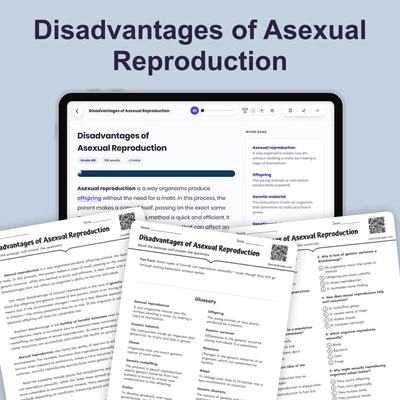
Asexual Reproduction Examples in Nature preview and details
About this printable Asexual Reproduction Examples in Nature science reading passage, NGSS-aligned (Grades 5-8)
Sample passage and quiz from Asexual Reproduction Examples in Nature
Reading passage and comprehension quiz preview
Asexual Reproduction Examples in Nature

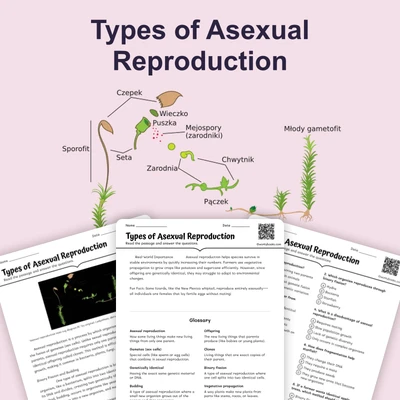
"Asexual reproduction moss svg diagram PL" by original: Masur / Wikimedia Commons.
Asexual reproduction allows organisms to produce offspring without mating, resulting in genetically identical copies of the parent. This process is efficient and common in bacteria, plants, fungi, and even some animals. Since no genetic mixing occurs, offspring inherit the exact traits of their parent, which can be advantageous in stable environments.
Binary Fission in Bacteria
One of the simplest examples of asexual reproduction is binary fission, used by bacteria like E. coli. The single bacterial cell grows, duplicates its DNA, and splits into two identical daughter cells. This rapid process allows bacteria to multiply quickly, sometimes in just 20 minutes under ideal conditions.
Budding in Hydra and Yeast
Some organisms, such as hydra (a freshwater animal) and yeast (a fungus), reproduce through budding. A small outgrowth, or bud, forms on the parent, develops into a miniature version, and eventually detaches. In yeast, the bud remains attached, forming chains of cells that help in fermentation processes like bread-making.
Fragmentation in Starfish and Planarians
Fragmentation occurs when an organism breaks apart, and each piece regenerates into a new individual. Starfish can regrow lost arms—and sometimes an entire new starfish—from a single severed limb. Similarly, planarians (flatworms) can split into fragments, each growing into a complete worm.
Vegetative Propagation in Plants
Many plants reproduce asexually through vegetative propagation. Strawberries send out runners that take root and form new plants. Potatoes grow from tubers, while spider plants produce plantlets on long stems. Farmers use these methods to grow crops quickly and maintain desirable traits.
Real-World Importance
Asexual reproduction is crucial in medicine (bacterial growth studies), agriculture (cloning crops), and ecology (invasive species spread). However, since offspring lack genetic variation, they may struggle with diseases or environmental changes.
Fun Fact: The Komodo dragon can reproduce asexually through a process called parthenogenesis, where females lay fertile eggs without mating!
Comprehension quiz (8 questions)
1. What is asexual reproduction?
2. Which organism reproduces through binary fission?
3. How does budding differ from binary fission?
4. What happens during fragmentation?
5. Which plant uses runners for reproduction?
6. Why is asexual reproduction useful in farming?
7. What is the main idea of the passage?
8. How does parthenogenesis occur in Komodo dragons?
Perfect for the way you teach
- Build comprehension skills
- Auto-graded quiz
- Differentiated reading
- Read together at home
- Improve fluency
- Quiet reading time
- Reading curriculum support
- Independent practice
- Track Lexile growth