Types of Asexual Reproduction
Interactive passage with audio narration, comprehension questions, and printable PDF.
By completing this purchase you agree to our Terms of Use and Privacy Policy. Your subscription renews automatically until you cancel. You can cancel anytime from your account settings. All sales are final and non-refundable. Digital content is available for download in your account immediately upon purchase.
What's included
Types of Asexual Reproduction preview and details
About this printable Types of Asexual Reproduction science reading passage, NGSS-aligned (Grades 5-8)
Sample passage and quiz from Types of Asexual Reproduction
Reading passage and comprehension quiz preview
Types of Asexual Reproduction
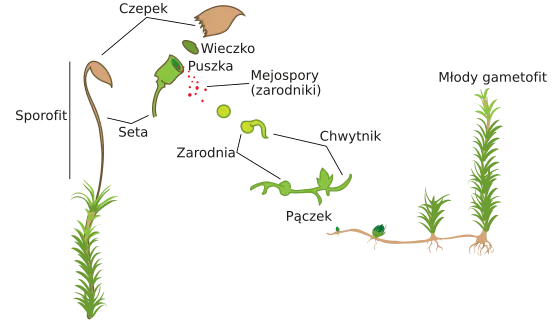
"Asexual reproduction moss svg diagram PL" by original: LadyofHats, derivative: Masur / Wikimedia Commons.
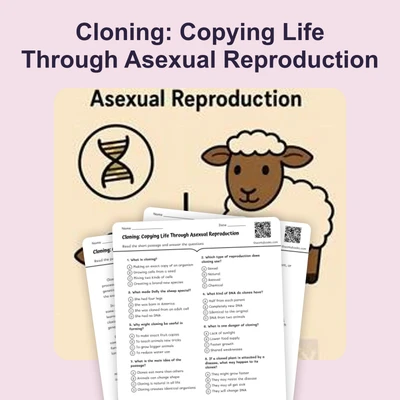
Asexual reproduction is a process by which organisms produce offspring without the fusion of gametes (sex cells). Unlike sexual reproduction, which involves two parents, asexual reproduction requires only one parent, resulting in genetically identical offspring called clones. This method is efficient and allows rapid population growth, making it common in bacteria, plants, fungi, and some animals.
Binary Fission and Budding
One type of asexual reproduction is binary fission, where a single-celled organism, like a bacterium, splits into two identical cells. The parent cell duplicates its DNA and divides, creating two genetically identical daughter cells. Another method, budding, occurs in organisms like yeast and hydra. A small bud grows on the parent, develops into a new organism, and may either detach or remain attached.
Fragmentation and Vegetative Propagation
Fragmentation happens when an organism breaks into pieces, each growing into a new individual. Starfish, for example, can regenerate lost arms into complete organisms. Plants often use vegetative propagation, where new plants grow from stems, roots, or leaves. Strawberries produce runners that take root and form new plants.
Real-World Importance
Asexual reproduction helps species survive in stable environments by quickly increasing their numbers. Farmers use vegetative propagation to grow crops like potatoes and sugarcane efficiently. However, since offspring are genetically identical, they may struggle to adapt to environmental changes.
Fun Fact: Some lizards, like the New Mexico whiptail, reproduce entirely asexually—all individuals are females that lay fertile eggs without mating!
Comprehension quiz (8 questions)
1. What is asexual reproduction?
2. Which organism reproduces through binary fission?
3. How does budding differ from binary fission?
4. What is a disadvantage of asexual reproduction?
5. Which plant uses vegetative propagation?
6. How does fragmentation help starfish?
7. What is the main idea of the passage?
8. If a farmer wants identical apple trees, which method should they use?
Perfect for the way you teach
- Build comprehension skills
- Auto-graded quiz
- Differentiated reading
- Read together at home
- Improve fluency
- Quiet reading time
- Reading curriculum support
- Independent practice
- Track Lexile growth