Battles of Lexington and Concord 1775
Interactive passage with audio narration, comprehension questions, and printable PDF.
By completing this purchase you agree to our Terms of Use and Privacy Policy. Your subscription renews automatically until you cancel. You can cancel anytime from your account settings. All sales are final and non-refundable. Digital content is available for download in your account immediately upon purchase.
What's included
Battles of Lexington and Concord 1775 preview and details
About this printable Battles of Lexington and Concord 1775 reading passage (Grades 6-8)
Sample passage and quiz from Battles of Lexington and Concord 1775
Reading passage and comprehension quiz preview
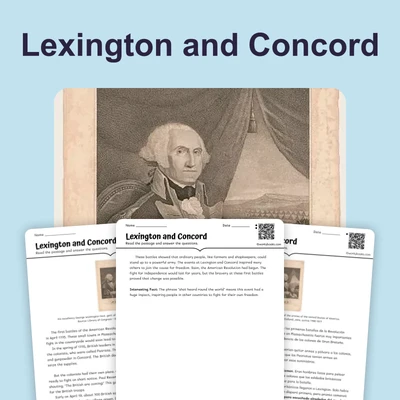
Battles of Lexington and Concord 1775
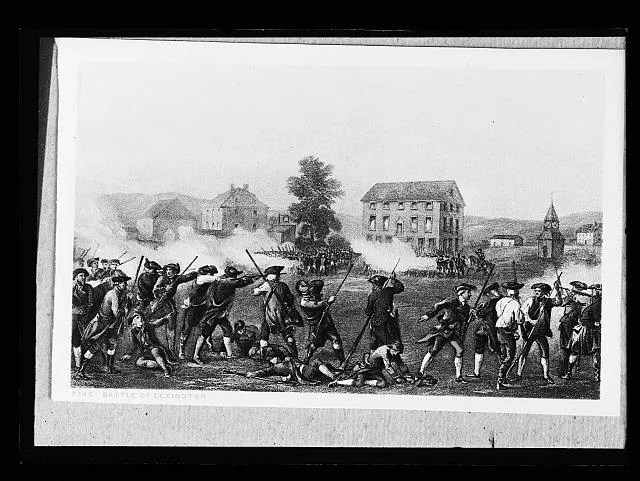
Source: Library of Congress - Detroit Publishing Co.
The Battles of Lexington and Concord, fought on April 19, 1775, marked the outbreak of open conflict between Great Britain and its American colonies. Tensions had been rising for years due to British attempts to control the colonies through taxes and strict laws, such as the Intolerable Acts. Many colonists viewed these policies as unfair and a violation of their rights as British subjects. British leaders, however, saw their actions as necessary to maintain order and authority in the growing colonies.
As conflict grew, colonial leaders formed local militias, groups of citizen-soldiers prepared to resist British control. Meanwhile, British officials in Boston received orders to seize colonial weapons stored in Concord, Massachusetts. The colonial militias, warned by riders such as Paul Revere, prepared to defend their supplies. Paul Revere’s midnight ride is famous for alerting the countryside, but he was one of several riders. As Revere later recalled, "I alarmed almost every house, till I got to Lexington." This primary source quote shows how quickly and widely the warning spread, shaping the events to come.
At dawn, British troops marched into Lexington. Colonial militiamen, known as "Minutemen," stood on the town green. A shot rang out—historians still debate who fired first. This "shot heard 'round the world" began the battle. British soldiers quickly overpowered the outnumbered colonists, killing eight and wounding several more. The British then marched on to Concord, but by then, hundreds of militia had gathered.
In Concord, the British began searching for hidden supplies. Skirmishes broke out at North Bridge, where the colonists pushed the British back. As British troops retreated to Boston, colonial militias fired on them from behind trees and stone walls. The British suffered more than 250 casualties, while colonial losses were much lower. This demonstrated the colonists' ability to effectively resist a professional army.
The events at Lexington and Concord had significant consequences. For the colonists, these battles proved that armed resistance was possible and even successful. For the British, the fighting signaled that restoring order would require far more force than expected. News of the battles spread quickly throughout the colonies and across the Atlantic. Many colonists who had been undecided now supported resistance. The British government responded by sending more troops, escalating the conflict into a full-scale war.
Multiple perspectives shaped the events. Colonial leaders argued for the right to self-government and protection of their liberties. British leaders believed they were enforcing the law and protecting the empire. Ordinary colonists faced difficult choices: some joined the Patriot cause, while others remained loyal to Britain or simply hoped to avoid violence. The complex motives and fears of each group led to misunderstandings and deep divisions in colonial society.
Historians use evidence such as letters, official reports, and eyewitness accounts to reconstruct the events and understand their meaning. Analyzing these sources helps us understand why the battles happened and how people on both sides viewed them. The legacy of Lexington and Concord is not just about who won, but about how a group of ordinary people challenged a powerful empire, setting in motion a revolution that would change the world.
Interesting Fact: The Old North Bridge in Concord, where the first organized colonial resistance occurred, is now a national historic site visited by thousands each year.
Comprehension quiz (8 questions)
1. When were the battles fought?
2. Who warned the colonists?
3. Where were the colonial weapons stored?
4. Why did the British march to Concord?
5. What was the impact on colonists?
6. What does the quote from Revere show?
7. The British won easily at Concord. True or false?
8. What is a 'militia'?
Common Core standards for Battles of Lexington and Concord 1775
Explain events, procedures, ideas, or concepts in a historical, scientific, or technical text, including what happened and why, based on specific information in the text.
Determine the meaning of general academic and domain-specific words or phrases in a text relevant to a grade 4 topic or subject area.
Write informative/explanatory texts to examine a topic and convey ideas and information clearly.
Perfect for the way you teach
- Build comprehension skills
- Auto-graded quiz
- Differentiated reading
- Read together at home
- Improve fluency
- Quiet reading time
- Reading curriculum support
- Independent practice
- Track Lexile growth