Benjamin Franklin in Colonial America — Reading Comprehension
Rate this
Premium Resource
Present
Present in classroom. No work saved
Assign
Classroom with student accounts, Track progress
Quick Play
No student accounts, assign with a link
Grades
6
7
8
Standards
HSS 5.5
8.1
RI.6-8.1
RI.6-8.3
PRINT+DIGITAL RESOURCE
This learning resource is available in interactive and printable formats. The interactive worksheet can be played online and assigned to students. The Printable PDF version can be downloaded and printed for completion by hand.
This U.S. History reading passage explores the life and influence of Benjamin Franklin, a key colonial leader whose ideas and actions helped shape American identity. Through a detailed, evidence-based account, students learn about Franklin’s journey from printer to polymath, his Enlightenment ideals, civic contributions, scientific inventions, and diplomatic achievements during the American Revolution. The passage also addresses complexities in Franklin’s life, including the challenges he faced and the solutions he developed. Activities include multiple-choice questions, writing prompts, graphic organizers, and a timeline of major events. The passage aligns with HSS 5.5 and 8.1, as well as Common Core standards RI.6-8.1 and RI.6-8.3. Audio read aloud and Spanish translation are available, along with differentiated versions for accessibility. Designed to build historical thinking, academic vocabulary, and reading comprehension, this resource is suitable for both classroom and independent study. Key terms such as Enlightenment, diplomacy, civic virtue, and polymath are highlighted to support vocabulary development and historical understanding.
CONTENT PREVIEW
Expand content preview
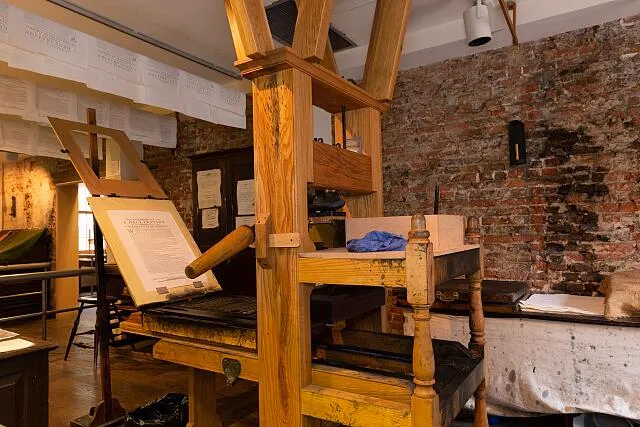
"Benjamin Franklin's press in his printing house, by Highsmith, Carol M., 1946- / Library of Congress.
Benjamin Franklin was one of the most influential figures in Colonial America and the American Revolution. Born in 1706 in Boston, Franklin began his career as a printer’s apprentice, using his skills to publish newspapers and pamphlets that spread new ideas throughout the colonies. He became known for his sharp wit, scientific curiosity, and ability to solve problems. Over time, Franklin would become a leading voice for American independence, using his talents as a polymath—a person skilled in many areas—to shape the course of history.
Franklin’s life is best understood by comparing his different roles: scientist, writer, and statesman. As a scientist, Franklin experimented with electricity and invented useful objects like the lightning rod, bifocal glasses, and the Franklin stove. His inventions improved everyday life and demonstrated the values of the Enlightenment, a movement that encouraged reason and scientific thinking. Franklin’s scientific work made him famous in Europe and helped establish America’s reputation for innovation.
As a writer and publisher, Franklin used his skills to influence colonial society. His newspaper, The Pennsylvania Gazette, became a leading source of news. Through Poor Richard’s Almanack, Franklin shared advice and proverbs, promoting ideas like civic virtue—the belief that citizens should work for the common good. During a time when not everyone could read, Franklin started the first public library in America, making knowledge more accessible.
Franklin faced many challenges in his career. In England, he tried to persuade British leaders to treat the colonies fairly, but his efforts failed. This disappointment led him to support American independence. As a diplomat, Franklin played a crucial role in negotiating the Treaty of Paris in 1783, which officially ended the Revolutionary War. His skillful diplomacy convinced France to support the American cause, providing vital resources and turning the tide of the war.
Despite his achievements, Franklin’s life had contradictions. He owned enslaved people for part of his life, but later became an outspoken critic of slavery. He also balanced loyalty to Britain with his desire for colonial rights, which created conflicts with friends and colleagues. Franklin’s willingness to change his views and admit mistakes is part of what made him an effective leader.
Franklin’s legacy continues today. His commitment to public service, science, and education left a lasting mark on American identity. He helped define what it meant to be an American—curious, practical, and committed to freedom and progress.
Interesting Fact: Benjamin Franklin was the only Founding Father to sign all three key documents: the Declaration of Independence, the Treaty of Paris, and the United States Constitution.
Where was Benjamin Franklin born?
BostonPhiladelphiaNew YorkParis
What was Franklin's first job?
Printer’s apprenticeTeacherLawyerFarmer
Which war ended with the Treaty of Paris?
Revolutionary WarCivil WarWorld War IFrench and Indian War
Why did Franklin support independence?
Britain ignored colonial rightsHe wanted more inventionsHe disliked scienceHe wanted to be king
How did Franklin help the American cause?
Diplomacy with FranceFought as a soldierBuilt shipsMoved to Britain
Franklin believed in civic virtue. What does this mean?
Helping the communityInventing machinesTraveling to EuropeOwning land
Franklin signed the Declaration of Independence. True or false?
TrueFalse
What is a 'polymath'?
Expert in many fieldsSkilled sailorPrinter onlyKing
Perfect For:
👩🏫 Teachers
• Reading comprehension practice
• Auto-graded assessments
• Literacy skill development
👨👩👧👦 Parents
• Reading practice at home
• Comprehension improvement
• Educational reading time
🏠 Homeschoolers
• Reading curriculum support
• Independent reading practice
• Progress monitoring
Reading Features:
📖
Reading Passage
Engaging fiction or nonfiction text
❓
Comprehension Quiz
Auto-graded questions
📊
Instant Feedback
Immediate results and scoring
📄
Printable Version
Download for offline reading
🔊
Read Aloud
Voice-over with word highlighting
Reviews & Ratings
No reviews yet. Be the first to share your experience!
Related Content
Pocahontas: Myth vs. Historical Reality
This passage explores the nuanced history of Pocahontas, moving beyond the myth made popular by movies and stories. Stud...
HSS 5.3.1RI.6-8.1RI.6-8.8
Roger Williams Religious Freedom
This passage explores the life and legacy of Roger Williams, a key figure in Colonial America who was banished from Mass...
HSS 5.4.38.2.2RI.6-8.1RI.6-8.6
Colonial Apprenticeship System
This comprehensive passage explores the Colonial Apprenticeship System and its role in education during Colonial America...
HSS 5.4.6RI.6-8.1RI.6-8.2
Colonial Printing Press
This passage explores the revolutionary impact of the colonial printing press in America, examining how it enabled the s...
HSS 5.58.1RI.6-8.1RI.6-8.2
Cities in Colonial America
This engaging U.S. history reading passage explores the rise of colonial American cities such as Boston, Philadelphia, a...
HSS 5.4.68.1RI.6-8.1RI.6-8.7
Frontier Life in Colonial America
This passage examines the realities of frontier life in colonial America, highlighting both the promise and peril faced ...
HSS 5.4.68.1RI.6-8.1RI.6-8.2
Mercy Otis Warren: Political Writer
This passage explores the life and impact of Mercy Otis Warren, a significant political writer during the American Revol...
HSS 5.6.38.1RI.6-8.1RI.6-8.6
Crispus Attucks
This comprehensive U.S. History reading passage examines the life and legacy of Crispus Attucks, the first person killed...
HSS 5.5.38.1RI.6-8.1RI.6-8.3
Lewis and Clark Expedition
This comprehensive U.S. History reading passage explores the Lewis and Clark Expedition (1804-1806), a pivotal journey l...
HSS 8.4.18.8.2RI.6-8.1RI.6-8.3
Exodusters
This passage explores the migration of Exodusters—African Americans who left the South in the 1870s to escape discrimina...
HSS 8.12.1RI.6-8.1RI.6-8.2
Uncle Tom's Cabin
This passage explores the impact of Harriet Beecher Stowe’s Uncle Tom’s Cabin on American society in the 1850s. It exami...
HSS 8.9.48.10.2RI.6-8.1RI.6-8.6
Dred Scott Decision
This rigorous history reading passage delves into the 1857 Dred Scott Decision, a pivotal moment in the lead-up to the C...
HSS 8.9.48.10.3RI.6-8.1RI.6-8.8
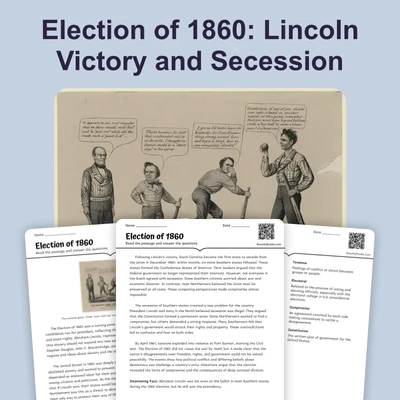
Election of 1860
This passage explores Abraham Lincoln’s election in 1860 and the critical reactions from Southern states, which set the ...
HSS 8.10.4RI.6-8.1RI.6-8.6
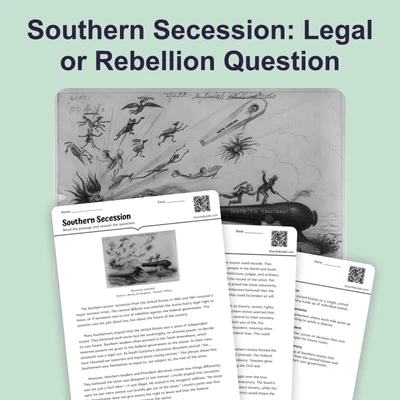
Southern Secession
This passage explores the significant moment in U.S. history when seven Southern states seceded from the Union after Abr...
HSS 8.10.4RI.6-8.1RI.6-8.2
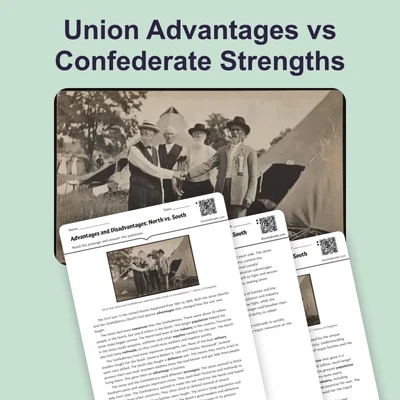
Advantages and Disadvantages: North vs. South
This history reading passage examines the contrasting strengths of the Union and Confederacy during the U.S. Civil War. ...
HSS 8.10.5RI.6-8.1RI.6-8.3
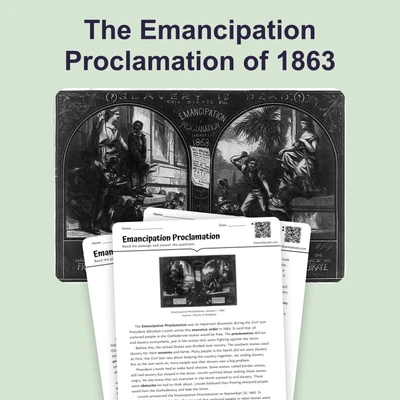
Emancipation Proclamation
This U.S. history passage explores the Emancipation Proclamation of 1863, an executive order issued by President Abraham...
HSS 8.10.6RI.6-8.1RI.6-8.3
Women's Roles in Civil War
This reading passage explores the critical roles women played during the U.S. Civil War, highlighting how they managed f...
HSS 8.10.7RI.6-8.1RI.6-8.2
Surrender at Appomattox
This reading passage explores the historic surrender at Appomattox Court House in April 1865, which marked the conclusio...
HSS 8.10.7RI.6-8.1RI.6-8.6
Abraham Lincoln Assassination
This passage explores the significant event of President Abraham Lincoln's assassination in April 1865, just days after ...