Frontier Life in Colonial America — Reading Comprehension
Rate this
Premium Resource
Present
Present in classroom. No work saved
Assign
Classroom with student accounts, Track progress
Quick Play
No student accounts, assign with a link
Grades
6
7
8
Standards
HSS 5.4.6
8.1
RI.6-8.1
RI.6-8.2
PRINT+DIGITAL RESOURCE
This learning resource is available in interactive and printable formats. The interactive worksheet can be played online and assigned to students. The Printable PDF version can be downloaded and printed for completion by hand.
This passage examines the realities of frontier life in colonial America, highlighting both the promise and peril faced by settlers moving beyond established settlements. Students will learn how the search for cheap land and personal autonomy drove colonial expansion, while also understanding the harsh realities of isolation, difficult living conditions, and conflict with Native peoples defending their homelands. Key terms such as 'frontier,' 'homestead,' 'expansion,' and 'isolation' are integrated throughout, supporting vocabulary development and historical analysis. The passage aligns with HSS 5.4.6 and 8.1, as well as CCSS.RI.6-8.1 and RI.6-8.2, and is accompanied by read aloud audio, Spanish translation, and differentiated versions for accessibility. Activities include comprehension questions, writing prompts, and graphic organizers to deepen engagement and support student mastery of both historical content and academic vocabulary.
CONTENT PREVIEW
Expand content preview
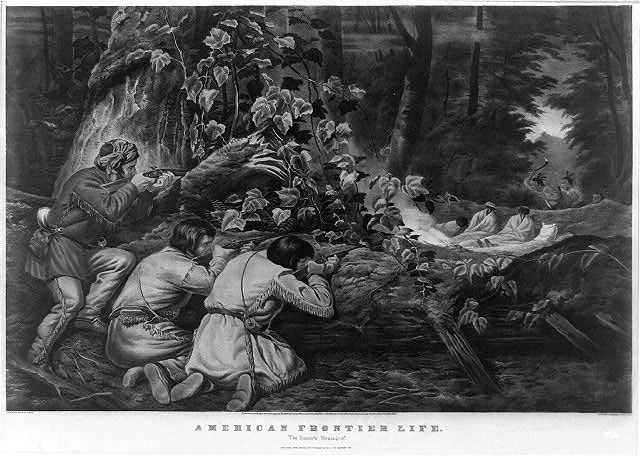
American Frontier Life - The Hunter's Stratagem. Source: Library of Congress
The frontier in colonial America was the edge of settled territory, where European colonies met vast, unknown lands. Many settlers saw the frontier as a place of opportunity, offering cheap or free land to create a new life. However, moving beyond established settlements brought great risks. People who chose to go west faced harsh weather, dense forests, and the constant threat of isolation from neighbors and family.
One of the main attractions of the frontier was the chance to start a homestead. A homestead was a piece of land where a family could build a home, grow crops, and raise animals. For many, owning land meant independence and hope for a better future. Yet, building a homestead was physically demanding. Settlers had to cut down trees, clear rocks, and construct sturdy shelters. Supplies were often scarce, and communities were far apart, increasing feelings of isolation.
The process of expansion into the frontier also brought settlers into conflict with Native American nations. These indigenous groups had lived on the land for generations and relied on its resources for survival. As colonial populations grew, more settlers pushed into Native homelands, often ignoring treaties or agreements. This led to violent conflicts over territory, resources, and ways of life. Native peoples defended their land through resistance and negotiation, but the pressure of colonial expansion was relentless.
Despite the dangers, settlers continued moving westward, drawn by stories of rich soil and new beginnings. Some families traveled in groups for protection, while others went alone. Cooperation with neighbors was essential for building homes and planting crops. At the same time, the threat of disease, wild animals, and food shortages constantly reminded settlers of the risks involved. Life on the frontier demanded resilience, adaptability, and strong community bonds.
The expansion of the frontier changed American society. It increased diversity as people from different backgrounds mingled and shared knowledge. It also shaped the nation's identity, fostering a spirit of independence and self-reliance. However, the rapid spread of colonial settlements often came at the expense of Native peoples, whose lands and cultures were threatened or destroyed. The story of the frontier is one of both hope and hardship, opportunity and loss.
Interesting Fact: Some frontier families used "dugouts"—homes built into hillsides—when wood was scarce, showing their creativity in adapting to new environments.
What is a homestead?
A piece of land for a familyA group of settlersA large cityA type of weapon
Which word means moving into new lands?
IsolationExpansionConflictResilience
Why did settlers want to move west?
For cheap landTo avoid workTo escape animalsFor better weather
What problem did settlers face?
IsolationToo many citiesOvercrowded homesEasy travel
How did expansion affect Native peoples?
Lost land and cultureGained new homesTraveled westBuilt large cities
Why was cooperation important on the frontier?
To build homes and surviveTo study animalsTo write treatiesTo avoid farming
Frontier life was easy. (True/False)
TrueFalse
What is the meaning of resilience?
To keep going when it's hardTo build a houseTo travel westTo make a treaty
Perfect For:
👩🏫 Teachers
• Reading comprehension practice
• Auto-graded assessments
• Literacy skill development
👨👩👧👦 Parents
• Reading practice at home
• Comprehension improvement
• Educational reading time
🏠 Homeschoolers
• Reading curriculum support
• Independent reading practice
• Progress monitoring
Reading Features:
📖
Reading Passage
Engaging fiction or nonfiction text
❓
Comprehension Quiz
Auto-graded questions
📊
Instant Feedback
Immediate results and scoring
📄
Printable Version
Download for offline reading
🔊
Read Aloud
Voice-over with word highlighting
Reviews & Ratings
No reviews yet. Be the first to share your experience!
Related Content
Pocahontas: Myth vs. Historical Reality
This passage explores the nuanced history of Pocahontas, moving beyond the myth made popular by movies and stories. Stud...
HSS 5.3.1RI.6-8.1RI.6-8.8
Roger Williams Religious Freedom
This passage explores the life and legacy of Roger Williams, a key figure in Colonial America who was banished from Mass...
HSS 5.4.38.2.2RI.6-8.1RI.6-8.6
Benjamin Franklin in Colonial America
This U.S. History reading passage explores the life and influence of Benjamin Franklin, a key colonial leader whose idea...
HSS 5.58.1RI.6-8.1RI.6-8.3
Colonial Apprenticeship System
This comprehensive passage explores the Colonial Apprenticeship System and its role in education during Colonial America...
HSS 5.4.6RI.6-8.1RI.6-8.2
Colonial Printing Press
This passage explores the revolutionary impact of the colonial printing press in America, examining how it enabled the s...
HSS 5.58.1RI.6-8.1RI.6-8.2
Cities in Colonial America
This engaging U.S. history reading passage explores the rise of colonial American cities such as Boston, Philadelphia, a...
HSS 5.4.68.1RI.6-8.1RI.6-8.7
Mercy Otis Warren: Political Writer
This passage explores the life and impact of Mercy Otis Warren, a significant political writer during the American Revol...
HSS 5.6.38.1RI.6-8.1RI.6-8.6
Crispus Attucks
This comprehensive U.S. History reading passage examines the life and legacy of Crispus Attucks, the first person killed...
HSS 5.5.38.1RI.6-8.1RI.6-8.3
Lewis and Clark Expedition
This comprehensive U.S. History reading passage explores the Lewis and Clark Expedition (1804-1806), a pivotal journey l...
HSS 8.4.18.8.2RI.6-8.1RI.6-8.3
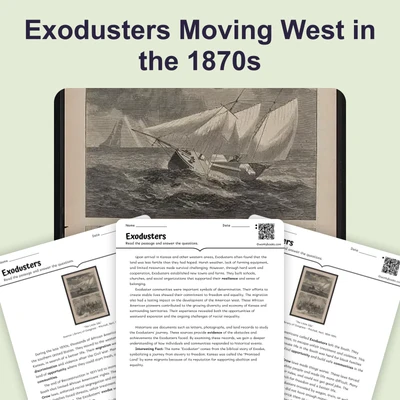
Exodusters
This passage explores the migration of Exodusters—African Americans who left the South in the 1870s to escape discrimina...
HSS 8.12.1RI.6-8.1RI.6-8.2
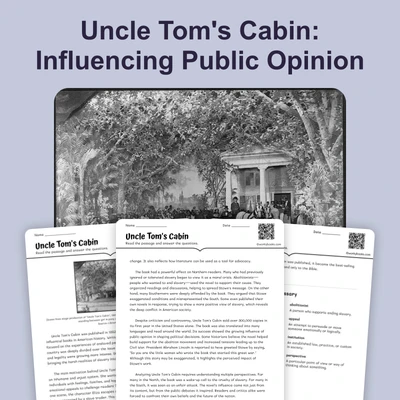
Uncle Tom's Cabin
This passage explores the impact of Harriet Beecher Stowe’s Uncle Tom’s Cabin on American society in the 1850s. It exami...
HSS 8.9.48.10.2RI.6-8.1RI.6-8.6
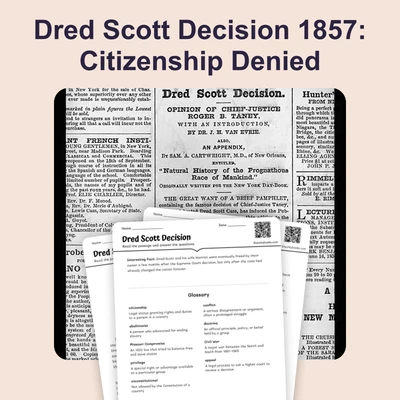
Dred Scott Decision
This rigorous history reading passage delves into the 1857 Dred Scott Decision, a pivotal moment in the lead-up to the C...
HSS 8.9.48.10.3RI.6-8.1RI.6-8.8
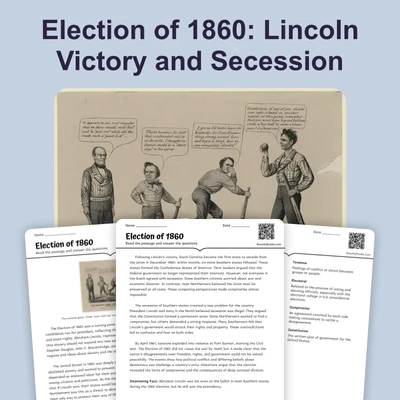
Election of 1860
This passage explores Abraham Lincoln’s election in 1860 and the critical reactions from Southern states, which set the ...
HSS 8.10.4RI.6-8.1RI.6-8.6
Southern Secession
This passage explores the significant moment in U.S. history when seven Southern states seceded from the Union after Abr...
HSS 8.10.4RI.6-8.1RI.6-8.2
Advantages and Disadvantages: North vs. South
This history reading passage examines the contrasting strengths of the Union and Confederacy during the U.S. Civil War. ...
HSS 8.10.5RI.6-8.1RI.6-8.3
Emancipation Proclamation
This U.S. history passage explores the Emancipation Proclamation of 1863, an executive order issued by President Abraham...
HSS 8.10.6RI.6-8.1RI.6-8.3
Women's Roles in Civil War
This reading passage explores the critical roles women played during the U.S. Civil War, highlighting how they managed f...
HSS 8.10.7RI.6-8.1RI.6-8.2
Surrender at Appomattox
This reading passage explores the historic surrender at Appomattox Court House in April 1865, which marked the conclusio...
HSS 8.10.7RI.6-8.1RI.6-8.6
Abraham Lincoln Assassination
This passage explores the significant event of President Abraham Lincoln's assassination in April 1865, just days after ...