Cities in Colonial America — Reading Comprehension
Rate this
Premium Resource
Present
Present in classroom. No work saved
Assign
Classroom with student accounts, Track progress
Quick Play
No student accounts, assign with a link
Grades
6
7
8
Standards
HSS 5.4.6
8.1
RI.6-8.1
RI.6-8.7
PRINT+DIGITAL RESOURCE
This learning resource is available in interactive and printable formats. The interactive worksheet can be played online and assigned to students. The Printable PDF version can be downloaded and printed for completion by hand.
This engaging U.S. history reading passage explores the rise of colonial American cities such as Boston, Philadelphia, and New York. Students will learn how these cities became centers of commerce, attracting people from diverse backgrounds and creating both prosperity and poverty. The passage explains the process of urbanization, the challenges faced by city dwellers, and the social inequalities that emerged. Designed for middle schoolers, it integrates key academic vocabulary, a glossary, reading comprehension quiz, writing activities, graphic organizers, and Spanish translations. It also provides a differentiated simplified version to support learners at all levels. This resource aligns with HSS 5.4.6, 8.1 and CCSS RI.6-8.1, RI.6-8.7, making it ideal for classroom or independent study. Features include read aloud audio, evidence-based analysis, and opportunities to practice critical thinking. Teachers and students can deepen their understanding of the complexities of colonial urban life and the lasting impact of these early cities on American society.
CONTENT PREVIEW
Expand content preview
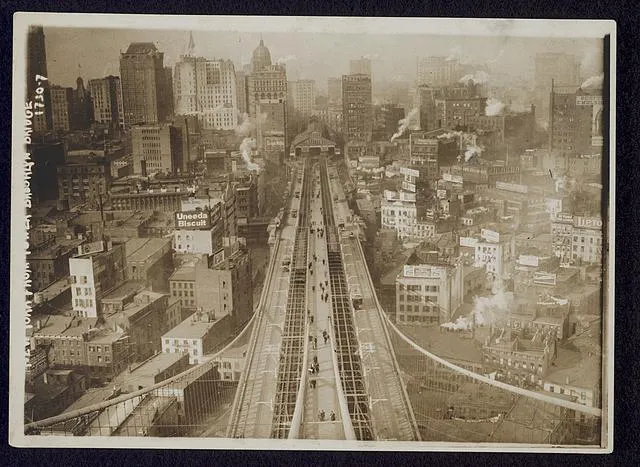
New York from tower of Brooklyn Bridge. Source: Library of Congress
During the colonial era, cities like Boston, Philadelphia, and New York became major centers of commerce in North America. Their location along the Atlantic coast allowed ships to travel easily, bringing in goods and people from Europe, Africa, and the Caribbean. The process of urbanization—the growth of cities—transformed these areas from small settlements into busy urban hubs. As more colonists arrived seeking opportunity, these cities quickly expanded, developing new neighborhoods and bustling marketplaces.
Economic activity in these cities was driven by trade, which made some residents very wealthy. Merchants controlled shipping, imported goods, and managed warehouses, becoming some of the most influential people in colonial society. Their prosperity enabled them to build grand homes and participate in local government. However, not everyone benefited equally. Many workers, such as dock laborers, artisans, and servants, lived modestly and struggled to support their families. Poverty was a persistent problem, especially as populations grew faster than jobs or housing could keep up.
The contrasts between rich and poor were visible in the layout of the cities. In Boston, for example, wealthy families often lived near the harbor in large houses, while the urban poor crowded into small alleys or rented rooms. Philadelphia became known for its carefully planned streets, yet social divisions were clear: the city’s founders hoped for equality, but economic realities made that difficult. New York’s diverse population included Dutch, English, African, and other communities, each facing unique opportunities and challenges within the city’s social structure.
Urban growth also brought new problems. Overcrowding led to poor sanitation, which sometimes caused disease outbreaks. The arrival of immigrants and enslaved Africans increased the population’s diversity but also led to tensions and competition for work. City leaders tried to address these issues with new regulations and public services, such as fire brigades and marketplaces, but solutions were often limited by the resources available.
Despite these challenges, colonial cities offered the promise of advancement. Schools, newspapers, and civic organizations developed, fostering a sense of community and innovation. The cities’ roles as centers of political debate and social change also set the stage for later revolutionary events. Colonial urban life was complex, marked by both remarkable energy and serious inequalities, shaping the early identity of what would become the United States.
Interesting Fact: By 1770, Philadelphia was the largest city in the American colonies, with more than 28,000 residents and one of the busiest ports in the world.
Which city was largest by 1770?
PhiladelphiaBostonNew YorkCharleston
What did merchants do?
Traded goodsBuilt roadsFarmed landTaught school
Which was a problem in cities?
OvercrowdingToo many farmsLack of shipsFew immigrants
Why did cities grow?
Location and tradeOnly farmingNo immigrantsNo jobs
How did wealth affect city life?
Created social divisionsMade all equalEnded tradeDecreased opportunity
What did city leaders try to fix?
Sanitation and safetyFarmingShipbuildingFishing
Colonial cities had no poverty.
TrueFalse
What is urbanization?
City growthShip repairFarmingVoting
Perfect For:
👩🏫 Teachers
• Reading comprehension practice
• Auto-graded assessments
• Literacy skill development
👨👩👧👦 Parents
• Reading practice at home
• Comprehension improvement
• Educational reading time
🏠 Homeschoolers
• Reading curriculum support
• Independent reading practice
• Progress monitoring
Reading Features:
📖
Reading Passage
Engaging fiction or nonfiction text
❓
Comprehension Quiz
Auto-graded questions
📊
Instant Feedback
Immediate results and scoring
📄
Printable Version
Download for offline reading
🔊
Read Aloud
Voice-over with word highlighting
Reviews & Ratings
No reviews yet. Be the first to share your experience!
Related Content
Pocahontas: Myth vs. Historical Reality
This passage explores the nuanced history of Pocahontas, moving beyond the myth made popular by movies and stories. Stud...
HSS 5.3.1RI.6-8.1RI.6-8.8
Roger Williams Religious Freedom
This passage explores the life and legacy of Roger Williams, a key figure in Colonial America who was banished from Mass...
HSS 5.4.38.2.2RI.6-8.1RI.6-8.6
Benjamin Franklin in Colonial America
This U.S. History reading passage explores the life and influence of Benjamin Franklin, a key colonial leader whose idea...
HSS 5.58.1RI.6-8.1RI.6-8.3
Colonial Apprenticeship System
This comprehensive passage explores the Colonial Apprenticeship System and its role in education during Colonial America...
HSS 5.4.6RI.6-8.1RI.6-8.2
Colonial Printing Press
This passage explores the revolutionary impact of the colonial printing press in America, examining how it enabled the s...
HSS 5.58.1RI.6-8.1RI.6-8.2
Frontier Life in Colonial America
This passage examines the realities of frontier life in colonial America, highlighting both the promise and peril faced ...
HSS 5.4.68.1RI.6-8.1RI.6-8.2
Mercy Otis Warren: Political Writer
This passage explores the life and impact of Mercy Otis Warren, a significant political writer during the American Revol...
HSS 5.6.38.1RI.6-8.1RI.6-8.6
Crispus Attucks
This comprehensive U.S. History reading passage examines the life and legacy of Crispus Attucks, the first person killed...
HSS 5.5.38.1RI.6-8.1RI.6-8.3
Lewis and Clark Expedition
This comprehensive U.S. History reading passage explores the Lewis and Clark Expedition (1804-1806), a pivotal journey l...
HSS 8.4.18.8.2RI.6-8.1RI.6-8.3
Exodusters
This passage explores the migration of Exodusters—African Americans who left the South in the 1870s to escape discrimina...
HSS 8.12.1RI.6-8.1RI.6-8.2
Uncle Tom's Cabin
This passage explores the impact of Harriet Beecher Stowe’s Uncle Tom’s Cabin on American society in the 1850s. It exami...
HSS 8.9.48.10.2RI.6-8.1RI.6-8.6
Dred Scott Decision
This rigorous history reading passage delves into the 1857 Dred Scott Decision, a pivotal moment in the lead-up to the C...
HSS 8.9.48.10.3RI.6-8.1RI.6-8.8
Election of 1860
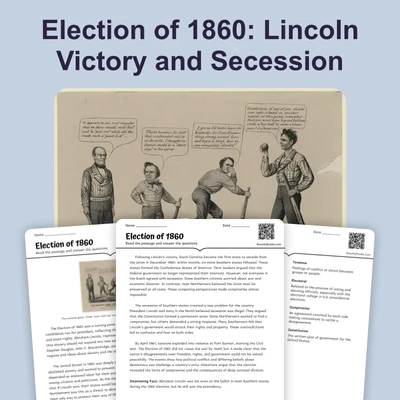
This passage explores Abraham Lincoln’s election in 1860 and the critical reactions from Southern states, which set the ...
HSS 8.10.4RI.6-8.1RI.6-8.6
Southern Secession
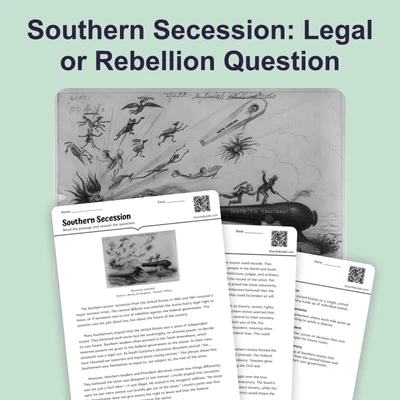
This passage explores the significant moment in U.S. history when seven Southern states seceded from the Union after Abr...
HSS 8.10.4RI.6-8.1RI.6-8.2
Advantages and Disadvantages: North vs. South
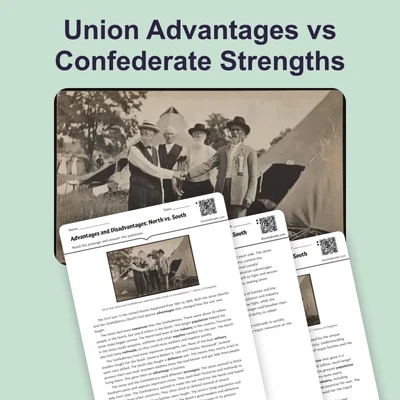
This history reading passage examines the contrasting strengths of the Union and Confederacy during the U.S. Civil War. ...
HSS 8.10.5RI.6-8.1RI.6-8.3
Emancipation Proclamation
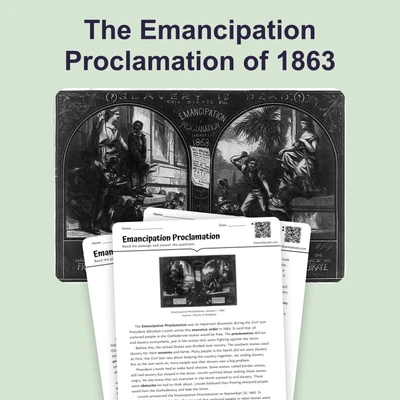
This U.S. history passage explores the Emancipation Proclamation of 1863, an executive order issued by President Abraham...
HSS 8.10.6RI.6-8.1RI.6-8.3
Women's Roles in Civil War
This reading passage explores the critical roles women played during the U.S. Civil War, highlighting how they managed f...
HSS 8.10.7RI.6-8.1RI.6-8.2
Surrender at Appomattox
This reading passage explores the historic surrender at Appomattox Court House in April 1865, which marked the conclusio...
HSS 8.10.7RI.6-8.1RI.6-8.6
Abraham Lincoln Assassination
This passage explores the significant event of President Abraham Lincoln's assassination in April 1865, just days after ...