This learning resource is available in interactive and printable formats. The interactive worksheet can be played online and assigned to students. The Printable PDF version can be downloaded and printed for completion by hand.
This passage explores the revolutionary impact of the colonial printing press in America, examining how it enabled the spread of news, political ideas, and religious texts across the colonies. Students will learn about key figures such as Benjamin Franklin and the ways in which printers connected distant communities and shaped public opinion through pamphlets, broadsides, and newspapers. The text addresses challenges faced by colonial printers, including censorship and resource shortages, and highlights the importance of printed material in events leading up to the American Revolution. Activities include a glossary, quizzes, writing prompts, graphic organizers, and a timeline to build historical reasoning skills. The resource features a read aloud audio option and a full Spanish translation, with differentiated versions for accessibility. Aligned to HSS 5.5, 8.1 and CCSS.RI.6-8.1, RI.6-8.2.
CONTENT PREVIEW
Expand content preview
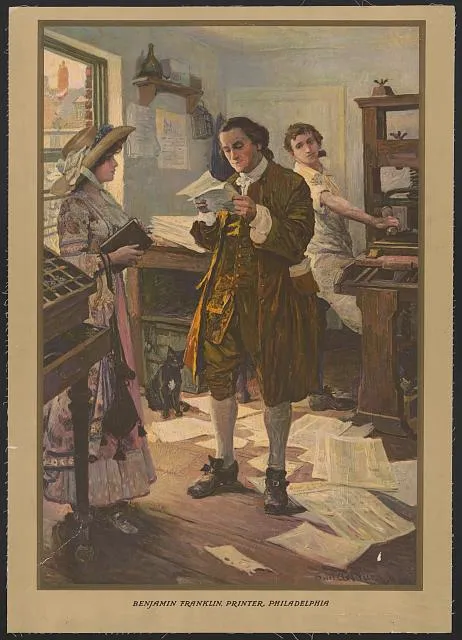
Benjamin Franklin, printer, Philadelphia. Source: Library of Congress
The colonial printing press changed how information traveled in the American colonies. Before the printing press, most news and ideas were shared by word of mouth, which could be slow and unreliable. With the arrival of printing technology, communities could produce multiple copies of the same text and distribute them across towns and cities. This innovation allowed colonists to read the same pamphlet, broadside, or newspaper, creating a shared understanding of current events.
The printing press played a crucial role in shaping public opinion during the years leading up to the American Revolution. Printers like Benjamin Franklin, who ran the Pennsylvania Gazette, used their presses to publish news, essays, and political arguments. These printed materials provided colonists with information about British laws, colonial protests, and debates about independence. Through the printing press, colonists read persuasive writing that influenced their views and sometimes encouraged them to take action.
However, colonial printers faced significant challenges. Paper and ink were expensive and had to be imported from Europe. Printers risked punishment for publishing information that angered British officials or violated colonial laws. Despite these difficulties, many printers continued their work because they believed in the importance of a free press. Their efforts made it possible for colonists to stay informed and connected, even when they lived far apart.
Printed materials were not just for politics. Printers also produced religious texts, almanacs, and advertisements. These publications helped unify the colonies by allowing people to share religious beliefs, practical advice, and commercial opportunities. Some printers used their presses for propaganda, which is information designed to persuade people to support a particular cause. This sometimes led to disagreements about what was true or fair to print.
During the American Revolution, the printing press became even more important. Patriots printed pamphlets like Thomas Paine's "Common Sense," which argued for independence from Britain. These texts spread rapidly and helped build support for the revolutionary cause. Broadsides announced meetings or protests, while newspapers reported on battles and political changes. The rapid spread of information helped colonists organize and make decisions together.
In summary, the colonial printing press solved the problem of slow and unreliable communication by making it possible to share news, ideas, and arguments quickly and widely. It allowed colonists to participate in debates about their future and played a central role in the movement for American independence.
Interesting Fact: In the early 1700s, there were only a few dozen printing presses in all of colonial America, but by the time of the Revolution, nearly every major city had its own print shop.
Who published the Pennsylvania Gazette?
Benjamin FranklinThomas PaineJohn AdamsSamuel Adams
What is a broadside?
A large single-sheet announcementA small coinA British lawA colonial battle
Which text helped spread revolutionary ideas?
Common SenseRedcoat TimesLiberty BellTea Act
Why was the printing press important?
It spread news quicklyIt imported goodsIt built shipsIt grew crops
How did printers face challenges?
Expensive suppliesNo waterFarming lossToo many workers
What did propaganda do?
Persuaded peopleGrew foodBuilt roadsCreated maps
The press unified the colonies. True or false?
TrueFalse
What is public opinion?
Shared community beliefsA lawA battleA building
Perfect For:
👩🏫 Teachers
• Reading comprehension practice
• Auto-graded assessments
• Literacy skill development
👨👩👧👦 Parents
• Reading practice at home
• Comprehension improvement
• Educational reading time
🏠 Homeschoolers
• Reading curriculum support
• Independent reading practice
• Progress monitoring
Reading Features:
📖
Reading Passage
Engaging fiction or nonfiction text
❓
Comprehension Quiz
Auto-graded questions
📊
Instant Feedback
Immediate results and scoring
📄
Printable Version
Download for offline reading
🔊
Read Aloud
Voice-over with word highlighting
Reviews & Ratings
No reviews yet. Be the first to share your experience!
Related Content
Pocahontas: Myth vs. Historical Reality
This passage explores the nuanced history of Pocahontas, moving beyond the myth made popular by movies and stories. Stud...
HSS 5.3.1RI.6-8.1RI.6-8.8
Roger Williams Religious Freedom
This passage explores the life and legacy of Roger Williams, a key figure in Colonial America who was banished from Mass...
HSS 5.4.38.2.2RI.6-8.1RI.6-8.6
Benjamin Franklin in Colonial America
This U.S. History reading passage explores the life and influence of Benjamin Franklin, a key colonial leader whose idea...
HSS 5.58.1RI.6-8.1RI.6-8.3
Colonial Apprenticeship System
This comprehensive passage explores the Colonial Apprenticeship System and its role in education during Colonial America...
HSS 5.4.6RI.6-8.1RI.6-8.2
Cities in Colonial America
This engaging U.S. history reading passage explores the rise of colonial American cities such as Boston, Philadelphia, a...
HSS 5.4.68.1RI.6-8.1RI.6-8.7
Frontier Life in Colonial America
This passage examines the realities of frontier life in colonial America, highlighting both the promise and peril faced ...
HSS 5.4.68.1RI.6-8.1RI.6-8.2
Mercy Otis Warren: Political Writer
This passage explores the life and impact of Mercy Otis Warren, a significant political writer during the American Revol...
HSS 5.6.38.1RI.6-8.1RI.6-8.6
Crispus Attucks
This comprehensive U.S. History reading passage examines the life and legacy of Crispus Attucks, the first person killed...
HSS 5.5.38.1RI.6-8.1RI.6-8.3
Lewis and Clark Expedition
This comprehensive U.S. History reading passage explores the Lewis and Clark Expedition (1804-1806), a pivotal journey l...
HSS 8.4.18.8.2RI.6-8.1RI.6-8.3
Exodusters
This passage explores the migration of Exodusters—African Americans who left the South in the 1870s to escape discrimina...
HSS 8.12.1RI.6-8.1RI.6-8.2
Uncle Tom's Cabin
This passage explores the impact of Harriet Beecher Stowe’s Uncle Tom’s Cabin on American society in the 1850s. It exami...
HSS 8.9.48.10.2RI.6-8.1RI.6-8.6
Dred Scott Decision
This rigorous history reading passage delves into the 1857 Dred Scott Decision, a pivotal moment in the lead-up to the C...
HSS 8.9.48.10.3RI.6-8.1RI.6-8.8
Election of 1860
This passage explores Abraham Lincoln’s election in 1860 and the critical reactions from Southern states, which set the ...
HSS 8.10.4RI.6-8.1RI.6-8.6
Southern Secession
This passage explores the significant moment in U.S. history when seven Southern states seceded from the Union after Abr...
HSS 8.10.4RI.6-8.1RI.6-8.2
Advantages and Disadvantages: North vs. South
This history reading passage examines the contrasting strengths of the Union and Confederacy during the U.S. Civil War. ...
HSS 8.10.5RI.6-8.1RI.6-8.3
Emancipation Proclamation
This U.S. history passage explores the Emancipation Proclamation of 1863, an executive order issued by President Abraham...
HSS 8.10.6RI.6-8.1RI.6-8.3
Women's Roles in Civil War
This reading passage explores the critical roles women played during the U.S. Civil War, highlighting how they managed f...
HSS 8.10.7RI.6-8.1RI.6-8.2
Surrender at Appomattox
This reading passage explores the historic surrender at Appomattox Court House in April 1865, which marked the conclusio...
HSS 8.10.7RI.6-8.1RI.6-8.6
Abraham Lincoln Assassination
This passage explores the significant event of President Abraham Lincoln's assassination in April 1865, just days after ...