This learning resource is available in interactive and printable formats. The interactive worksheet can be played online and assigned to students. The Printable PDF version can be downloaded and printed for completion by hand.
This passage explores the significant moment in U.S. history when seven Southern states seceded from the Union after Abraham Lincoln’s election in 1860. Students will analyze the complex causes of secession, the arguments surrounding states' rights and the Union, and the events leading up to the Civil War. The text is aligned to HSS 8.10.4 and CCSS.RI.6-8.1, RI.6-8.2, supporting historical thinking and textual analysis skills. The passage is available in both standard and differentiated versions, accompanied by a Spanish translation and read aloud audio. Activities include a comprehension quiz, writing prompts, graphic organizers, and a timeline to deepen understanding. Students will build vocabulary, analyze primary causes and effects, and practice evidence-based reasoning while exploring one of the most important turning points in American history.
CONTENT PREVIEW
Expand content preview
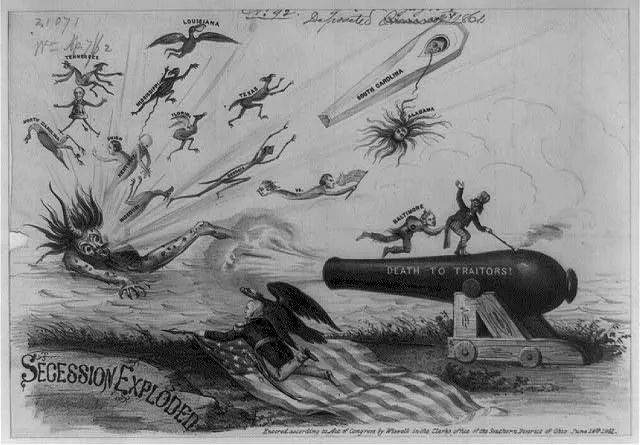
Secession exploded. Source: Library of Congress - Wiswell, William.
The Southern states' secession from the United States in 1860 and 1861 created a major national crisis. The central debate was whether the states had a legal right to leave, or if secession was an act of rebellion against the federal government. This question was not just about law, but about the future of the country.
Many Southerners argued that the United States was a union of independent states. They believed each state had the sovereignty, or ultimate power, to decide its own future. Southern leaders often pointed to the Tenth Amendment, which reserves powers not given to the federal government to the states. In their view, secession was a legal act. As South Carolina’s secession document stated, “We… have resumed our separate and equal place among nations.” This phrase shows how Southerners saw themselves as equal to, not subject to, the rest of the Union.
However, Northern leaders and President Abraham Lincoln saw things differently. They believed the Union was designed to last forever. Lincoln argued that secession was not just a bad idea—it was illegal. He stated in his inaugural address, “No state upon its own mere motion can lawfully get out of the Union.” Lincoln’s point was that the Constitution does not give states the right to leave and that the federal government has the authority to preserve the nation.
The Constitution itself did not clearly say whether states could secede. That uncertainty made the issue more complicated. Some people in the North and South tried to find a compromise. Others argued fiercely. Politicians, judges, and ordinary citizens debated the meaning of the Constitution and the nature of the Union. For example, Southern leaders claimed that since they had joined the Union voluntarily, they could also leave voluntarily. In contrast, many Northerners believed that the Union was a permanent bond, not a simple agreement that could be broken at will.
At the heart of the conflict were deeper issues, such as slavery, states' rights, and the balance of power between North and South. Southern states worried that the federal government might abolish slavery, which was central to their economy and society. Secession was, for many, a way to protect their way of life. For Northerners, allowing secession would set a dangerous precedent, meaning other groups could break away whenever they disagreed with federal laws. This could quickly destroy the United States.
The immediate result of secession was conflict. When Southern states formed the Confederacy, they took over federal property like forts and arsenals. The federal government refused to recognize the Confederacy’s independence. Tensions grew until fighting broke out at Fort Sumter in April 1861, beginning the Civil War.
Looking back, historians see the secession crisis as a struggle over the true meaning of the Constitution and the American experiment in democracy. The South’s arguments for states’ rights were rooted in their desire to protect slavery, while the North fought to preserve the Union. The consequences of this crisis would shape the nation for generations.
Interesting Fact: The U.S. Supreme Court did not officially rule that secession was illegal until after the Civil War, in the 1869 case Texas v. White.
Which state first seceded from the Union?
South CarolinaVirginiaGeorgiaTexas
Who was president during Southern secession?
Abraham LincolnAndrew JacksonJames MadisonUlysses S. Grant
What started in April 1861?
Civil WarWorld War IRevolutionary WarWar of 1812
Why did Southerners believe secession was legal?
States joined voluntarilyPresident told them toThey wanted more taxesSupreme Court said so
What was Lincoln’s main argument against secession?
Union is permanentSouth needed helpSlavery was wrongStates needed more power
What did the Confederacy do after secession?
Took over federal fortsAsked for peaceStarted new currencyHelped the Union
Secession was ruled illegal in 1869. True or false?
TrueFalse
What does 'sovereignty' mean?
Supreme power to governVoting rightsFederal taxesMilitary force
Perfect For:
👩🏫 Teachers
• Reading comprehension practice
• Auto-graded assessments
• Literacy skill development
👨👩👧👦 Parents
• Reading practice at home
• Comprehension improvement
• Educational reading time
🏠 Homeschoolers
• Reading curriculum support
• Independent reading practice
• Progress monitoring
Reading Features:
📖
Reading Passage
Engaging fiction or nonfiction text
❓
Comprehension Quiz
Auto-graded questions
📊
Instant Feedback
Immediate results and scoring
📄
Printable Version
Download for offline reading
🔊
Read Aloud
Voice-over with word highlighting
Reviews & Ratings
No reviews yet. Be the first to share your experience!
Related Content
Pocahontas: Myth vs. Historical Reality
This passage explores the nuanced history of Pocahontas, moving beyond the myth made popular by movies and stories. Stud...
HSS 5.3.1RI.6-8.1RI.6-8.8
Roger Williams Religious Freedom
This passage explores the life and legacy of Roger Williams, a key figure in Colonial America who was banished from Mass...
HSS 5.4.38.2.2RI.6-8.1RI.6-8.6
Benjamin Franklin in Colonial America
This U.S. History reading passage explores the life and influence of Benjamin Franklin, a key colonial leader whose idea...
HSS 5.58.1RI.6-8.1RI.6-8.3
Colonial Apprenticeship System
This comprehensive passage explores the Colonial Apprenticeship System and its role in education during Colonial America...
HSS 5.4.6RI.6-8.1RI.6-8.2
Colonial Printing Press
This passage explores the revolutionary impact of the colonial printing press in America, examining how it enabled the s...
HSS 5.58.1RI.6-8.1RI.6-8.2
Cities in Colonial America
This engaging U.S. history reading passage explores the rise of colonial American cities such as Boston, Philadelphia, a...
HSS 5.4.68.1RI.6-8.1RI.6-8.7
Frontier Life in Colonial America
This passage examines the realities of frontier life in colonial America, highlighting both the promise and peril faced ...
HSS 5.4.68.1RI.6-8.1RI.6-8.2
Mercy Otis Warren: Political Writer
This passage explores the life and impact of Mercy Otis Warren, a significant political writer during the American Revol...
HSS 5.6.38.1RI.6-8.1RI.6-8.6
Crispus Attucks
This comprehensive U.S. History reading passage examines the life and legacy of Crispus Attucks, the first person killed...
HSS 5.5.38.1RI.6-8.1RI.6-8.3
Lewis and Clark Expedition
This comprehensive U.S. History reading passage explores the Lewis and Clark Expedition (1804-1806), a pivotal journey l...
HSS 8.4.18.8.2RI.6-8.1RI.6-8.3
Exodusters
This passage explores the migration of Exodusters—African Americans who left the South in the 1870s to escape discrimina...
HSS 8.12.1RI.6-8.1RI.6-8.2
Uncle Tom's Cabin
This passage explores the impact of Harriet Beecher Stowe’s Uncle Tom’s Cabin on American society in the 1850s. It exami...
HSS 8.9.48.10.2RI.6-8.1RI.6-8.6
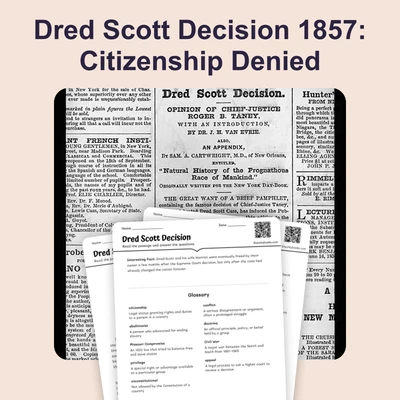
Dred Scott Decision
This rigorous history reading passage delves into the 1857 Dred Scott Decision, a pivotal moment in the lead-up to the C...
HSS 8.9.48.10.3RI.6-8.1RI.6-8.8
Election of 1860
This passage explores Abraham Lincoln’s election in 1860 and the critical reactions from Southern states, which set the ...
HSS 8.10.4RI.6-8.1RI.6-8.6
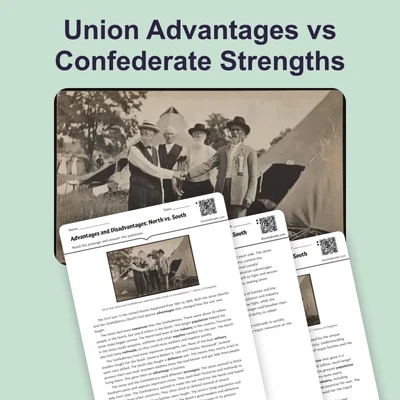
Advantages and Disadvantages: North vs. South
This history reading passage examines the contrasting strengths of the Union and Confederacy during the U.S. Civil War. ...
HSS 8.10.5RI.6-8.1RI.6-8.3
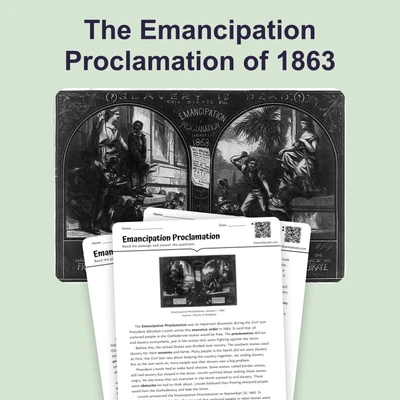
Emancipation Proclamation
This U.S. history passage explores the Emancipation Proclamation of 1863, an executive order issued by President Abraham...
HSS 8.10.6RI.6-8.1RI.6-8.3
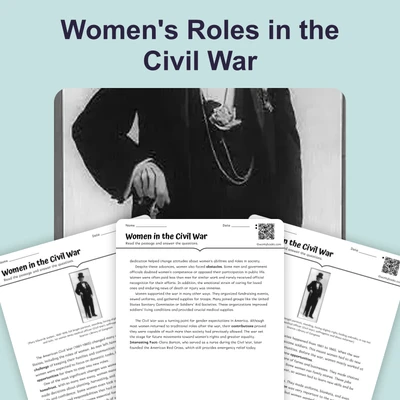
Women's Roles in Civil War
This reading passage explores the critical roles women played during the U.S. Civil War, highlighting how they managed f...
HSS 8.10.7RI.6-8.1RI.6-8.2
Surrender at Appomattox
This reading passage explores the historic surrender at Appomattox Court House in April 1865, which marked the conclusio...
HSS 8.10.7RI.6-8.1RI.6-8.6
Abraham Lincoln Assassination
This passage explores the significant event of President Abraham Lincoln's assassination in April 1865, just days after ...