Colonial Apprenticeship System — Reading Comprehension
Rate this
Premium Resource
Present
Present in classroom. No work saved
Assign
Classroom with student accounts, Track progress
Quick Play
No student accounts, assign with a link
Grades
6
7
8
Standards
HSS 5.4.6
RI.6-8.1
RI.6-8.2
PRINT+DIGITAL RESOURCE
This learning resource is available in interactive and printable formats. The interactive worksheet can be played online and assigned to students. The Printable PDF version can be downloaded and printed for completion by hand.
This comprehensive passage explores the Colonial Apprenticeship System and its role in education during Colonial America. Students will learn how boys and girls acquired skills for adulthood through hands-on training with masters and craftsmen, rather than formal schooling. The passage compares the apprenticeship model to modern education, addresses its complexities, and examines the roles of apprentices, trades, and domestic skills. Activities include a glossary, Spanish translation, differentiated reading level, multiple-choice quiz, writing prompts, graphic organizers, and a historical timeline. This resource is designed for U.S. History classrooms and aligns with HSS 5.4.6 and CCSS.RI.6-8.1, RI.6-8.2. It also features read aloud audio and supports English Language Learners with a Spanish version.
CONTENT PREVIEW
Expand content preview
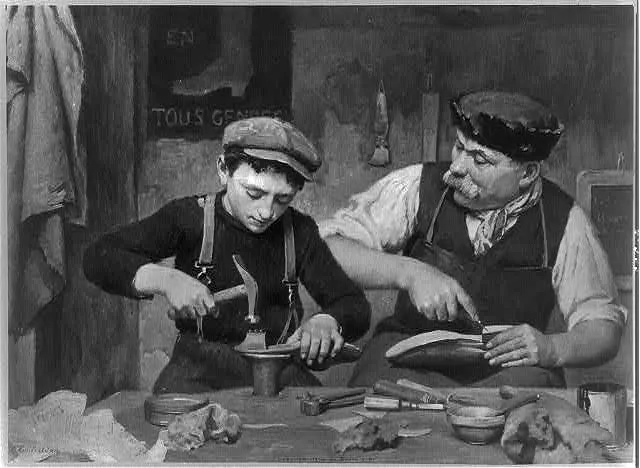
Apprentice Source: Library of Congress
In Colonial America, most children did not attend formal schools. Instead, families relied on the apprenticeship system and home-based education to prepare young people for adult roles. The apprenticeship system involved a young person, called an apprentice, learning a specific skill or trade from an experienced master. This process was essential for building the workforce and ensuring that communities had skilled workers such as blacksmiths, carpenters, or shoemakers.
Boys usually left home between ages 10 and 14 to become apprentices. They signed legal agreements, often called indentures, which described their duties and how long they would serve. An apprentice lived with the master, received food and shelter, and spent years learning by doing. In exchange for their labor, apprentices gained valuable knowledge and skills. Masters were responsible for teaching the craft and sometimes basic reading and writing, especially if these skills were needed for the trade.
Girls, on the other hand, rarely became formal apprentices. Instead, they learned domestic skills at home from their mothers or female relatives. These skills included cooking, sewing, spinning, and managing a household. Although this education was not formalized in legal contracts, it was equally important for the survival and well-being of colonial families. In rare cases, girls apprenticed in trades such as midwifery or millinery, but these opportunities were limited.
The apprenticeship system had advantages and disadvantages. One benefit was that it provided practical training and a clear path to employment. However, the quality of education varied greatly depending on the master. Some masters were excellent teachers, while others overworked or mistreated apprentices. Because the system focused on hands-on learning, it often neglected academic subjects such as literature, science, or advanced mathematics. As a result, few colonial children received broad academic education unless their families were wealthy enough to hire tutors or send them to rare grammar schools.
This approach to education was different from today’s system, which emphasizes formal schooling and a broad range of subjects. In colonial times, education was tightly linked to one’s future work. Children learned what they needed to survive and contribute to the community. This system helped maintain social order, pass down traditions, and meet the economic needs of colonial society. Yet, it also reinforced social divisions, as only a few could rise above their family's status or learn beyond their assigned roles.
Over time, the limitations of the apprenticeship system and a growing need for broader knowledge led to the development of public schools. Colonial leaders began to see the value in teaching reading, writing, and arithmetic to all children, not just those training for trades. This shift marked the beginning of the American commitment to universal education.
Interesting Fact: Some of America’s Founding Fathers, such as Benjamin Franklin, started their careers as apprentices before making significant contributions to science and government.
What is an apprentice?
A young person learning a tradeA master craftsmanA school teacherA colonial farmer
At what age did boys usually become apprentices?
Between 10 and 14After age 18At 5 years oldOver age 20
What did girls mainly learn at home?
Domestic skillsBlacksmithingSailingLaw
Why did the apprenticeship system develop?
To prepare youth for adult workTo avoid hard workTo start factoriesTo become wealthy
What was a disadvantage of the apprenticeship system?
Few academic subjects taughtToo much free timeNo work experienceNo masters available
How did the system affect social divisions?
Reinforced family statusMade everyone equalEnded tradesEncouraged travel
Public schools replaced apprenticeships immediately. True or false?
TrueFalse
What is a trade?
A job or craftA lawA schoolA letter
Perfect For:
👩🏫 Teachers
• Reading comprehension practice
• Auto-graded assessments
• Literacy skill development
👨👩👧👦 Parents
• Reading practice at home
• Comprehension improvement
• Educational reading time
🏠 Homeschoolers
• Reading curriculum support
• Independent reading practice
• Progress monitoring
Reading Features:
📖
Reading Passage
Engaging fiction or nonfiction text
❓
Comprehension Quiz
Auto-graded questions
📊
Instant Feedback
Immediate results and scoring
📄
Printable Version
Download for offline reading
🔊
Read Aloud
Voice-over with word highlighting
Reviews & Ratings
No reviews yet. Be the first to share your experience!
Related Content
Pocahontas: Myth vs. Historical Reality
This passage explores the nuanced history of Pocahontas, moving beyond the myth made popular by movies and stories. Stud...
HSS 5.3.1RI.6-8.1RI.6-8.8
Roger Williams Religious Freedom
This passage explores the life and legacy of Roger Williams, a key figure in Colonial America who was banished from Mass...
HSS 5.4.38.2.2RI.6-8.1RI.6-8.6
Benjamin Franklin in Colonial America
This U.S. History reading passage explores the life and influence of Benjamin Franklin, a key colonial leader whose idea...
HSS 5.58.1RI.6-8.1RI.6-8.3
Colonial Printing Press
This passage explores the revolutionary impact of the colonial printing press in America, examining how it enabled the s...
HSS 5.58.1RI.6-8.1RI.6-8.2
Cities in Colonial America
This engaging U.S. history reading passage explores the rise of colonial American cities such as Boston, Philadelphia, a...
HSS 5.4.68.1RI.6-8.1RI.6-8.7
Frontier Life in Colonial America
This passage examines the realities of frontier life in colonial America, highlighting both the promise and peril faced ...
HSS 5.4.68.1RI.6-8.1RI.6-8.2
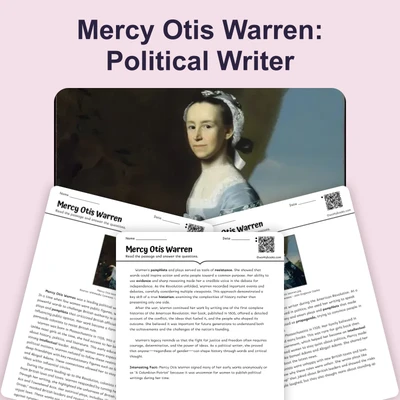
Mercy Otis Warren: Political Writer
This passage explores the life and impact of Mercy Otis Warren, a significant political writer during the American Revol...
HSS 5.6.38.1RI.6-8.1RI.6-8.6
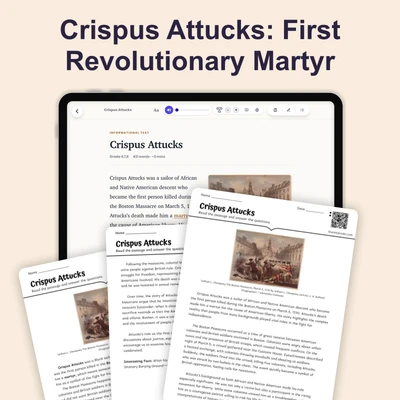
Crispus Attucks
This comprehensive U.S. History reading passage examines the life and legacy of Crispus Attucks, the first person killed...
HSS 5.5.38.1RI.6-8.1RI.6-8.3
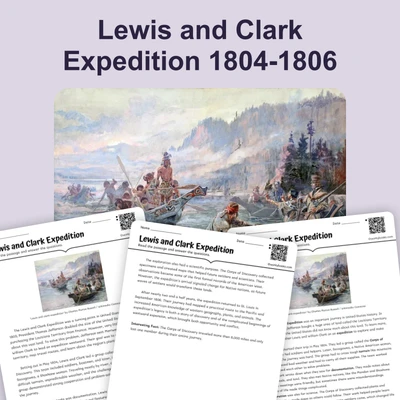
Lewis and Clark Expedition
This comprehensive U.S. History reading passage explores the Lewis and Clark Expedition (1804-1806), a pivotal journey l...
HSS 8.4.18.8.2RI.6-8.1RI.6-8.3
Exodusters
This passage explores the migration of Exodusters—African Americans who left the South in the 1870s to escape discrimina...
HSS 8.12.1RI.6-8.1RI.6-8.2
Uncle Tom's Cabin
This passage explores the impact of Harriet Beecher Stowe’s Uncle Tom’s Cabin on American society in the 1850s. It exami...
HSS 8.9.48.10.2RI.6-8.1RI.6-8.6
Dred Scott Decision
This rigorous history reading passage delves into the 1857 Dred Scott Decision, a pivotal moment in the lead-up to the C...
HSS 8.9.48.10.3RI.6-8.1RI.6-8.8
Election of 1860
This passage explores Abraham Lincoln’s election in 1860 and the critical reactions from Southern states, which set the ...
HSS 8.10.4RI.6-8.1RI.6-8.6
Southern Secession
This passage explores the significant moment in U.S. history when seven Southern states seceded from the Union after Abr...
HSS 8.10.4RI.6-8.1RI.6-8.2
Advantages and Disadvantages: North vs. South
This history reading passage examines the contrasting strengths of the Union and Confederacy during the U.S. Civil War. ...
HSS 8.10.5RI.6-8.1RI.6-8.3
Emancipation Proclamation
This U.S. history passage explores the Emancipation Proclamation of 1863, an executive order issued by President Abraham...
HSS 8.10.6RI.6-8.1RI.6-8.3
Women's Roles in Civil War
This reading passage explores the critical roles women played during the U.S. Civil War, highlighting how they managed f...
HSS 8.10.7RI.6-8.1RI.6-8.2
Surrender at Appomattox
This reading passage explores the historic surrender at Appomattox Court House in April 1865, which marked the conclusio...
HSS 8.10.7RI.6-8.1RI.6-8.6
Abraham Lincoln Assassination
This passage explores the significant event of President Abraham Lincoln's assassination in April 1865, just days after ...