This learning resource is available in interactive and printable formats. The interactive worksheet can be played online and assigned to students. The Printable PDF version can be downloaded and printed for completion by hand.
This passage explores Abraham Lincoln’s election in 1860 and the critical reactions from Southern states, which set the stage for the Civil War. Students will examine how Lincoln, representing the Republican Party, won the presidency without carrying a single Southern state and how this event heightened sectional tensions across the nation. The reading encourages analysis of historical causes and effects, the role of elections in democratic societies, and the ways political victories can spark major social change. Key vocabulary terms are highlighted and defined, supporting deeper understanding. This resource includes a Spanish translation, a differentiated version for diverse learners, comprehension activities, and graphic organizers. Aligned with HSS 8.10.4 and CCSS.RI.6-8.1/6-8.6, the passage is designed to support history instruction with engaging, standards-based content. Read aloud audio is available for accessibility.
CONTENT PREVIEW
Expand content preview
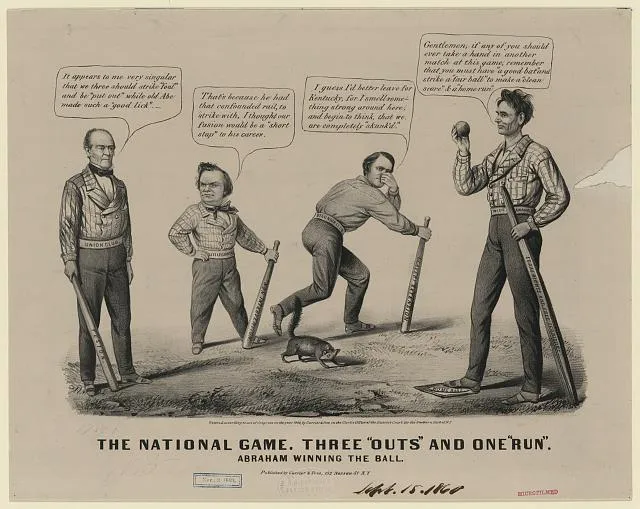
"The national game. Three "outs" and one "run"" by Currier & Ives. / Library of Congress.
The Election of 1860 was a turning point in United States history. Four major candidates ran for president, reflecting the nation’s growing divisions over slavery and state rights. Abraham Lincoln, representing the new Republican Party, believed that slavery should not expand into new western territories. His main opponents, Stephen Douglas, John C. Breckinridge, and John Bell, each represented different regions and ideas about slavery and the Union.
The United States in 1860 was deeply divided. Northern states had mostly abolished slavery and wanted to prevent its spread, while many Southern states depended on enslaved labor for their economy. This conflict created deep tensions among citizens and politicians. As the election approached, Southern leaders warned that if Lincoln won, their states would leave, or secede, from the Union. Some Northerners saw this as a threat to democracy, while many Southerners felt it was their only way to protect their way of life.
Abraham Lincoln won the presidency in November 1860 with less than 40% of the popular vote, but he received enough electoral votes to win. Lincoln’s victory was seen as a crisis by many in the South. In a letter written after the election, South Carolina’s leaders declared, “The guarantees of the Constitution will no longer protect us.” This primary source quote shows that Southern leaders believed Lincoln’s election threatened their rights and safety.
Following Lincoln’s victory, South Carolina became the first state to secede from the Union in December 1860. Within months, six more Southern states followed. These states formed the Confederate States of America. Their leaders argued that the federal government no longer represented their interests. However, not everyone in the South agreed with secession. Some Southern citizens worried about war and economic disaster. In contrast, most Northerners believed the Union must be preserved at all costs. These competing perspectives made compromise almost impossible.
The secession of Southern states created a new problem for the country. President Lincoln and many in the North believed secession was illegal. They argued that the Constitution formed a permanent union. Some Northerners wanted to find a compromise, but others demanded a strong response. Many Southerners felt that Lincoln’s government would attack their rights and property. These contradictions led to confusion and fear on both sides.
By April 1861, tensions exploded into violence at Fort Sumter, starting the Civil War. The Election of 1860 did not cause the war by itself, but it made clear that the nation’s disagreements over freedom, rights, and government could not be solved peacefully. The events show how political conflict and differing beliefs about democracy can challenge a country’s unity. Historians argue that the election revealed the limits of compromise and the consequences of deep national division.
Interesting Fact: Abraham Lincoln was not even on the ballot in most Southern states during the 1860 election, but he still won the presidency.
Who won the election of 1860?
Abraham LincolnStephen DouglasJohn BellJohn C. Breckinridge
Which state seceded first?
South CarolinaGeorgiaVirginiaTexas
When did the Civil War begin?
April 1861November 1860February 1861July 1863
Why did many Southerners want to secede?
To protect slaveryTo lower taxesTo gain landTo support Lincoln
What did Lincoln's election threaten for Southerners?
Their rights and safetyTheir religionTheir businesses onlyTheir voting rights only
What did most Northerners believe about the Union?
It must be preservedIt should break upIt needed new leadersIt should expand slavery
Lincoln was on all Southern ballots. True or false?
TrueFalse
What does 'secede' mean?
To withdraw from a groupTo join a groupTo vote for a leaderTo write new laws
Perfect For:
👩🏫 Teachers
• Reading comprehension practice
• Auto-graded assessments
• Literacy skill development
👨👩👧👦 Parents
• Reading practice at home
• Comprehension improvement
• Educational reading time
🏠 Homeschoolers
• Reading curriculum support
• Independent reading practice
• Progress monitoring
Reading Features:
📖
Reading Passage
Engaging fiction or nonfiction text
❓
Comprehension Quiz
Auto-graded questions
📊
Instant Feedback
Immediate results and scoring
📄
Printable Version
Download for offline reading
🔊
Read Aloud
Voice-over with word highlighting
Reviews & Ratings
No reviews yet. Be the first to share your experience!
Related Content
Pocahontas: Myth vs. Historical Reality
This passage explores the nuanced history of Pocahontas, moving beyond the myth made popular by movies and stories. Stud...
HSS 5.3.1RI.6-8.1RI.6-8.8
Roger Williams Religious Freedom
This passage explores the life and legacy of Roger Williams, a key figure in Colonial America who was banished from Mass...
HSS 5.4.38.2.2RI.6-8.1RI.6-8.6
Benjamin Franklin in Colonial America
This U.S. History reading passage explores the life and influence of Benjamin Franklin, a key colonial leader whose idea...
HSS 5.58.1RI.6-8.1RI.6-8.3
Colonial Apprenticeship System
This comprehensive passage explores the Colonial Apprenticeship System and its role in education during Colonial America...
HSS 5.4.6RI.6-8.1RI.6-8.2
Colonial Printing Press
This passage explores the revolutionary impact of the colonial printing press in America, examining how it enabled the s...
HSS 5.58.1RI.6-8.1RI.6-8.2
Cities in Colonial America
This engaging U.S. history reading passage explores the rise of colonial American cities such as Boston, Philadelphia, a...
HSS 5.4.68.1RI.6-8.1RI.6-8.7
Frontier Life in Colonial America
This passage examines the realities of frontier life in colonial America, highlighting both the promise and peril faced ...
HSS 5.4.68.1RI.6-8.1RI.6-8.2
Mercy Otis Warren: Political Writer
This passage explores the life and impact of Mercy Otis Warren, a significant political writer during the American Revol...
HSS 5.6.38.1RI.6-8.1RI.6-8.6
Crispus Attucks
This comprehensive U.S. History reading passage examines the life and legacy of Crispus Attucks, the first person killed...
HSS 5.5.38.1RI.6-8.1RI.6-8.3
Lewis and Clark Expedition
This comprehensive U.S. History reading passage explores the Lewis and Clark Expedition (1804-1806), a pivotal journey l...
HSS 8.4.18.8.2RI.6-8.1RI.6-8.3
Exodusters
This passage explores the migration of Exodusters—African Americans who left the South in the 1870s to escape discrimina...
HSS 8.12.1RI.6-8.1RI.6-8.2
Uncle Tom's Cabin
This passage explores the impact of Harriet Beecher Stowe’s Uncle Tom’s Cabin on American society in the 1850s. It exami...
HSS 8.9.48.10.2RI.6-8.1RI.6-8.6
Dred Scott Decision
This rigorous history reading passage delves into the 1857 Dred Scott Decision, a pivotal moment in the lead-up to the C...
HSS 8.9.48.10.3RI.6-8.1RI.6-8.8
Southern Secession
This passage explores the significant moment in U.S. history when seven Southern states seceded from the Union after Abr...
HSS 8.10.4RI.6-8.1RI.6-8.2
Advantages and Disadvantages: North vs. South
This history reading passage examines the contrasting strengths of the Union and Confederacy during the U.S. Civil War. ...
HSS 8.10.5RI.6-8.1RI.6-8.3
Emancipation Proclamation
This U.S. history passage explores the Emancipation Proclamation of 1863, an executive order issued by President Abraham...
HSS 8.10.6RI.6-8.1RI.6-8.3
Women's Roles in Civil War
This reading passage explores the critical roles women played during the U.S. Civil War, highlighting how they managed f...
HSS 8.10.7RI.6-8.1RI.6-8.2
Surrender at Appomattox
This reading passage explores the historic surrender at Appomattox Court House in April 1865, which marked the conclusio...
HSS 8.10.7RI.6-8.1RI.6-8.6
Abraham Lincoln Assassination
This passage explores the significant event of President Abraham Lincoln's assassination in April 1865, just days after ...