This learning resource is available in interactive and printable formats. The interactive worksheet can be played online and assigned to students. The Printable PDF version can be downloaded and printed for completion by hand.
This rigorous history reading passage delves into the 1857 Dred Scott Decision, a pivotal moment in the lead-up to the Civil War. Students will explore how the Supreme Court’s ruling that enslaved people were not citizens and could not sue in federal court intensified sectional tensions and influenced the national debate over slavery. The passage models historical reasoning by examining the legal arguments, the broader context, and the profound impact of the decision on the United States. Designed to align with HSS 8.9.4, 8.10.3, RI.6-8.1, and RI.6-8.8, the resource features a glossary, multiple-choice quiz, explanatory writing prompts, graphic organizers, timeline, and both standard and differentiated Spanish translations. The passage and activities are perfect for classroom use or independent study, enabling students to think critically about history and make connections to citizenship, rights, and justice. Includes read aloud audio and a variety of learning supports.
CONTENT PREVIEW
Expand content preview
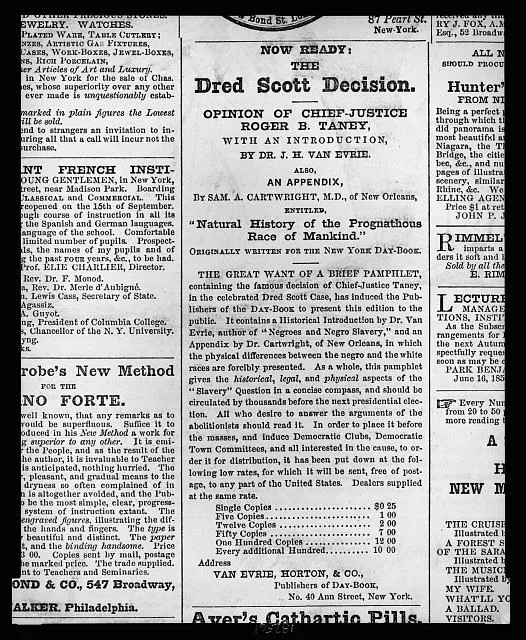
Now ready: the Dred Scott decision--Opinion of Chief-Justice Roger B. Taney ... Source: Library of Congress
In 1857, the United States Supreme Court made a decision that greatly affected the status of citizenship and the future of slavery in America. This case, known as the Dred Scott Decision, began when Dred Scott, an enslaved African American man, sued for his freedom. He argued that because he had lived in free states, he should be free. The case highlighted intense conflict and division in the United States over the issue of slavery.
The main problem involved whether enslaved people could become citizens and have legal rights. At the time, the country was deeply divided. Many Northerners, including abolitionists, believed slavery was morally wrong and wanted it abolished. Southern slaveholders, on the other hand, saw slavery as essential to their economy and way of life. This contrast fueled heated debates in Congress and the Supreme Court.
Dred Scott's case reached the Supreme Court after years of appeals. The Court had to decide if Scott, or any person of African descent, could be a U.S. citizen and, therefore, sue in federal court. In a 7-2 decision, Chief Justice Roger B. Taney wrote that, "[African Americans] had no rights which the white man was bound to respect." This shocking statement from the official Supreme Court opinion revealed the prejudice and legal doctrine of the time. Taney argued that, according to the framers of the Constitution, African Americans were not included as citizens and could not claim any rights or privileges.
The Court's reasoning went further. The justices ruled that Congress did not have the power to prohibit slavery in U.S. territories. This meant that the Missouri Compromise of 1820, which had tried to limit the spread of slavery, was declared unconstitutional. As a result, slaveholders could bring enslaved people anywhere in the territories, expanding the reach of slavery. This decision increased tensions between North and South and angered many Americans who opposed slavery.
Different groups responded in different ways. Abolitionists and many Northerners were outraged. They saw the decision as a threat to freedom and democracy. Frederick Douglass, a famous abolitionist, said the decision would "exalt slavery above freedom," but he also hoped it would encourage more resistance to slavery. Southern slaveholders felt validated and believed their way of life was protected by the highest court.
For enslaved people like Dred Scott, the decision was devastating. It denied their hope for legal recognition and freedom. Yet, the fierce public debate showed that the nation was not united on the issue of slavery. The Dred Scott Decision made it clear that the conflict over slavery and citizenship would not be settled peacefully. In fact, it pushed the country closer to the Civil War.
This case is a powerful example of how the Supreme Court can shape the rights of individuals and the direction of the nation. It also shows how laws and court decisions can reflect the values, prejudices, and struggles of a society. The Dred Scott Decision’s legacy is a reminder of the importance of equal rights and the ongoing fight for justice in American history.
Interesting Fact: Dred Scott and his wife Harriet were eventually freed by their owner a few months after the Supreme Court decision, but only after the case had already changed the nation forever.
Who was Dred Scott?
An enslaved man who sued for freedomA Supreme Court judgeA U.S. presidentA famous abolitionist
In what year did the Supreme Court rule?
1820185718651800
What law did the decision overturn?
Missouri CompromiseBill of RightsEmancipation ProclamationDeclaration of Independence
Why did Dred Scott sue for freedom?
He lived in free statesHe was a judgeHe owned a plantationHe wanted to move to Europe
How did abolitionists respond to the decision?
They were outraged and resistedThey agreed with the courtThey ignored the decisionThey moved to the South
What was the main effect of the ruling?
Expanded slavery into territoriesEnded all slaveryGranted citizenship to allCaused a new compromise
The Dred Scott Decision led to the Civil War. True or false?
TrueFalse
What does 'doctrine' mean in the passage?
An official principle or beliefA type of courtA secret meetingA new law
Perfect For:
👩🏫 Teachers
• Reading comprehension practice
• Auto-graded assessments
• Literacy skill development
👨👩👧👦 Parents
• Reading practice at home
• Comprehension improvement
• Educational reading time
🏠 Homeschoolers
• Reading curriculum support
• Independent reading practice
• Progress monitoring
Reading Features:
📖
Reading Passage
Engaging fiction or nonfiction text
❓
Comprehension Quiz
Auto-graded questions
📊
Instant Feedback
Immediate results and scoring
📄
Printable Version
Download for offline reading
🔊
Read Aloud
Voice-over with word highlighting
Reviews & Ratings
No reviews yet. Be the first to share your experience!
Related Content
Pocahontas: Myth vs. Historical Reality
This passage explores the nuanced history of Pocahontas, moving beyond the myth made popular by movies and stories. Stud...
HSS 5.3.1RI.6-8.1RI.6-8.8
Roger Williams Religious Freedom
This passage explores the life and legacy of Roger Williams, a key figure in Colonial America who was banished from Mass...
HSS 5.4.38.2.2RI.6-8.1RI.6-8.6
Benjamin Franklin in Colonial America
This U.S. History reading passage explores the life and influence of Benjamin Franklin, a key colonial leader whose idea...
HSS 5.58.1RI.6-8.1RI.6-8.3
Colonial Apprenticeship System
This comprehensive passage explores the Colonial Apprenticeship System and its role in education during Colonial America...
HSS 5.4.6RI.6-8.1RI.6-8.2
Colonial Printing Press
This passage explores the revolutionary impact of the colonial printing press in America, examining how it enabled the s...
HSS 5.58.1RI.6-8.1RI.6-8.2
Cities in Colonial America
This engaging U.S. history reading passage explores the rise of colonial American cities such as Boston, Philadelphia, a...
HSS 5.4.68.1RI.6-8.1RI.6-8.7
Frontier Life in Colonial America
This passage examines the realities of frontier life in colonial America, highlighting both the promise and peril faced ...
HSS 5.4.68.1RI.6-8.1RI.6-8.2
Mercy Otis Warren: Political Writer
This passage explores the life and impact of Mercy Otis Warren, a significant political writer during the American Revol...
HSS 5.6.38.1RI.6-8.1RI.6-8.6
Crispus Attucks
This comprehensive U.S. History reading passage examines the life and legacy of Crispus Attucks, the first person killed...
HSS 5.5.38.1RI.6-8.1RI.6-8.3
Lewis and Clark Expedition
This comprehensive U.S. History reading passage explores the Lewis and Clark Expedition (1804-1806), a pivotal journey l...
HSS 8.4.18.8.2RI.6-8.1RI.6-8.3
Exodusters
This passage explores the migration of Exodusters—African Americans who left the South in the 1870s to escape discrimina...
HSS 8.12.1RI.6-8.1RI.6-8.2
Uncle Tom's Cabin
This passage explores the impact of Harriet Beecher Stowe’s Uncle Tom’s Cabin on American society in the 1850s. It exami...
HSS 8.9.48.10.2RI.6-8.1RI.6-8.6
Election of 1860
This passage explores Abraham Lincoln’s election in 1860 and the critical reactions from Southern states, which set the ...
HSS 8.10.4RI.6-8.1RI.6-8.6
Southern Secession
This passage explores the significant moment in U.S. history when seven Southern states seceded from the Union after Abr...
HSS 8.10.4RI.6-8.1RI.6-8.2
Advantages and Disadvantages: North vs. South
This history reading passage examines the contrasting strengths of the Union and Confederacy during the U.S. Civil War. ...
HSS 8.10.5RI.6-8.1RI.6-8.3
Emancipation Proclamation
This U.S. history passage explores the Emancipation Proclamation of 1863, an executive order issued by President Abraham...
HSS 8.10.6RI.6-8.1RI.6-8.3
Women's Roles in Civil War
This reading passage explores the critical roles women played during the U.S. Civil War, highlighting how they managed f...
HSS 8.10.7RI.6-8.1RI.6-8.2
Surrender at Appomattox
This reading passage explores the historic surrender at Appomattox Court House in April 1865, which marked the conclusio...
HSS 8.10.7RI.6-8.1RI.6-8.6
Abraham Lincoln Assassination
This passage explores the significant event of President Abraham Lincoln's assassination in April 1865, just days after ...