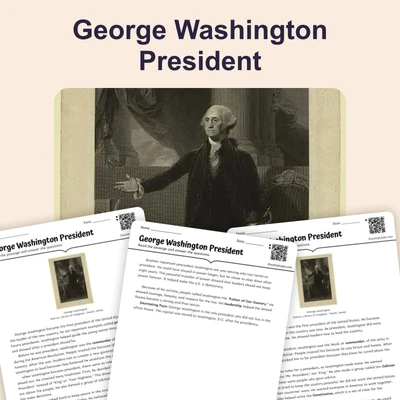
This learning resource is available in interactive and printable formats. The interactive worksheet can be played online and assigned to students. The Printable PDF version can be downloaded and printed for completion by hand.
This history reading passage examines the Bill of Rights, the first ten amendments to the U.S. Constitution, and their significance in protecting individual freedoms. Students will learn why these amendments were added in 1791, the concerns of Anti-Federalists, and how the Bill of Rights addresses key issues such as freedom of speech, religion, and fair trials. The passage encourages historical analysis, critical thinking, and understanding of constitutional principles. The resource includes read aloud audio, Spanish translation, and a differentiated version for accessibility. Aligned with HSS 8.2.6 and CCSS.RI.6-8.1, RI.6-8.3, it provides comprehension questions, writing prompts, and graphic organizers to support inquiry-based learning about American rights and government. Key vocabulary, a timeline, and a glossary help reinforce academic language and historical content.
CONTENT PREVIEW
Expand content preview
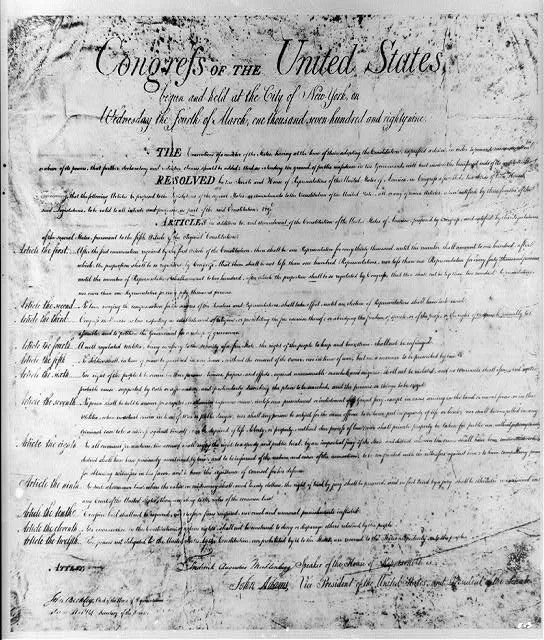
The Bill of Rights. Source: Library of Congress
The Bill of Rights refers to the first ten amendments added to the United States Constitution in 1791. These amendments were created to protect individual freedoms and limit the power of the federal government. After the Constitution was written in 1787, many Americans feared that the new government might become too powerful and threaten their liberties. This concern was especially strong among the Anti-Federalists, a group who believed that without clear protections, citizens' rights could be easily violated.
Supporters of the Constitution, called Federalists, argued that a bill of rights was unnecessary. They believed the Constitution already limited government power through a system called checks and balances. However, opponents wanted written guarantees. This difference caused serious debate. Both sides agreed that a compromise was needed to unite the new nation.
James Madison, one of the Constitution's main authors, played a key role in creating the Bill of Rights. He studied many state bills of rights and selected important protections for speech, religion, press, assembly, and the right to a fair trial. Madison presented these ideas to Congress in 1789. In a speech to Congress, he said, “The great object in view is to limit and qualify the powers of government, by excepting out of the grant of power those cases in which the government ought not to act.” This quote shows that the amendments were designed to set clear boundaries on government power.
From the start, the Bill of Rights reflected different perspectives. Some Americans, especially in large states, wanted strong government for unity and safety. Others, living in smaller states or with recent memories of British rule, were more worried about government abuse. The Bill of Rights tried to balance these fears by listing specific rights, such as freedom of speech, the right to bear arms, and protection from unreasonable searches. However, not all groups were equally protected. For example, enslaved people, Native Americans, and women did not receive the same rights, revealing a contradiction between America's ideals and its laws.
The Bill of Rights solved the problem of mistrust between government and people by promising protections for basic freedoms. Over time, the courts have used these amendments to expand rights for more Americans. However, debates about how to interpret them—like freedom of speech or gun rights—continue today. This shows that the Bill of Rights is both a product of its time and a living document, constantly re-examined as society changes.
Interesting Fact: The original Bill of Rights included twelve amendments, but only ten were ratified at first. One of the rejected amendments, about congressional pay, was finally adopted over 200 years later as the 27th Amendment.
Who played a key role in creating the Bill of Rights?
James MadisonGeorge WashingtonThomas JeffersonAlexander Hamilton
When were the first ten amendments ratified?
1791178718001789
What does the Bill of Rights protect?
Individual freedomsState bordersThe British kingTrade laws
Why did Anti-Federalists want a bill of rights?
To protect libertiesTo increase taxesTo help the BritishTo support war
What is a contradiction mentioned in the passage?
Not all groups were protectedToo many amendmentsNo debates occurredEveryone agreed
How did the Bill of Rights solve mistrust?
By guaranteeing basic rightsBy giving Congress more powerBy removing amendmentsBy banning elections
The Bill of Rights had 12 original amendments. True or false?
TrueFalse
What does 'ratified' mean?
Formally approvedWritten in pencilArgued aboutVoted against
Perfect For:
👩🏫 Teachers
• Reading comprehension practice
• Auto-graded assessments
• Literacy skill development
👨👩👧👦 Parents
• Reading practice at home
• Comprehension improvement
• Educational reading time
🏠 Homeschoolers
• Reading curriculum support
• Independent reading practice
• Progress monitoring
Reading Features:
📖
Reading Passage
Engaging fiction or nonfiction text
❓
Comprehension Quiz
Auto-graded questions
📊
Instant Feedback
Immediate results and scoring
📄
Printable Version
Download for offline reading
🔊
Read Aloud
Voice-over with word highlighting
Reviews & Ratings
No reviews yet. Be the first to share your experience!
Related Content
Native American Tribes Across America
This engaging history reading passage introduces students to Native American tribes across America, focusing on their da...
D2.HIS.1.3-5D2.HIS.2.3-5RI.4.1RI.4.2
Teepees: Homes on the Great Plains
This engaging history reading passage introduces students to teepees, the unique homes of Native American tribes on the ...
D2.HIS.2.3-5D2.HIS.14.3-5RI.4.1RI.4.2RI.4.4
Traditional Native American Clothing
This engaging history passage explores traditional Native American clothing and how it reflected the environment, values...
D2.HIS.2.3-5D2.HIS.3.3-5RI.4.3RI.4.4
The Iroquois Confederacy: A System of Peace
This engaging U.S. History reading passage introduces students to the Iroquois Confederacy, a powerful alliance of Nativ...
D2.HIS.2.3-5D2.HIS.3.3-5RI.4.3RI.4.4
The Cherokee Nation: History and Culture
This reading passage explores the rich history and culture of the Cherokee Nation, one of the largest Native American tr...
D2.HIS.2.3-5D2.HIS.14.3-5RI.4.3RI.4.4RI.4.10
The Sioux: Warriors and Tribal Leaders
This history reading passage explores the Sioux Nation, focusing on their roles as warriors and tribal leaders. Students...
D2.HIS.1.3-5D2.HIS.2.3-5RI.4.1RI.4.3
Native American Respect for Nature
This engaging history reading passage explores Native American respect for nature, emphasizing the close relationship be...
D2.HIS.2.3-5D2.HIS.3.3-5RI.4.3RI.4.4
Jamestown: The First Permanent English Colony
This engaging history passage explores the founding of Jamestown, the first permanent English colony in America. Aligned...
D2.HIS.1.3-5D2.HIS.2.3-5RI.4.3RI.4.4
Pocahontas and the Powhatan People
This engaging reading passage explores the life of Pocahontas and the Powhatan people and their important role in early ...
D2.HIS.1.3-5D2.HIS.2.3-5RI.4.1RI.4.3
Colonial Children: School and Chores
This reading passage explores the daily lives of colonial children, focusing on their experiences at school and their ma...
D2.HIS.2.3-5D2.HIS.3.3-5RI.4.1RI.4.2RI.4.4
Colonial Clothing and Homemade Goods
This engaging U.S. history passage explores the daily life of early American colonists with a focus on colonial clothing...
D2.HIS.2.3-5RI.4.3RI.4.4
Colonial Jobs: Blacksmiths, Bakers, and Craftsmen
This engaging history reading passage explores the vital roles of blacksmiths, bakers, and craftsmen in colonial America...
D2.HIS.2.3-5D2.HIS.3.3-5RI.4.3RI.4.4
Colonial Towns and Village Life
This engaging history reading passage explores the daily life, work, and unity found in colonial towns and villages. Ali...
D2.HIS.1.3-5D2.HIS.2.3-5RI.4.3RI.4.4
Colonial Trade with England and Africa
This history reading passage explores colonial trade between the American colonies, England, and Africa, focusing on the...
D2.HIS.2.3-5D2.HIS.14.3-5RI.4.3RI.4.4
Benjamin Franklin: Printer, Inventor, and Leader
This history reading passage explores the life and achievements of Benjamin Franklin, one of America's most important ea...
D2.HIS.2.3-5D2.HIS.3.3-5RI.4.1RI.4.3
George Washington Leads the Army
This engaging history reading passage explores how George Washington bravely led the Continental Army during the America...
D2.HIS.1.3-5D2.HIS.2.3-5RI.4.3RI.4.4
Women and Children During the Revolutionary War
This reading passage explores the important roles women and children played during the Revolutionary War. Students will ...
D2.HIS.2.3-5RI.4.3RI.5.3
African Americans Fight for Freedom
This educational passage explores the brave and inspiring story of how African Americans fought for freedom in the Unite...
D2.HIS.2.3-5D2.HIS.3.3-5RI.4.3RI.4.4
The Battle of Yorktown Ends War
This engaging U.S. history reading passage explores the Battle of Yorktown, a key event that ended the American Revoluti...
D2.HIS.1.3-5D2.HIS.2.3-5RI.4.1RI.4.3
Loyalists vs. Patriots: Divided Families
This engaging U.S. history reading passage explores the division between Loyalists and Patriots during the American Revo...