Biodiversity and Its Importance — Reading Comprehension
Rate this
Premium Resource
Present
Present in classroom. No work saved
Assign
Classroom with student accounts, Track progress
Quick Play
No student accounts, assign with a link
Grades
5
6
7
8
Standards
MS-LS4-4
MS-LS2-5
PRINT+DIGITAL RESOURCE
This learning resource is available in interactive and printable formats. The interactive worksheet can be played online and assigned to students. The Printable PDF version can be downloaded and printed for completion by hand.
This comprehensive middle school science passage explores the concept of biodiversity at the genetic, species, and ecosystem levels, emphasizing its crucial role in maintaining ecosystem stability, supporting food security, providing medicine, and offering economic, cultural, and aesthetic value. Aligned with NGSS standards MS-LS4-4 and MS-LS2-5, the passage guides students through examples of biodiversity hotspots, explains major threats like habitat destruction and climate change, and highlights both global and personal conservation strategies. Designed at a Lexile 750-850 level (with a simplified version provided), the passage includes a glossary, Spanish translation, multiple-choice and writing activities, and graphic organizers. This resource is ideal for science classrooms, supports ELLs, and is audio integrated for accessibility.
CONTENT PREVIEW
Expand content preview
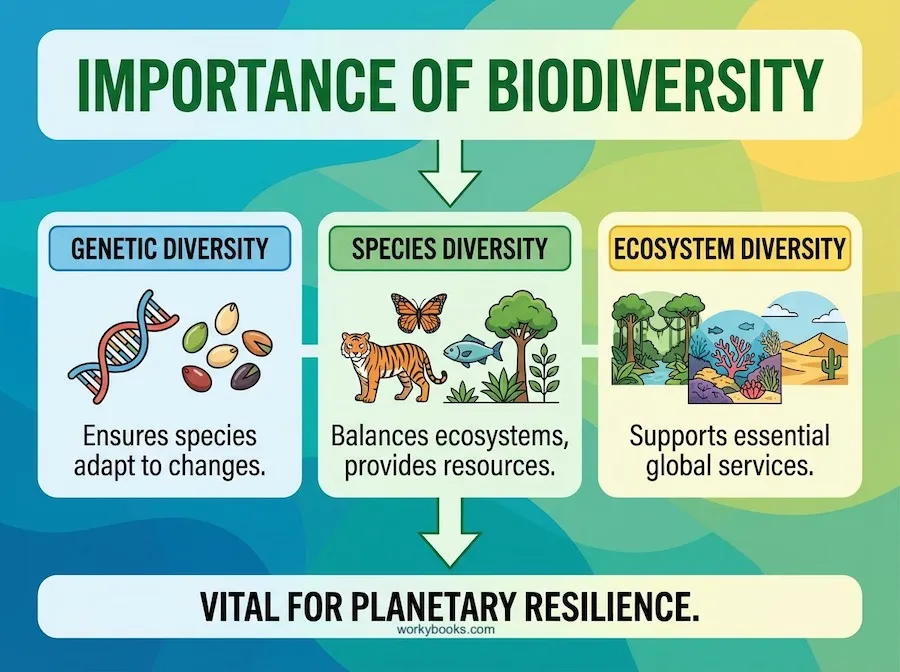
Biodiversity describes the variety of life found on Earth. Scientists study biodiversity to understand how ecosystems remain balanced and how living things interact. When an ecosystem has high biodiversity, it can recover more quickly from changes, such as storms or disease outbreaks. Biodiversity operates at three main levels: genetic diversity, species diversity, and ecosystem diversity. Each level plays a unique role in the health and stability of the planet.
Three Levels of Biodiversity Genetic diversity refers to the differences in DNA among individuals within a species. This diversity allows populations to adapt to changes, like new diseases or temperature shifts. Species diversity is the number and variety of species in a region or ecosystem. For example, a tropical rainforest may contain over 400 tree species in a single hectare. Ecosystem diversity means the variety of habitats, such as forests, wetlands, and coral reefs. Each ecosystem supports different communities of organisms and provides essential services like clean water and air.
Why Biodiversity Matters Biodiversity is vital for ecosystem stability. Diverse ecosystems are more resilient and able to maintain balance even when faced with pressures like drought or invasive species. Biodiversity also supports food security, since many different crops and animals contribute to our diets. Over 50% of modern medicines are derived from plants, animals, or microorganisms, making biodiversity a source for new treatments. Economically, biodiversity boosts industries like tourism and fisheries. Many cultures also value the beauty and inspiration found in nature, which is called aesthetic value.
Biodiversity Hotspots and Threats Some regions, called hotspots, have especially high biodiversity. Examples include tropical rainforests and coral reefs, which together hold more than half of all known species. However, biodiversity is under threat. Habitat destruction, often caused by deforestation or urban growth, removes homes for plants and animals. Climate change, pollution, invasive species, and overexploitation also reduce biodiversity. For instance, scientists estimate that species are going extinct at rates 100 to 1,000 times higher than natural background rates due to human activities.
Conservation and Our Role Conservation strategies help protect biodiversity. These include creating protected areas, restoring damaged habitats, and breeding endangered species in captivity. Governments, scientists, and local communities all work together to save biodiversity. Students can help by learning about local species, reducing waste, planting native plants, and supporting conservation organizations. Every action, big or small, contributes to maintaining the balance of life on Earth.
Interesting Fact: The Amazon rainforest, a biodiversity hotspot, is home to about 10% of all known species on Earth.
What are the three main levels of biodiversity described in the passage?
Genetic, species, and ecosystem diversityPlants, animals, and fungiForests, oceans, and desertsRainforests, coral reefs, and mountains
Why is genetic diversity important for a species?
It allows populations to adapt to changesIt makes plants grow fasterIt creates more oxygenIt causes habitat destruction
Which of the following is an example of a biodiversity hotspot?
Tropical rainforestDesertUrban cityTundra
According to the passage, what is one direct benefit of biodiversity to humans?
Medicine developmentAir pollutionFaster internetIncreased noise
What does the term 'ecosystem stability' mean as used in the passage?
The ability of an ecosystem to remain balanced and recover from disturbancesThe number of species in an ecosystemThe amount of rainfall in a regionHow quickly trees grow in a forest
What is the meaning of the word 'hotspots' as used in the passage?
Regions with especially high biodiversityPlaces with high temperaturesAreas with volcanic activityLocations with a lot of pollution
How does biodiversity support food security?
By providing many different crops and animals for our dietsBy making water cleanerBy increasing city sizeBy reducing the need for conservation
If habitat destruction continues, what could be a likely effect?
Loss of species and reduced biodiversityMore genetic diversityIncrease in ecosystem stabilityMore tourism
True or False: Biodiversity only matters to animals, not to humans.
FalseTrue
True or False: Students can help protect biodiversity by supporting conservation organizations.
TrueFalse
Perfect For:
👩🏫 Teachers
• Reading comprehension practice
• Auto-graded assessments
• Literacy skill development
👨👩👧👦 Parents
• Reading practice at home
• Comprehension improvement
• Educational reading time
🏠 Homeschoolers
• Reading curriculum support
• Independent reading practice
• Progress monitoring
Reading Features:
📖
Reading Passage
Engaging fiction or nonfiction text
❓
Comprehension Quiz
Auto-graded questions
📊
Instant Feedback
Immediate results and scoring
📄
Printable Version
Download for offline reading
🔊
Read Aloud
Voice-over with word highlighting
Reviews & Ratings
No reviews yet. Be the first to share your experience!
Related Content
How Rainforests Help the Planet
This NGSS-aligned reading passage for middle school students explains how rainforests help regulate Earth’s climate and ...
MS-ESS2-6MS-LS2-5
Understanding the Koppen Climate Classification System
This NGSS-aligned science reading passage explains the Köppen Climate Classification System, a scientific method used to...
MS-ESS2-6MS-LS2-5
Human Impacts: Invasive Species
This passage explores the science behind invasive species—non-native organisms that harm native ecosystems. Aligned to N...
MS-LS2-4MS-LS2-5
Human Impacts: Habitat Destruction
This grade 6-8 science passage explores human impacts on ecosystems, focusing on habitat destruction as the leading caus...
MS-LS2-4MS-LS2-5MS-ESS3-3
What Is Biodiversity?
This comprehensive science reading passage for grades 6-8 introduces students to biodiversity and explores its importanc...
MS-LS2-5MS-LS4-4
Biodiversity and Ecosystem Health
This comprehensive middle school science passage explores the relationship between biodiversity and ecosystem health, al...
MS-LS2-5
Ecosystem Services
This engaging middle school science passage introduces students to the concept of ecosystem services, the vital benefits...
MS-LS2-5MS-ESS3-3
Human Impacts: Overexploitation
This middle school science passage aligns with NGSS standards MS-LS2-4 and MS-LS2-5, focusing on human impacts through o...
MS-LS2-4MS-LS2-5
Conservation Strategies
This comprehensive passage introduces students in grades 6-8 to the major strategies used in conservation biology, such ...
MS-LS2-5MS-ESS3-4
Extinction: Past and Present
This comprehensive reading passage for grades 6-8 explores the concept of extinction, its causes, and its impact on life...
MS-LS4-1MS-LS2-5
Endangered Species and the Sixth Extinction
This engaging science reading passage for grades 6-8 explores the current biodiversity crisis, known as the 'Sixth Extin...
MS-LS4-1MS-LS2-5
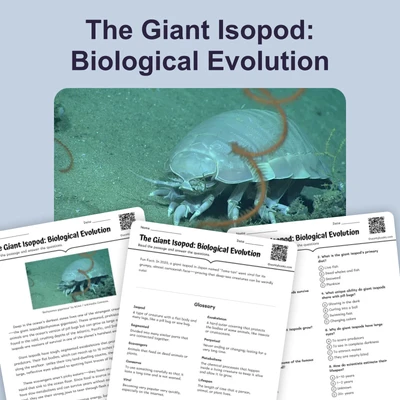
The Giant Isopod: Biological Evolution
This NGSS passage examines how giant isopods evolved for deep-sea survival, including slow metabolism for food scarcity,...
MS-LS4-4RI.6.3RI.7.3RI.8.8
Vertebrates: Fishes
This middle school science reading passage offers an in-depth look at fishes, a major group of vertebrates. It covers fi...
MS-LS4-2MS-LS4-4
Vertebrates: Amphibians
This comprehensive middle school science passage dives into the fascinating world of amphibians, a group of vertebrates ...
MS-LS4-2MS-LS4-4
Vertebrates: Reptiles
This comprehensive science passage for grades 6-8 introduces students to reptiles, a fascinating class of vertebrates. A...
MS-LS4-2MS-LS4-4
Vertebrates: Birds
This middle school science passage explores birds as vertebrates, focusing on their unique adaptations such as feathers,...
MS-LS4-2MS-LS4-4
Vertebrates: Mammals
This comprehensive passage introduces middle school students to the class Mammalia and their defining characteristics, i...
MS-LS4-2MS-LS4-4
Invertebrates: Arthropods
This comprehensive science passage introduces middle school students to the phylum Arthropoda, the largest and most dive...
MS-LS4-2MS-LS4-4
Galápagos Islands
This engaging science passage explores the Galápagos Islands, a volcanic archipelago located off the coast of Ecuador in...