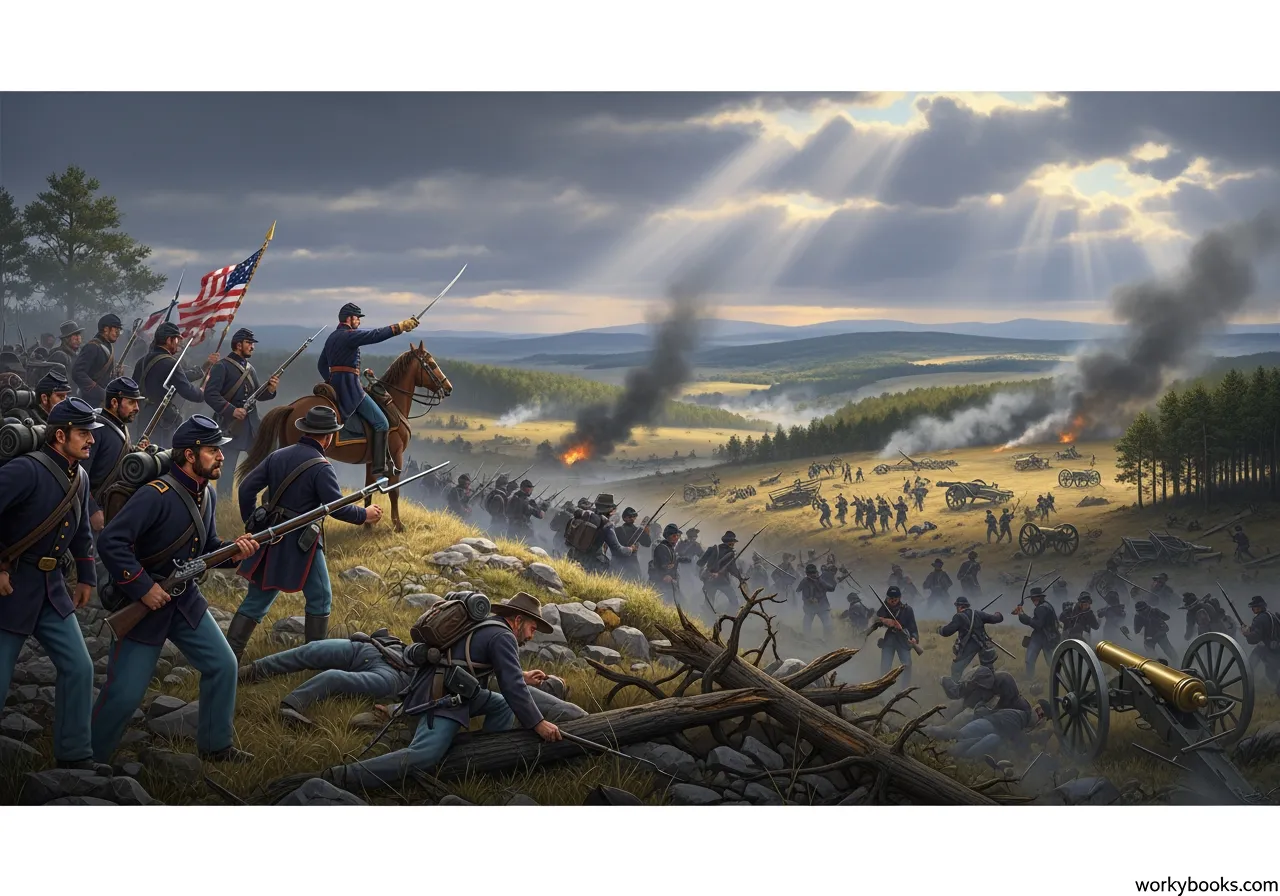
This reading passage explores the history of the Union and Confederate sides during the American Civil War, focusing on their differences, key leaders, and main events such as the Battle of Gettysburg and the surrender at Appomattox. Students will learn about the causes and effects of the war, the bravery of soldiers on both sides, and the importance of unity and problem-solving in American history. The passage features grade-appropriate vocabulary and includes a glossary, timeline, multiple-choice quiz, and writing activities. It is aligned with the C3 Framework and Common Core ELA standards, and is designed to build foundational literacy and historical understanding. Read aloud audio and a Spanish translation are included to make the content accessible to all learners.
Written by Workybooks TeamPublished by Workybooks
Preview
Sample passage and quiz content
CONTENT PREVIEW
Expand content preview
The American Civil War tore the nation apart from 1861 to 1865.
The Civil War was a major event in United States history. It began in 1861 when the country split into two sides: the Union in the North and the Confederacy in the South. The North wanted to keep the country together. The South wanted to form their own nation and keep slavery legal.
The North, called the Union, was made up of states that did not allow slavery. Abraham Lincoln was the President of the United States. He believed the country should stay united and that slavery should not spread. Many people in the North thought slavery was wrong. They wanted to preserve the Union and keep all the states together.
The South, called the Confederacy, included states that allowed slavery. These states decided to secede, or leave, the United States. They formed their own government and chose Jefferson Davis as their President. People in the South believed they had the right to make their own laws, including keeping slavery. They wanted independence from the United States and to protect their way of life.
Fighting began in April 1861 at Fort Sumter, South Carolina. The war lasted four long years. Many battles took place, such as Gettysburg and Antietam. Both sides showed great bravery and faced many hardships. Soldiers and families suffered, but each side believed they were fighting for the right cause.
In 1863, President Lincoln gave the Emancipation Proclamation. This order freed slaves in the Confederate states. It gave new hope to the Union and showed the war was also about ending slavery. The South kept fighting to protect their homes and beliefs, but they faced many problems, like fewer supplies and soldiers.
The war ended in 1865 when the Confederacy surrendered. The Union won, and the country was reunited. Slavery was ended in all states. The Civil War changed America forever. It showed the power of unity and the importance of freedom for all people.
Interesting Fact: Over 600,000 soldiers died in the Civil War, making it the deadliest war in American history.
What year did the Civil War start?
1861177618651800
Who was president of the Union?
Abraham LincolnUlysses GrantJefferson DavisGeorge Washington
Which battle was mentioned in the passage?
GettysburgYorktownBunker HillPearl Harbor
Why did the Confederacy secede?
To keep slaveryTo stop a warTo gain landFor gold
What did the Emancipation Proclamation do?
Freed slaves in the SouthEnded the warStarted the warBuilt new cities
What was the main goal of the Union?
Keep the country togetherFind goldStart a new governmentMake new laws
The Union won the Civil War. True or false?
TrueFalse
What does 'secede' mean?
To break awayTo voteTo fightTo build
Curriculum
Common Core standards covered
RI.4.3
Explain events, procedures, ideas, or concepts in a historical, scientific, or technical text, including what happened and why, based on specific information in the text.
RI.4.4
Determine the meaning of general academic and domain-specific words or phrases in a text relevant to a grade 4 topic or subject area.
Who it's for
Perfect for the way you teach
Teachers
Build comprehension skills
Auto-graded quiz
Differentiated reading
Parents
Read together at home
Improve fluency
Quiet reading time
Homeschoolers
Reading curriculum support
Independent practice
Track Lexile growth
Topics
Civil WarUnionConfederateU.S. historyAbraham LincolnGettysburgBlue and Grayhistory reading passage
Reviews & Ratings
No reviews yet. Be the first to share your experience!
More reading you might love
20 more
Native American Tribes Across America
This engaging history reading passage introduces students to Native American tribes across America, focusing on their da...
D2.HIS.1.3-5D2.HIS.2.3-5RI.4.1RI.4.2
Teepees: Homes on the Great Plains
This engaging history reading passage introduces students to teepees, the unique homes of Native American tribes on the ...
D2.HIS.2.3-5D2.HIS.14.3-5RI.4.1RI.4.2RI.4.4
Traditional Native American Clothing
This engaging history passage explores traditional Native American clothing and how it reflected the environment, values...
D2.HIS.2.3-5D2.HIS.3.3-5RI.4.3RI.4.4
The Iroquois Confederacy: A System of Peace
This engaging U.S. History reading passage introduces students to the Iroquois Confederacy, a powerful alliance of Nativ...
D2.HIS.2.3-5D2.HIS.3.3-5RI.4.3RI.4.4
The Cherokee Nation: History and Culture
This reading passage explores the rich history and culture of the Cherokee Nation, one of the largest Native American tr...
D2.HIS.2.3-5D2.HIS.14.3-5RI.4.3RI.4.4RI.4.10
The Sioux: Warriors and Tribal Leaders
This history reading passage explores the Sioux Nation, focusing on their roles as warriors and tribal leaders. Students...
D2.HIS.1.3-5D2.HIS.2.3-5RI.4.1RI.4.3
Native American Respect for Nature
This engaging history reading passage explores Native American respect for nature, emphasizing the close relationship be...
D2.HIS.2.3-5D2.HIS.3.3-5RI.4.3RI.4.4
Jamestown: The First Permanent English Colony
This engaging history passage explores the founding of Jamestown, the first permanent English colony in America. Aligned...
D2.HIS.1.3-5D2.HIS.2.3-5RI.4.3RI.4.4
Pocahontas and the Powhatan People
This engaging reading passage explores the life of Pocahontas and the Powhatan people and their important role in early ...
D2.HIS.1.3-5D2.HIS.2.3-5RI.4.1RI.4.3
Colonial Children: School and Chores
This reading passage explores the daily lives of colonial children, focusing on their experiences at school and their ma...
D2.HIS.2.3-5D2.HIS.3.3-5RI.4.1RI.4.2RI.4.4
Colonial Clothing and Homemade Goods
This engaging U.S. history passage explores the daily life of early American colonists with a focus on colonial clothing...
D2.HIS.2.3-5RI.4.3RI.4.4
Colonial Jobs: Blacksmiths, Bakers, and Craftsmen
This engaging history reading passage explores the vital roles of blacksmiths, bakers, and craftsmen in colonial America...
D2.HIS.2.3-5D2.HIS.3.3-5RI.4.3RI.4.4
Colonial Towns and Village Life
This engaging history reading passage explores the daily life, work, and unity found in colonial towns and villages. Ali...
D2.HIS.1.3-5D2.HIS.2.3-5RI.4.3RI.4.4
Colonial Trade with England and Africa
This history reading passage explores colonial trade between the American colonies, England, and Africa, focusing on the...
D2.HIS.2.3-5D2.HIS.14.3-5RI.4.3RI.4.4
Benjamin Franklin: Printer, Inventor, and Leader
This history reading passage explores the life and achievements of Benjamin Franklin, one of America's most important ea...
D2.HIS.2.3-5D2.HIS.3.3-5RI.4.1RI.4.3
George Washington Leads the Army
This engaging history reading passage explores how George Washington bravely led the Continental Army during the America...
D2.HIS.1.3-5D2.HIS.2.3-5RI.4.3RI.4.4
Women and Children During the Revolutionary War
This reading passage explores the important roles women and children played during the Revolutionary War. Students will ...
D2.HIS.2.3-5RI.4.3RI.5.3
The Battle of Yorktown Ends War
This engaging U.S. history reading passage explores the Battle of Yorktown, a key event that ended the American Revoluti...
D2.HIS.1.3-5D2.HIS.2.3-5RI.4.1RI.4.3
Loyalists vs. Patriots: Divided Families
This engaging U.S. history reading passage explores the division between Loyalists and Patriots during the American Revo...
D2.HIS.1.3-5D2.HIS.2.3-5RI.4.3RI.4.4
George Washington: Our First President
This engaging U.S. history reading passage introduces students to George Washington, America’s first president, through ...