This learning resource is available in interactive and printable formats. The interactive worksheet can be played online and assigned to students. The Printable PDF version can be downloaded and printed for completion by hand.
This history reading passage explores the Bonus Army protest of 1932, when thousands of World War I veterans marched on Washington, D.C., demanding early payment of promised bonuses during the Great Depression. Students will analyze the causes, motivations, and consequences of the event, comparing perspectives of veterans, government leaders, and the public. The passage integrates a primary source quote and models historical reasoning with an analytical, evidence-based approach. Activities include a multiple-choice quiz, writing prompts, graphic organizers, and a timeline to deepen understanding. The passage aligns with D2.His.2.3-5, D2.His.3.3-5, RI.4.3, and RI.4.4. Read aloud audio and a Spanish translation are included to support all learners. This text challenges students to think critically about protest movements, government responses, and the complexities of American democracy during times of crisis.
CONTENT PREVIEW
Expand content preview
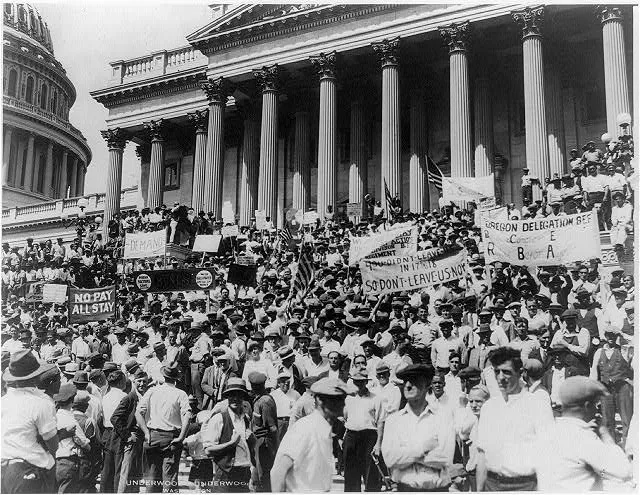
"Bonus Army stages huge demonstration at empty Capitol" by Underwood & Underwood. / Library of Congress.
The Bonus Army March of 1932 was a significant event in United States history during the Great Depression. In the early 1930s, many Americans faced extreme poverty and unemployment. Among them were thousands of veterans of World War I, who had served their country with honor. Congress had promised these veterans a cash bonus for their service, but payment was scheduled for 1945. As economic conditions worsened, many veterans could not wait that long and demanded early payment.
In the spring and summer of 1932, approximately 20,000 veterans and their families traveled to Washington, D.C. They came from across the nation, often riding freight trains or walking. The veterans set up camps and shantytowns near the Capitol, hoping to persuade Congress to grant immediate payment. This demonstration was peaceful, organized, and focused on their cause. The veterans called themselves the "Bonus Expeditionary Force," but the press nicknamed them the "Bonus Army." Their presence attracted national attention and put pressure on the government.
Congress debated the veterans’ demands, but the bill to pay the bonus early was defeated in the Senate. Disappointed, some veterans left, but thousands remained in Washington. The protest became a symbol of the struggle faced by many Americans during the Depression. President Herbert Hoover and other officials worried that the camps might become a threat to public order. Tensions rose as the summer heat intensified and resources grew scarce.
On July 28, 1932, the government decided to remove the remaining veterans. Washington police tried to clear the camps, but clashes broke out. President Hoover then ordered the U.S. Army, led by General Douglas MacArthur, to disperse the protesters. Soldiers used tear gas, tanks, and burned the veterans’ camps. The military action shocked many Americans. Photos and news reports showed veterans and their families fleeing the destruction.
The violent removal of the Bonus Army damaged President Hoover’s public image. Many citizens sympathized with the veterans and criticized the government’s harsh response. The incident became a powerful example of how the government responded to public protest and economic crisis. It influenced public opinion and likely contributed to Hoover’s defeat in the 1932 presidential election. The Bonus Army March remains an important moment for understanding the relationship between citizens, the government, and the right to protest.
Interesting Fact: Some Bonus Army veterans later received their bonus payments early, after Congress overrode President Roosevelt’s veto in 1936.
When did the Bonus Army March happen?
1932192919451918
Who led the Army to remove the protesters?
General MacArthurPresident RooseveltGeneral EisenhowerSenator Long
What did the veterans want?
Early bonus paymentFree housingJobs in factoriesFood supplies
Why did the Bonus Army protest?
Unemployment and povertySupport for World War IIDislike of the CapitolDisagree with new laws
How did President Hoover’s reputation change?
It was damagedIt improvedIt stayed the sameHe became more popular
What was the effect of the Army’s actions?
Public shock and criticismImmediate bonus paidVeterans got jobsCongress praised Hoover
The Bonus Army protest was peaceful at first.
TrueFalse
What does 'veterans' mean?
People who served in the militaryProtest leadersGovernment workersNewspaper reporters
Perfect For:
👩🏫 Teachers
• Reading comprehension practice
• Auto-graded assessments
• Literacy skill development
👨👩👧👦 Parents
• Reading practice at home
• Comprehension improvement
• Educational reading time
🏠 Homeschoolers
• Reading curriculum support
• Independent reading practice
• Progress monitoring
Reading Features:
📖
Reading Passage
Engaging fiction or nonfiction text
❓
Comprehension Quiz
Auto-graded questions
📊
Instant Feedback
Immediate results and scoring
📄
Printable Version
Download for offline reading
🔊
Read Aloud
Voice-over with word highlighting
Reviews & Ratings
No reviews yet. Be the first to share your experience!
Related Content
Native American Tribes Across America
This engaging history reading passage introduces students to Native American tribes across America, focusing on their da...
D2.HIS.1.3-5D2.HIS.2.3-5RI.4.1RI.4.2
Teepees: Homes on the Great Plains
This engaging history reading passage introduces students to teepees, the unique homes of Native American tribes on the ...
D2.HIS.2.3-5D2.HIS.14.3-5RI.4.1RI.4.2RI.4.4
Traditional Native American Clothing
This engaging history passage explores traditional Native American clothing and how it reflected the environment, values...
D2.HIS.2.3-5D2.HIS.3.3-5RI.4.3RI.4.4
The Iroquois Confederacy: A System of Peace
This engaging U.S. History reading passage introduces students to the Iroquois Confederacy, a powerful alliance of Nativ...
D2.HIS.2.3-5D2.HIS.3.3-5RI.4.3RI.4.4
The Cherokee Nation: History and Culture
This reading passage explores the rich history and culture of the Cherokee Nation, one of the largest Native American tr...
D2.HIS.2.3-5D2.HIS.14.3-5RI.4.3RI.4.4RI.4.10
The Sioux: Warriors and Tribal Leaders
This history reading passage explores the Sioux Nation, focusing on their roles as warriors and tribal leaders. Students...
D2.HIS.1.3-5D2.HIS.2.3-5RI.4.1RI.4.3
Native American Respect for Nature
This engaging history reading passage explores Native American respect for nature, emphasizing the close relationship be...
D2.HIS.2.3-5D2.HIS.3.3-5RI.4.3RI.4.4
Jamestown: The First Permanent English Colony
This engaging history passage explores the founding of Jamestown, the first permanent English colony in America. Aligned...
D2.HIS.1.3-5D2.HIS.2.3-5RI.4.3RI.4.4
Pocahontas and the Powhatan People
This engaging reading passage explores the life of Pocahontas and the Powhatan people and their important role in early ...
D2.HIS.1.3-5D2.HIS.2.3-5RI.4.1RI.4.3
Colonial Children: School and Chores
This reading passage explores the daily lives of colonial children, focusing on their experiences at school and their ma...
D2.HIS.2.3-5D2.HIS.3.3-5RI.4.1RI.4.2RI.4.4
Colonial Clothing and Homemade Goods
This engaging U.S. history passage explores the daily life of early American colonists with a focus on colonial clothing...
D2.HIS.2.3-5RI.4.3RI.4.4
Colonial Jobs: Blacksmiths, Bakers, and Craftsmen
This engaging history reading passage explores the vital roles of blacksmiths, bakers, and craftsmen in colonial America...
D2.HIS.2.3-5D2.HIS.3.3-5RI.4.3RI.4.4
Colonial Towns and Village Life
This engaging history reading passage explores the daily life, work, and unity found in colonial towns and villages. Ali...
D2.HIS.1.3-5D2.HIS.2.3-5RI.4.3RI.4.4
Colonial Trade with England and Africa
This history reading passage explores colonial trade between the American colonies, England, and Africa, focusing on the...
D2.HIS.2.3-5D2.HIS.14.3-5RI.4.3RI.4.4
Benjamin Franklin: Printer, Inventor, and Leader
This history reading passage explores the life and achievements of Benjamin Franklin, one of America's most important ea...
D2.HIS.2.3-5D2.HIS.3.3-5RI.4.1RI.4.3
George Washington Leads the Army
This engaging history reading passage explores how George Washington bravely led the Continental Army during the America...
D2.HIS.1.3-5D2.HIS.2.3-5RI.4.3RI.4.4
Women and Children During the Revolutionary War
This reading passage explores the important roles women and children played during the Revolutionary War. Students will ...
D2.HIS.2.3-5RI.4.3RI.5.3
African Americans Fight for Freedom
This educational passage explores the brave and inspiring story of how African Americans fought for freedom in the Unite...
D2.HIS.2.3-5D2.HIS.3.3-5RI.4.3RI.4.4
The Battle of Yorktown Ends War
This engaging U.S. history reading passage explores the Battle of Yorktown, a key event that ended the American Revoluti...
D2.HIS.1.3-5D2.HIS.2.3-5RI.4.1RI.4.3
Loyalists vs. Patriots: Divided Families
This engaging U.S. history reading passage explores the division between Loyalists and Patriots during the American Revo...