Burning of Washington DC 1814
Interactive passage with audio narration, comprehension questions, and printable PDF.
By completing this purchase you agree to our Terms of Use and Privacy Policy. Your subscription renews automatically until you cancel. You can cancel anytime from your account settings. All sales are final and non-refundable. Digital content is available for download in your account immediately upon purchase.
What's included
Burning of Washington DC 1814 preview and details
About this printable Burning of Washington DC 1814 reading passage (Grades 6-8)
Sample passage and quiz from Burning of Washington DC 1814
Reading passage and comprehension quiz preview
Burning of Washington DC 1814
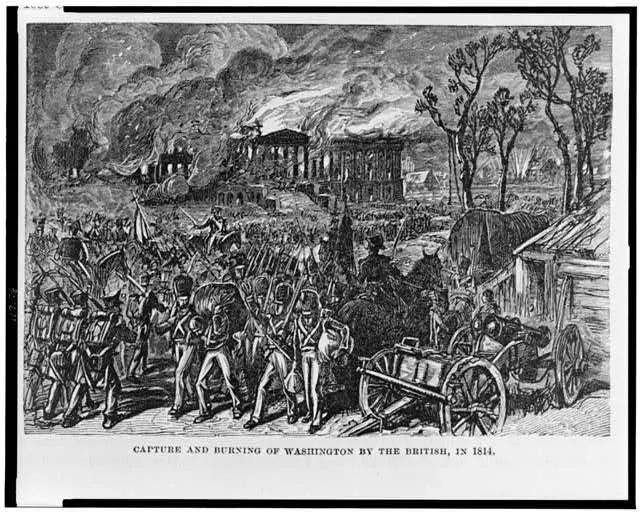
Source: Library of Congress
In August 1814, during the War of 1812, British forces invaded Washington, DC, and set fire to many important buildings, including the White House and the Capitol. This event became known as the Burning of Washington. The attack shocked Americans and became a turning point in the war.
The British invasion was a response to earlier American actions. American troops had attacked and burned the city of York (now Toronto) in Canada, which was then under British control. In retaliation, British leaders decided to strike the American capital, aiming to weaken morale and demonstrate British military power. The British army, led by Major General Robert Ross, landed near the Chesapeake Bay and marched toward Washington, DC.
On August 24, 1814, British troops easily defeated American defenders at the Battle of Bladensburg. This defeat allowed the British to enter the nearly unprotected city. As they moved through Washington, they set fire to government buildings, including the White House, the Capitol, and other public offices. The destruction was extensive; flames lit up the night sky, and smoke could be seen for miles. Many important documents and works of art were lost to the fire.
The destruction caused by the British was intended to punish Americans and force them to negotiate peace. However, the attack had the opposite effect. Instead of surrendering, Americans responded with greater determination to defend their country. The event united citizens and inspired a new sense of national pride. First Lady Dolley Madison became a symbol of courage when she saved a portrait of George Washington from the burning White House.
After the fires, a sudden and powerful storm, possibly a tornado, struck Washington. The storm helped extinguish the flames and drove the British out of the city. While the physical destruction was significant, the spirit of the nation was not broken. Within a few years, the government rebuilt the White House and Capitol, and the war soon ended with the Treaty of Ghent.
The Burning of Washington showed the vulnerability of the young United States but also its resilience. The event taught Americans lessons about defense, unity, and the importance of their institutions. It remains a reminder of the challenges faced by the new nation and the determination to overcome them.
Interesting Fact: The famous Star-Spangled Banner was written just weeks later, inspired by another British attack on Fort McHenry in Baltimore.
Comprehension quiz (8 questions)
1. What year did the Burning of Washington happen?
2. Which buildings were burned by the British?
3. Who saved the portrait of George Washington?
4. Why did the British attack Washington, DC?
5. How did Americans react to the attack?
6. What natural event helped put out the fires?
7. The White House was destroyed in 1814.
8. What does 'determination' mean?
Common Core standards for Burning of Washington DC 1814
Explain events, procedures, ideas, or concepts in a historical, scientific, or technical text, including what happened and why, based on specific information in the text.
Determine the meaning of general academic and domain-specific words or phrases in a text relevant to a grade 4 topic or subject area.
Write informative/explanatory texts to examine a topic and convey ideas and information clearly.
Perfect for the way you teach
- Build comprehension skills
- Auto-graded quiz
- Differentiated reading
- Read together at home
- Improve fluency
- Quiet reading time
- Reading curriculum support
- Independent practice
- Track Lexile growth