Business Integration Strategies — Reading Comprehension
Rate this
Premium Resource
Present
Present in classroom. No work saved
Assign
Classroom with student accounts, Track progress
Quick Play
No student accounts, assign with a link
Grades
6
7
8
Standards
D2.HIS.2.3-5
D2.HIS.3.3-5
RI.4.3
RI.4.4
W.4.2
PRINT+DIGITAL RESOURCE
This learning resource is available in interactive and printable formats. The interactive worksheet can be played online and assigned to students. The Printable PDF version can be downloaded and printed for completion by hand.
This rigorous U.S. History reading passage explores the concepts of vertical and horizontal integration business strategies, pivotal during America’s industrialization. Students will analyze how business leaders like John D. Rockefeller and Andrew Carnegie used these strategies to build powerful companies, as well as the consequences for workers, consumers, and American society. The passage uses compare/contrast structure, integrates a primary source quote, and highlights multiple perspectives to help students think critically. Included are glossary terms, a timeline of major events, multiple-choice and writing activities, a graphic organizer, and a Spanish translation. This passage aligns with C3 Framework D2.His.2.3-5, D2.His.3.3-5, and Common Core RI.4.3, RI.4.4, W.4.2 standards. Audio support and visual resources make this an engaging and accessible resource for all learners.
CONTENT PREVIEW
Expand content preview
During the Progressive Era of U.S. history, large companies used business integration strategies to expand their power and reduce competition. These strategies helped transform the American economy by allowing companies to control large portions of their industries. The two main types were horizontal integration and vertical integration, each with different methods and impacts.
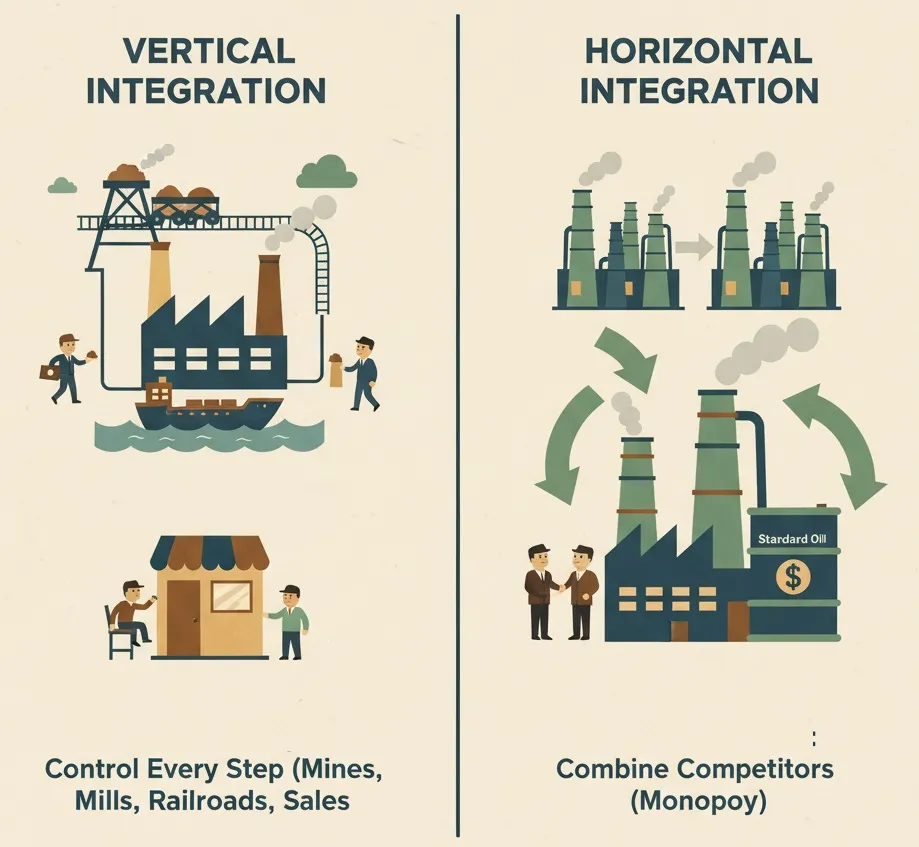
Horizontal integration occurs when a company acquires or merges with other companies that produce similar products or services. Through this process, the company eliminates competitors and increases its market share. For example, John D. Rockefeller’s Standard Oil Company used horizontal integration by buying out other oil refineries. As a result, Standard Oil came to dominate the oil industry, setting prices and influencing market conditions. However, this concentration of business power led to concerns about monopolies, where a single company controls almost all of a market.
In contrast, vertical integration describes a company’s control over every step of the production process, from raw materials to finished products. Andrew Carnegie’s steel company is a classic example. Carnegie owned not only steel mills but also the mines that supplied iron ore, the railroads that transported resources, and the factories that shaped the steel. By controlling all stages, companies reduced costs, improved efficiency, and made it harder for other businesses to compete.
Both strategies aimed to increase profits and efficiency. However, their effects on competition and consumers were complex. Supporters argued that integration resulted in lower prices and better products due to economies of scale. Critics, however, worried about the loss of smaller businesses and the lack of fair competition. The government responded with new regulations, such as the Sherman Antitrust Act, to prevent monopolies and promote fair business practices.
Integration strategies often involved mergers and consolidations. A merger occurs when two companies join to form one larger company. Consolidation happens when several companies combine their resources and management under a single organization. These processes changed the structure of American industries, making some corporations extremely powerful and wealthy.
The rise of big business during the Progressive Era brought both opportunities and challenges. While integration created powerful corporations and new jobs, it also led to labor disputes, economic inequality, and debates about government regulation. Historians continue to debate whether these strategies benefited society overall or harmed it by reducing competition and consumer choice.
Interesting Fact: In 1911, the U.S. Supreme Court ordered the breakup of Standard Oil into 34 separate companies because it violated antitrust laws.
What is horizontal integration?
Buying similar companiesControlling all production stepsSetting government rulesCreating new technology
Who used vertical integration?
Henry FordAndrew CarnegieJohn D. RockefellerCornelius Vanderbilt
What law aimed to stop monopolies?
Sherman Antitrust ActHomestead ActCivil Rights ActInterstate Commerce Act
How did Standard Oil reduce competition?
Using horizontal integrationCreating new jobsLowering wagesInventing steel
Why did critics worry about integration?
It reduced competitionIt created new productsIt raised wagesIt helped small businesses
What is a merger?
Two companies joinOne company closesA price increaseA government law
The Supreme Court broke up Standard Oil.
TrueFalse
What is a monopoly?
One company controls a marketMany small businessesTwo companies tradeA government agency
Perfect For:
👩🏫 Teachers
• Reading comprehension practice
• Auto-graded assessments
• Literacy skill development
👨👩👧👦 Parents
• Reading practice at home
• Comprehension improvement
• Educational reading time
🏠 Homeschoolers
• Reading curriculum support
• Independent reading practice
• Progress monitoring
Reading Features:
📖
Reading Passage
Engaging fiction or nonfiction text
❓
Comprehension Quiz
Auto-graded questions
📊
Instant Feedback
Immediate results and scoring
📄
Printable Version
Download for offline reading
🔊
Read Aloud
Voice-over with word highlighting
Reviews & Ratings
No reviews yet. Be the first to share your experience!
Related Content
Native American Tribes Across America
This engaging history reading passage introduces students to Native American tribes across America, focusing on their da...
D2.HIS.1.3-5D2.HIS.2.3-5RI.4.1RI.4.2
Teepees: Homes on the Great Plains
This engaging history reading passage introduces students to teepees, the unique homes of Native American tribes on the ...
D2.HIS.2.3-5D2.HIS.14.3-5RI.4.1RI.4.2RI.4.4
Traditional Native American Clothing
This engaging history passage explores traditional Native American clothing and how it reflected the environment, values...
D2.HIS.2.3-5D2.HIS.3.3-5RI.4.3RI.4.4
The Iroquois Confederacy: A System of Peace
This engaging U.S. History reading passage introduces students to the Iroquois Confederacy, a powerful alliance of Nativ...
D2.HIS.2.3-5D2.HIS.3.3-5RI.4.3RI.4.4
The Cherokee Nation: History and Culture
This reading passage explores the rich history and culture of the Cherokee Nation, one of the largest Native American tr...
D2.HIS.2.3-5D2.HIS.14.3-5RI.4.3RI.4.4RI.4.10
The Sioux: Warriors and Tribal Leaders
This history reading passage explores the Sioux Nation, focusing on their roles as warriors and tribal leaders. Students...
D2.HIS.1.3-5D2.HIS.2.3-5RI.4.1RI.4.3
Native American Respect for Nature
This engaging history reading passage explores Native American respect for nature, emphasizing the close relationship be...
D2.HIS.2.3-5D2.HIS.3.3-5RI.4.3RI.4.4
Jamestown: The First Permanent English Colony
This engaging history passage explores the founding of Jamestown, the first permanent English colony in America. Aligned...
D2.HIS.1.3-5D2.HIS.2.3-5RI.4.3RI.4.4
Pocahontas and the Powhatan People
This engaging reading passage explores the life of Pocahontas and the Powhatan people and their important role in early ...
D2.HIS.1.3-5D2.HIS.2.3-5RI.4.1RI.4.3
Colonial Children: School and Chores
This reading passage explores the daily lives of colonial children, focusing on their experiences at school and their ma...
D2.HIS.2.3-5D2.HIS.3.3-5RI.4.1RI.4.2RI.4.4
Colonial Clothing and Homemade Goods
This engaging U.S. history passage explores the daily life of early American colonists with a focus on colonial clothing...
D2.HIS.2.3-5RI.4.3RI.4.4
Colonial Jobs: Blacksmiths, Bakers, and Craftsmen
This engaging history reading passage explores the vital roles of blacksmiths, bakers, and craftsmen in colonial America...
D2.HIS.2.3-5D2.HIS.3.3-5RI.4.3RI.4.4
Colonial Towns and Village Life
This engaging history reading passage explores the daily life, work, and unity found in colonial towns and villages. Ali...
D2.HIS.1.3-5D2.HIS.2.3-5RI.4.3RI.4.4
Colonial Trade with England and Africa
This history reading passage explores colonial trade between the American colonies, England, and Africa, focusing on the...
D2.HIS.2.3-5D2.HIS.14.3-5RI.4.3RI.4.4
Benjamin Franklin: Printer, Inventor, and Leader
This history reading passage explores the life and achievements of Benjamin Franklin, one of America's most important ea...
D2.HIS.2.3-5D2.HIS.3.3-5RI.4.1RI.4.3
George Washington Leads the Army
This engaging history reading passage explores how George Washington bravely led the Continental Army during the America...
D2.HIS.1.3-5D2.HIS.2.3-5RI.4.3RI.4.4
Women and Children During the Revolutionary War
This reading passage explores the important roles women and children played during the Revolutionary War. Students will ...
D2.HIS.2.3-5RI.4.3RI.5.3
African Americans Fight for Freedom
This educational passage explores the brave and inspiring story of how African Americans fought for freedom in the Unite...
D2.HIS.2.3-5D2.HIS.3.3-5RI.4.3RI.4.4
The Battle of Yorktown Ends War
This engaging U.S. history reading passage explores the Battle of Yorktown, a key event that ended the American Revoluti...
D2.HIS.1.3-5D2.HIS.2.3-5RI.4.1RI.4.3
Loyalists vs. Patriots: Divided Families
This engaging U.S. history reading passage explores the division between Loyalists and Patriots during the American Revo...