Solutions, Suspensions, and Colloids
Interactive passage with audio narration, comprehension questions, and printable PDF.
By completing this purchase you agree to our Terms of Use and Privacy Policy. Your subscription renews automatically until you cancel. You can cancel anytime from your account settings. All sales are final and non-refundable. Digital content is available for download in your account immediately upon purchase.
What's included
Solutions, Suspensions, and Colloids preview and details
About this printable Solutions, Suspensions, and Colloids science reading passage, NGSS-aligned (Grades 5-8)
Sample passage and quiz from Solutions, Suspensions, and Colloids
Reading passage and comprehension quiz preview
Solutions, Suspensions, and Colloids

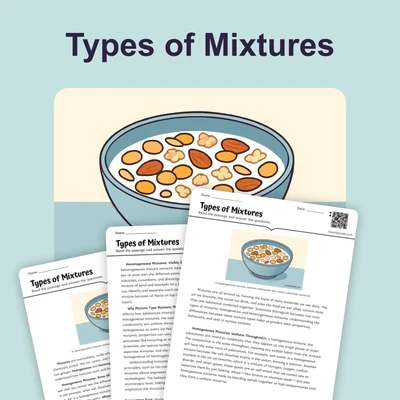
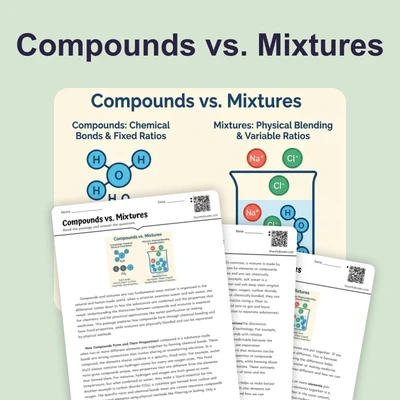
Mixtures play a crucial role in science and daily life. For example, when salt is stirred into water, the salt disappears, but when soil is mixed with water, the particles remain visible. Understanding the different types of mixtures helps scientists explain how substances interact and behave in various systems. The three main types of mixtures—solutions, suspensions, and colloids—are distinguished by the size of their particles and how they interact with light and gravity. These differences impact everything from food production to environmental science.
How Particle Size Determines Mixture Type
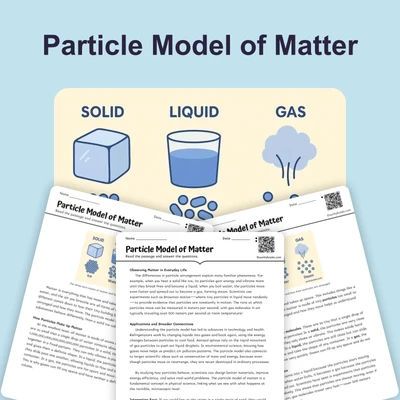
Each type of mixture is defined by the size of its particles. In a solution, such as lemonade, the solute particles (like sugar or salt) are so small—less than 1 nanometer—that they dissolve completely in the solvent (like water). This results in a transparent liquid where the particles cannot be seen, and they do not settle out over time. In contrast, a suspension, like muddy water, contains much larger particles—over 1,000 nanometers—that do not dissolve. Instead, these particles remain suspended for a short time but eventually settle to the bottom due to gravity, making the mixture cloudy. Colloids are intermediate: their particles are between 1 and 1,000 nanometers. Colloids, such as milk or fog, do not settle out and often appear cloudy. One way to identify a colloid is the Tyndall effect, where a beam of light is scattered by the particles, making the path of the light visible.
Real-World Examples and Applications
Knowing the type of mixture is important in many fields. In food science, a chef making gelatin needs to understand that it is a colloid, as its texture relies on the suspended particles. Environmental scientists study suspensions like muddy river water to monitor pollution levels. The transparency of a solution, such as drinking water, is a sign of purity, which is critical for health. Technological applications also depend on these properties: for example, lasers are used to test for colloids in pharmaceuticals to ensure medicine is safe for use. Even weather scientists study colloids, like fog, to understand visibility and climate impacts.
Systems, Interactions, and Scientific Principles
The behavior of mixtures is explained by the interactions between particles, light, and gravity. In solutions, molecular-level interactions allow the solute to dissolve fully. Suspensions are affected by gravity, which causes larger particles to separate out over time. Colloids interact with light in unique ways, scattering it rather than letting it pass through or blocking it completely. Scientists use these observations to classify mixtures and predict their behavior in new situations. This approach supports scientific thinking and aligns with the principles of physical science by connecting macroscopic observations to microscopic mechanisms.
Understanding the types of mixtures helps us solve real-world problems, from ensuring safe drinking water to developing better medicines. As our scientific tools and methods advance, we continue to discover new mixtures and applications.
Interesting Fact:
Milk is a colloid that contains tiny fat droplets suspended in water. Without special processing called homogenization, the fat would eventually rise to the top, forming a layer of cream!
Comprehension quiz (10 questions)
1. What is the main difference between solutions, suspensions, and colloids?
2. In a solution like lemonade, why can't you see the particles?
3. Which mixture will eventually settle out over time?
4. What is the Tyndall effect?
5. Which mixture is gelatin an example of?
6. What is the best definition of a suspension, based on the passage?
7. Why do scientists care about whether water is a solution, suspension, or colloid?
8. If a beam of light passes through a liquid and you can see the path of the light, what type of mixture is it?
9. True or False: In a solution, the solute always settles to the bottom over time.
10. True or False: Suspensions are usually transparent and never settle.
Perfect for the way you teach
- Build comprehension skills
- Auto-graded quiz
- Differentiated reading
- Read together at home
- Improve fluency
- Quiet reading time
- Reading curriculum support
- Independent practice
- Track Lexile growth