This learning resource is available in interactive and printable formats. The interactive worksheet can be played online and assigned to students. The Printable PDF version can be downloaded and printed for completion by hand.
This comprehensive science passage for grades 6-8 introduces students to the concept of mixtures, focusing on distinguishing between homogeneous and heterogeneous mixtures in alignment with NGSS standard MS-PS1-1. The passage explains the mechanisms that make these mixtures different, using real-world examples such as salt water, salad, and alloys. Students will discover how the properties of mixtures affect their uses in technology, medicine, and everyday life. The content is supported by a glossary, differentiated versions for accessibility, Spanish translations, engaging comprehension questions, and writing prompts. Graphic organizers are included to reinforce classification and comparison skills. Audio integration ensures accessibility for all learners. This resource is ideal for building science literacy and critical thinking about the material world.
CONTENT PREVIEW
Expand content preview
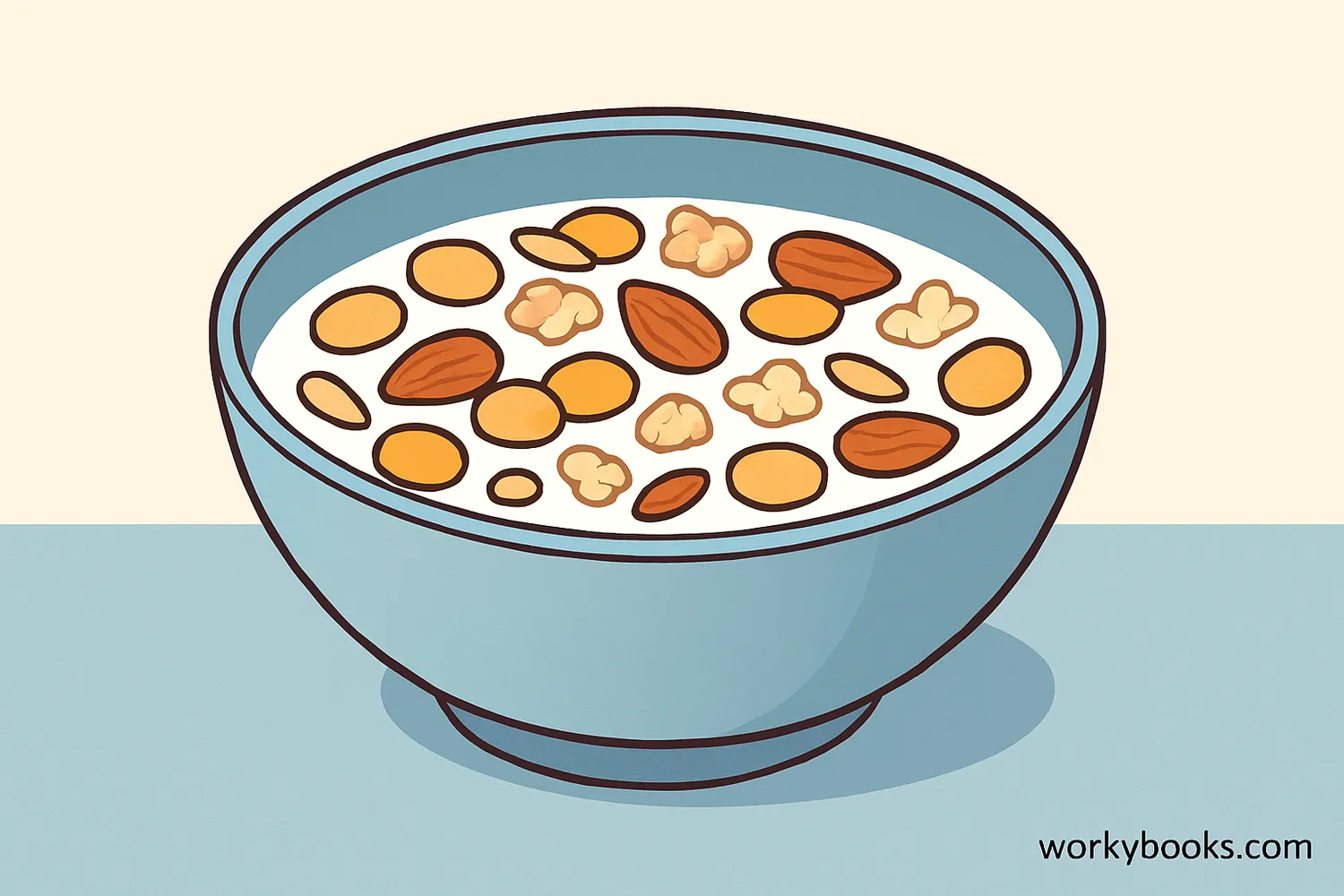
A heterogeneous mixture contains substances that remain physically separate.
Mixtures are all around us, forming the basis of many materials we use daily. The air we breathe, the water we drink, and even the food we eat often contain more than one substance combined together. Scientists distinguish between two main types of mixtures: homogeneous and heterogeneous mixtures. Understanding the differences between these mixture types helps us predict their properties, behaviors, and uses in various systems.
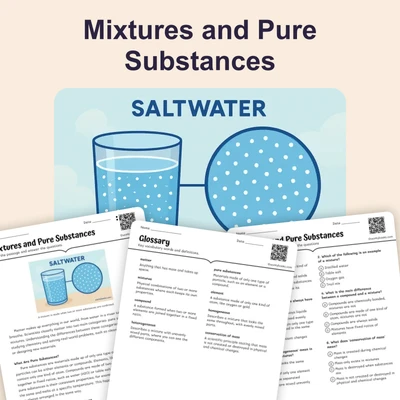
Homogeneous Mixtures: Uniform Throughout In a homogeneous mixture, the substances are mixed so completely that they appear as one single phase or layer. The composition is the same throughout, meaning any sample taken from the mixture will have the same ratio of substances. For example, salt water is a homogeneous mixture because the salt dissolves evenly in the water, forming a solution. Another example is the air we breathe, which is a mixture of nitrogen, oxygen, carbon dioxide, and other gases; these gases are so well mixed that we cannot see or separate them by just looking. Alloys—like bronze or stainless steel—are also homogeneous mixtures made by blending metals together at high temperatures until they form a uniform material.
Heterogeneous Mixtures: Visibly Different Parts On the other hand, a heterogeneous mixture contains substances that remain physically separate. You can see or even sort the different parts. For example, a salad contains lettuce, tomatoes, cucumbers, and dressing—all clearly visible and not evenly mixed. A mixture of sand and seashells on a beach is another heterogeneous mixture, as you can identify and separate each component. Oil and water also form a heterogeneous mixture because oil floats on top of water instead of dissolving, creating two distinct layers.
Why Mixture Type Matters: Mechanisms and Applications The type of mixture affects how substances interact and how they can be used or separated. In homogeneous mixtures, the even distribution means properties like taste, color, or conductivity are uniform throughout. For example, sports drinks must be homogeneous so every sip has the same amount of electrolytes. In heterogeneous mixtures, properties can vary from one part to another, which is important in processes like recycling or mining, where separation of components is needed. Scientists use special techniques such as filtration, distillation, and centrifugation to separate mixtures, and the choice of method depends on whether the mixture is homogeneous or heterogeneous.
Understanding mixtures is fundamental in science because it connects to larger principles, such as the conservation of matter and chemical reactions. Classifying mixtures allows engineers and chemists to design better materials, medicines, and technologies. The behavior of mixtures also reveals how particles interact on a microscopic level, linking to the Next Generation Science Standards (MS-PS1-1) that emphasize the structure and properties of matter.
Interesting Fact: Stainless steel, a homogeneous mixture or alloy, resists rust and is used in everything from medical tools to skyscrapers thanks to its uniform composition!
What is the main difference between homogeneous and heterogeneous mixtures?
Homogeneous mixtures look the same throughout, while heterogeneous mixtures have visible different parts.Homogeneous mixtures are always liquids, and heterogeneous mixtures are always solids.Heterogeneous mixtures can only be found in nature, not made by people.Homogeneous mixtures cannot be separated.
Which of the following is an example of a homogeneous mixture?
Salt waterSaladSand and seashellsOil and water
What is a real-world use of homogeneous mixtures mentioned in the passage?
Making sports drinks with the same amount of electrolytes in every sipBuilding sandcastles at the beachSorting trash for recyclingSeparating oil from water
Which technique is used to separate solids from liquids in a mixture?
FiltrationMixingMeltingCondensation
What does the word "alloy" mean as described in the passage?
A homogeneous mixture of metalsA pure metalA type of gasA heterogeneous mixture of gases
In a heterogeneous mixture, what is true about the properties in different parts?
They can be different from one part to another.They are always the same everywhere.
True or False: Oil and water form a homogeneous mixture.
TrueFalse
True or False: Air is an example of a homogeneous mixture.
TrueFalse
If you want to separate sand from seashells, which kind of mixture are you working with?
A heterogeneous mixtureA homogeneous mixtureA chemical compoundA pure substance
Why do scientists need to know the type of mixture before choosing a separation technique?
Because different mixtures require different methods to separate their parts.Because all mixtures are separated the same way.Because mixtures cannot be separated.Because mixtures only exist in science labs.
Perfect For:
👩🏫 Teachers
• Reading comprehension practice
• Auto-graded assessments
• Literacy skill development
👨👩👧👦 Parents
• Reading practice at home
• Comprehension improvement
• Educational reading time
🏠 Homeschoolers
• Reading curriculum support
• Independent reading practice
• Progress monitoring
Reading Features:
📖
Reading Passage
Engaging fiction or nonfiction text
❓
Comprehension Quiz
Auto-graded questions
📊
Instant Feedback
Immediate results and scoring
📄
Printable Version
Download for offline reading
🔊
Read Aloud
Voice-over with word highlighting
Reviews & Ratings
No reviews yet. Be the first to share your experience!
Related Content
Atomic Structure
This reading passage on Atomic Structure provides middle school students with an accessible explanation of the fundament...
MS-PS1-1RI.6.3RI.7.1
Parts of an Atom
This reading passage on Parts of an Atom provides middle school students with a structured and accessible explanation of...
MS-PS1-1RI.6.3RI.7.1
Chemical Bonds
This reading passage on Chemical Bonds provides middle school students with a clear explanation of how and why atoms con...
MS-PS1-1RI.6.3RI.7.1
The Freezing Point of Water
This science reading passage, titled 'The Freezing Point of Water', introduces students to a key physical science concep...
MS-PS1-1RI.6.3RI.7.1
Physical Properties of Matter
This comprehensive reading passage introduces grades 6-8 students to the concept of physical properties of matter, perfe...
MS-PS1-1
Mixtures and Pure Substances
This middle school science passage provides an in-depth exploration of mixtures and pure substances, directly aligned to...
MS-PS1-1
Solutions, Suspensions, and Colloids
This comprehensive science passage explores the differences between solutions, suspensions, and colloids, focusing on ho...
MS-PS1-1
The Nature of Science
This passage explores the nature of science for middle school students, aligning with NGSS standards MS-ETS1-4, MS-PS1-1...
MS-ETS1-4MS-PS1-1MS-LS1-1
Scientific Theories
This reading passage for grades 6-8 introduces students to the concept of scientific theories, emphasizing that these ar...
MS-PS1-1MS-PS1-4MS-PS3-4SCIENCE AND ENGINEERING PRACTICES
Particle Model of Matter
This comprehensive science reading passage for grades 6-8 explores the particle model of matter, aligning with NGSS stan...
MS-PS1-1MS-PS1-4
Valence Electrons
This middle school science passage introduces students to the concept of valence electrons, the outermost electrons that...
MS-PS1-1
The Idea of the Atom
This informational science passage introduces middle school students (grades 6-8) to the concept that all matter is made...
MS-PS1-1
Protons, Neutrons, and Electrons
This comprehensive middle school science passage explores the roles of protons, neutrons, and electrons, the three main ...
MS-PS1-1
What are Ions
This passage introduces middle school students to the concept of ions, explaining the processes by which atoms gain or l...
MS-PS1-1
Nucleus of the Atom
This comprehensive passage for grades 6-8 introduces students to the nucleus of the atom, the dense center that contains...
MS-PS1-1
How Atoms Differ
This middle school science reading passage, aligned with NGSS standard MS-PS1-1, explores the fundamental differences am...
MS-PS1-1
Isotopes
This middle school science passage explores the concept of isotopes, which are atoms of the same element with different ...
MS-PS1-1
Compounds vs. Mixtures
This educational passage for grades 6-8 explores the fundamental differences between compounds and mixtures, aligning wi...
MS-PS1-1
Organizing the Elements
This passage for middle school science explores how scientists organized the elements as more were discovered, leading t...