Mixtures and Pure Substances — Reading Comprehension
Rate this
Premium Resource
Present
Present in classroom. No work saved
Assign
Classroom with student accounts, Track progress
Quick Play
No student accounts, assign with a link
Grades
5
6
7
8
Standards
MS-PS1-1
PRINT+DIGITAL RESOURCE
This learning resource is available in interactive and printable formats. The interactive worksheet can be played online and assigned to students. The Printable PDF version can be downloaded and printed for completion by hand.
This middle school science passage provides an in-depth exploration of mixtures and pure substances, directly aligned to NGSS standard MS-PS1-1. Students will learn to distinguish between elements, compounds, and mixtures, understanding why and how their properties differ. The passage explains scientific mechanisms, such as why pure substances have fixed compositions, while mixtures retain the individual properties of their components. Real-world examples, including salt, trail mix, distilled water, and ocean water, make concepts relatable. The resource includes a glossary, Spanish translation, a simplified version for accessibility, comprehension and vocabulary quizzes, writing activities, and graphic organizers for structured learning. Audio integration ensures accessibility for all learners. This resource supports scientific literacy and helps students apply knowledge to environmental, health, and technological questions.
CONTENT PREVIEW
Expand content preview
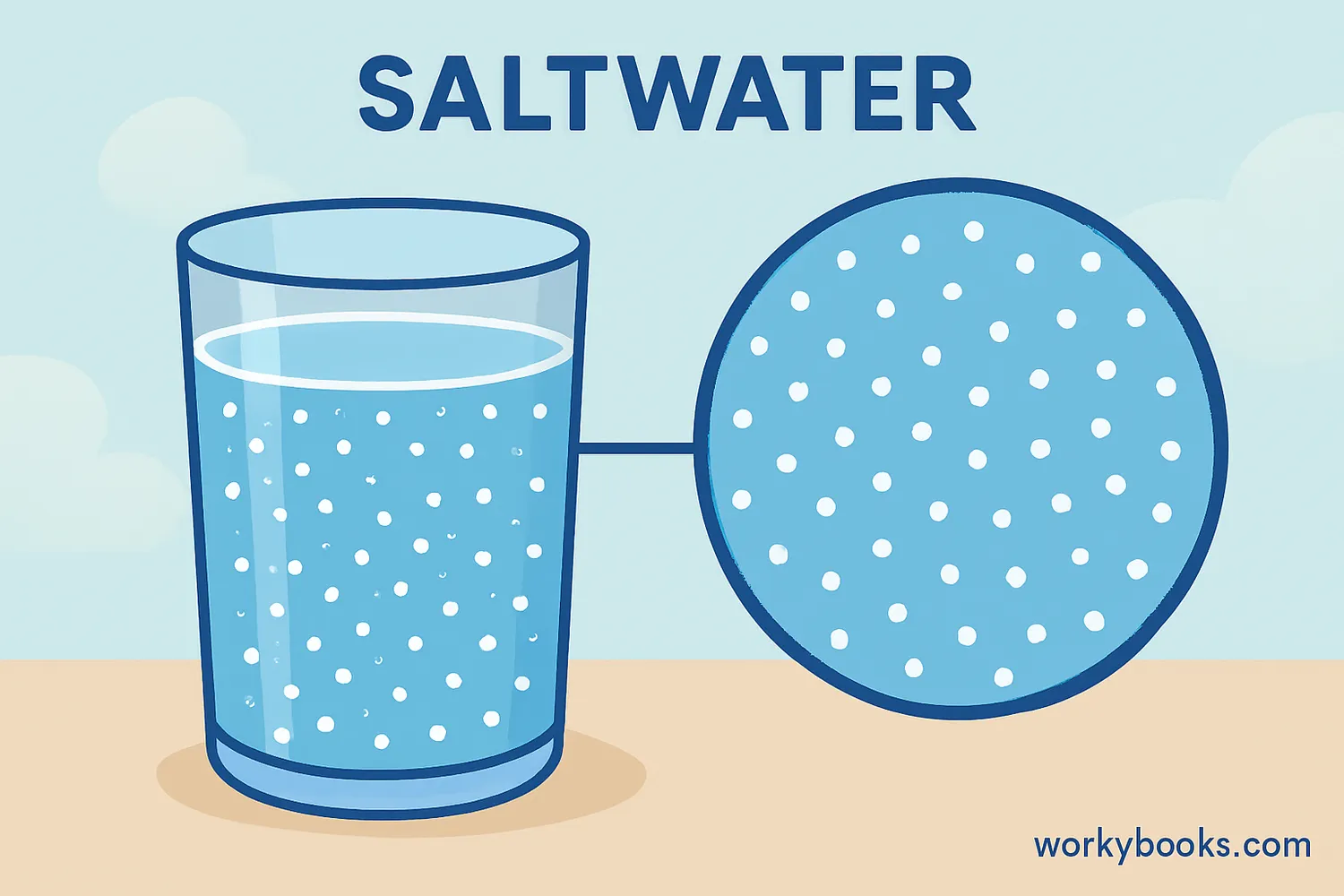
A mixture is made when two or more substances are combined.
Matter makes up everything in our world, from water in a river to the air we breathe. Scientists classify matter into two main categories: pure substances and mixtures. Understanding the differences between these categories is essential for studying chemistry and solving real-world problems, such as cleaning polluted water or designing new materials.
What Are Pure Substances?
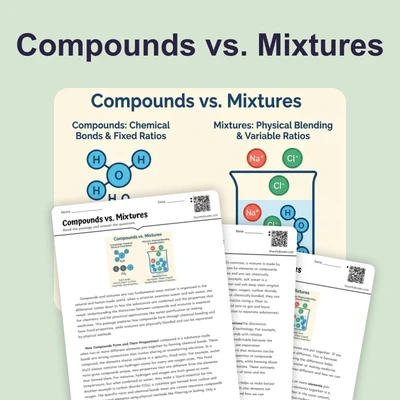
Pure substances are materials made up of only one type of particle. These particles can be either elements or compounds. Elements, like oxygen or gold, contain only one kind of atom. Compounds are made of two or more elements bonded together in fixed ratios, such as water (H2O) or table salt (NaCl). A key feature of pure substances is their consistent properties; for example, pure salt always tastes the same and melts at a specific temperature. This happens because the particles are always arranged in the same way.
How Mixtures Differ from Pure Substances
A mixture is made when two or more substances are combined, but not chemically bonded. Each component in a mixture retains its own properties. For instance, trail mix contains nuts, raisins, and chocolate chips. You can see and separate each part, and each piece still tastes like itself. Mixtures can be homogeneous (evenly mixed, like saltwater) or heterogeneous (unevenly mixed, like salad). Unlike pure substances, mixtures do not have a fixed composition. The amount of each part can vary; for example, ocean water contains different amounts of salt, minerals, and water, depending on location.
Interactions, Applications, and Scientific Importance
The separation of mixtures uses the distinct properties of their components. For example, salt can be separated from ocean water by evaporation, leaving pure salt crystals behind. Distilled water is a pure substance made by boiling water and condensing the steam, removing dissolved minerals. Understanding the difference between mixtures and pure substances is crucial for many scientific and industrial processes, such as producing medicines or ensuring safe drinking water. This classification also helps scientists predict how materials will behave in different situations, like how pollutants move in the environment.
Mixtures and pure substances are part of a larger system of chemical classification. Their study is connected to the conservation of mass and the behavior of particles, which are fundamental ideas in physical science. By analyzing the properties and interactions of these materials, scientists can design new products, develop environmental solutions, and understand natural processes at a deeper level.
Interesting Fact: Nearly all natural water sources, including rain, rivers, and oceans, are mixtures, not pure substances!
What is a pure substance?
A material made of only one kind of particleA mixture of two or more substancesA substance that changes its propertiesA combination of liquids and solids
Which of the following is an example of a mixture?
Distilled waterTable saltTrail mixOxygen gas
Why do pure substances always have the same properties?
Because they contain only one type of particle arranged in the same wayBecause they are mixed evenlyBecause their amount changes every timeBecause they are always liquids
What is the main difference between a compound and a mixture?
Compounds are made of one kind of atom, mixtures are notCompounds are chemically bonded, mixtures are notMixtures have fixed ratios of elementsCompounds are always solids
What does 'homogeneous' mean in the context of mixtures?
The parts are mixed unevenlyThe mixture looks the same throughoutIt is made of only one elementIt cannot be separated
What does 'conservation of mass' mean?
Mass is created during chemical changesMass is destroyed when substances mixMass is not created or destroyed in physical and chemical changesMass only exists in mixtures
If you separate salt from ocean water by evaporation, what kind of process is this?
Separating a compound into elementsSeparating a mixture using physical propertiesCreating a new elementMaking a homogeneous mixture
Which is TRUE about mixtures?
The parts are chemically bonded togetherThey always have the same amount of each partEach part keeps its own propertiesThey are always liquids
Ocean water is a pure substance. True or False?
TrueFalse
Elements and compounds are both types of pure substances. True or False?
TrueFalse
Perfect For:
👩🏫 Teachers
• Reading comprehension practice
• Auto-graded assessments
• Literacy skill development
👨👩👧👦 Parents
• Reading practice at home
• Comprehension improvement
• Educational reading time
🏠 Homeschoolers
• Reading curriculum support
• Independent reading practice
• Progress monitoring
Reading Features:
📖
Reading Passage
Engaging fiction or nonfiction text
❓
Comprehension Quiz
Auto-graded questions
📊
Instant Feedback
Immediate results and scoring
📄
Printable Version
Download for offline reading
🔊
Read Aloud
Voice-over with word highlighting
Reviews & Ratings
No reviews yet. Be the first to share your experience!
Related Content
Atomic Structure
This reading passage on Atomic Structure provides middle school students with an accessible explanation of the fundament...
MS-PS1-1RI.6.3RI.7.1
Parts of an Atom
This reading passage on Parts of an Atom provides middle school students with a structured and accessible explanation of...
MS-PS1-1RI.6.3RI.7.1
Chemical Bonds
This reading passage on Chemical Bonds provides middle school students with a clear explanation of how and why atoms con...
MS-PS1-1RI.6.3RI.7.1
The Freezing Point of Water
This science reading passage, titled 'The Freezing Point of Water', introduces students to a key physical science concep...
MS-PS1-1RI.6.3RI.7.1
Physical Properties of Matter
This comprehensive reading passage introduces grades 6-8 students to the concept of physical properties of matter, perfe...
MS-PS1-1
Types of Mixtures
This comprehensive science passage for grades 6-8 introduces students to the concept of mixtures, focusing on distinguis...
MS-PS1-1
Solutions, Suspensions, and Colloids
This comprehensive science passage explores the differences between solutions, suspensions, and colloids, focusing on ho...
MS-PS1-1
The Nature of Science
This passage explores the nature of science for middle school students, aligning with NGSS standards MS-ETS1-4, MS-PS1-1...
MS-ETS1-4MS-PS1-1MS-LS1-1
Scientific Theories
This reading passage for grades 6-8 introduces students to the concept of scientific theories, emphasizing that these ar...
MS-PS1-1MS-PS1-4MS-PS3-4SCIENCE AND ENGINEERING PRACTICES
Particle Model of Matter
This comprehensive science reading passage for grades 6-8 explores the particle model of matter, aligning with NGSS stan...
MS-PS1-1MS-PS1-4
Valence Electrons
This middle school science passage introduces students to the concept of valence electrons, the outermost electrons that...
MS-PS1-1
The Idea of the Atom
This informational science passage introduces middle school students (grades 6-8) to the concept that all matter is made...
MS-PS1-1
Protons, Neutrons, and Electrons
This comprehensive middle school science passage explores the roles of protons, neutrons, and electrons, the three main ...
MS-PS1-1
What are Ions
This passage introduces middle school students to the concept of ions, explaining the processes by which atoms gain or l...
MS-PS1-1
Nucleus of the Atom
This comprehensive passage for grades 6-8 introduces students to the nucleus of the atom, the dense center that contains...
MS-PS1-1
How Atoms Differ
This middle school science reading passage, aligned with NGSS standard MS-PS1-1, explores the fundamental differences am...
MS-PS1-1
Isotopes
This middle school science passage explores the concept of isotopes, which are atoms of the same element with different ...
MS-PS1-1
Compounds vs. Mixtures
This educational passage for grades 6-8 explores the fundamental differences between compounds and mixtures, aligning wi...
MS-PS1-1
Organizing the Elements
This passage for middle school science explores how scientists organized the elements as more were discovered, leading t...