Carpetbaggers and Scalawags
Interactive passage with audio narration, comprehension questions, and printable PDF.
By completing this purchase you agree to our Terms of Use and Privacy Policy. Your subscription renews automatically until you cancel. You can cancel anytime from your account settings. All sales are final and non-refundable. Digital content is available for download in your account immediately upon purchase.
What's included
Carpetbaggers and Scalawags preview and details
About this printable Carpetbaggers and Scalawags reading passage (Grades 6-8)
Sample passage and quiz from Carpetbaggers and Scalawags
Reading passage and comprehension quiz preview
Carpetbaggers and Scalawags
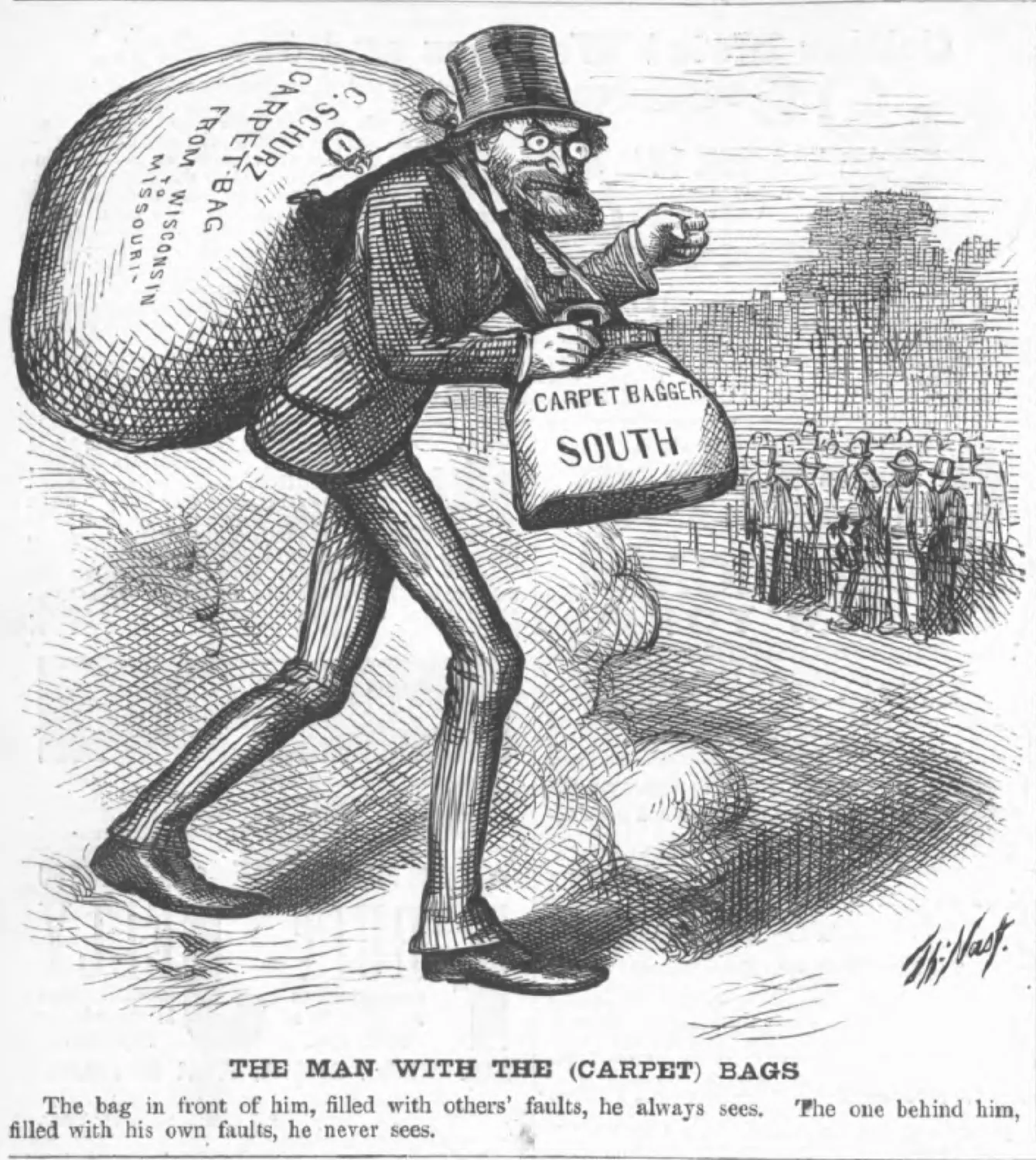
"Carpetbagger" by Thomas Nast.
Source: Wikimedia Commons (Public domain).
The terms carpetbagger and scalawag became widely used during the period of Reconstruction after the U.S. Civil War. Carpetbaggers referred to Northerners who moved to the South after the war, while scalawags described white Southerners who supported Reconstruction and the new political order. Both groups played vital roles in rebuilding the South, but their motivations and actions were often misunderstood or criticized.
Many carpetbaggers traveled South seeking opportunities. Some wanted to help newly freed African Americans, while others hoped for economic gain by buying cheap land or starting businesses. They often carried their belongings in bags made from old carpets, which is where the nickname came from. However, some Southerners thought of them as outsiders taking advantage of their troubles. This viewpoint led to conflict and mistrust between local populations and the newcomers.
Scalawags faced different, but equally complex, challenges. These were Southern whites who chose to support Reconstruction policies, often siding with the Republican Party and advocating for the rights of freedmen. Their decisions sometimes split families and communities. Many scalawags believed that supporting Reconstruction would modernize the South and improve economic conditions. Others, however, saw them as traitors to their region and heritage.
The actions of carpetbaggers and scalawags were both praised and criticized. Supporters argued that their efforts led to the creation of new schools, roads, and state governments that included African Americans in the political process. They helped pass legislation granting civil rights and worked to rebuild the Southern economy. On the other hand, opponents accused them of corruption and exploitation, blaming them for high taxes and political instability. The controversy around these groups shows how difficult and divided the Reconstruction era was.
Despite hostility, carpetbaggers and scalawags contributed to major changes in Southern society. They supported public education, helped establish new laws, and encouraged political participation by African Americans. Yet, their presence also intensified resistance from groups like the Ku Klux Klan, who used violence to oppose Reconstruction efforts. This struggle between change and tradition shaped the future of the South and the nation as a whole.
In conclusion, the experience of carpetbaggers and scalawags demonstrates that history is rarely simple. Their actions reflected a mix of idealism, ambition, and practical needs. Although they faced enormous difficulties and criticism, their legacy includes both progress and conflict. Understanding their story helps us see the challenges of creating a more equal society after a time of war and division.
Interesting Fact: The term "carpetbagger" is still sometimes used today to describe outsiders who move to a new place for their own benefit, but its origins come from this unique period in American history.
Comprehension quiz (8 questions)
1. Who were carpetbaggers?
2. What did scalawags support?
3. Why did many carpetbaggers go South?
4. How did carpetbaggers and scalawags help the South?
5. What was a negative effect faced by both groups?
6. Why did some people dislike scalawags?
7. Carpetbaggers only wanted to help African Americans. True or false?
8. What does 'controversy' mean?
Common Core standards for Carpetbaggers and Scalawags
Explain events, procedures, ideas, or concepts in a historical, scientific, or technical text, including what happened and why, based on specific information in the text.
Determine the meaning of general academic and domain-specific words or phrases in a text relevant to a grade 4 topic or subject area.
Write informative/explanatory texts to examine a topic and convey ideas and information clearly.
Perfect for the way you teach
- Build comprehension skills
- Auto-graded quiz
- Differentiated reading
- Read together at home
- Improve fluency
- Quiet reading time
- Reading curriculum support
- Independent practice
- Track Lexile growth