This learning resource is available in interactive and printable formats. The interactive worksheet can be played online and assigned to students. The Printable PDF version can be downloaded and printed for completion by hand.
This comprehensive science passage for middle school students explores the key concept of mitosis, the division of the nucleus into two identical daughter cells. Aligned with NGSS standard MS-LS1-4, the passage explains the mechanisms of mitosis, details the four phases (Prophase, Metaphase, Anaphase, Telophase) using the PMAT mnemonic, and connects the process to real-world applications such as growth, tissue repair, and asexual reproduction. Students will discover how mitosis supports multicellular life and examine both the systems and interactions involved. The resource includes a glossary, differentiated versions, a Spanish translation, diagrams, quizzes, writing prompts, and graphic organizers, making it ideal for diverse learners. Audio integration supports accessibility. This resource is perfect for grades 6-8 science instruction, providing a blend of scientific explanation, examples, and critical thinking activities.
CONTENT PREVIEW
Expand content preview
Mitosis is the essential process by which a eukaryotic cell divides its nucleus to create two identical nuclei. This mechanism ensures that each new cell receives the exact same genetic material as the original. Without mitosis, multicellular organisms could not grow, heal, or replace damaged cells. The process of mitosis is especially important for tissue growth in animals, leaf formation in plants, and even some forms of asexual reproduction.
The Mechanism of Mitosis: How Does It Work?
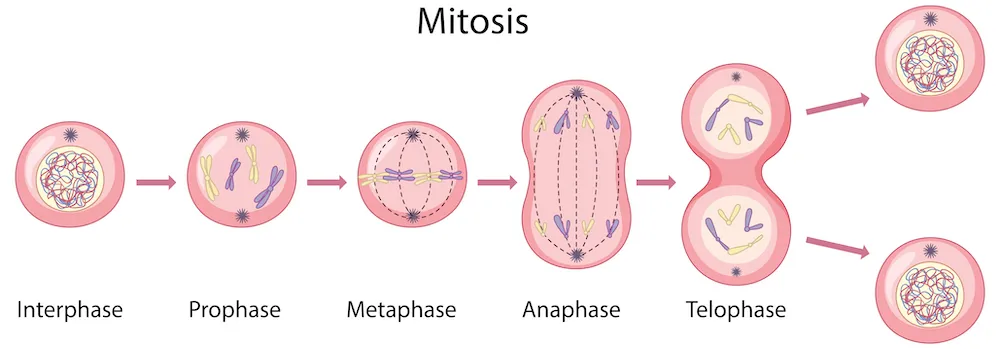
During mitosis, a single cell undergoes a series of well-organized steps to evenly split its chromosomes. These steps are grouped into four main phases, often remembered by the mnemonic PMAT: Prophase, Metaphase, Anaphase, and Telophase. In Prophase, the chromosomes condense and become visible under a microscope, and the nuclear membrane breaks down. Next, during Metaphase, the chromosomes align at the cell’s center. In Anaphase, the chromosomes are pulled apart to opposite poles of the cell. Finally, in Telophase, new nuclear membranes form around each set of chromosomes, creating two distinct nuclei. The result is two genetically identical daughter cells, each with the same number of chromosomes as the parent cell.
Applications and Interactions: Why Is Mitosis Important?
Mitosis plays a crucial role in the life of all multicellular organisms. For example, when a human child grows from 50 centimeters to 160 centimeters, trillions of cells must divide through mitosis. After an injury, such as a scraped knee, mitosis allows skin cells to multiply and repair the wound. In plants, mitosis enables roots and shoots to extend for better nutrient absorption and light capture. Some organisms, like single-celled amoebas or hydra, reproduce asexually by mitosis, creating offspring that are clones of the parent. The accuracy of mitosis is vital: if chromosomes are not evenly divided, it can result in genetic disorders or cell malfunction.
Complexities and Broader Implications
Mitosis does not act alone; it is part of the larger cell cycle that also includes periods of growth and DNA replication. Scientists first identified mitosis in the late 19th century using improved microscopes and staining techniques, which allowed them to observe chromosome movement. Errors in mitosis can lead to diseases like cancer, where cells divide uncontrollably. Advances in cell biology now allow researchers to study mitosis in real time, leading to treatments that can target dividing cancer cells while sparing healthy ones.
Understanding mitosis deepens our knowledge of how living systems grow, heal, and reproduce. This process connects to larger scientific principles of heredity, stability, and change. By studying mitosis, scientists can uncover causes of disease, improve agriculture, and design new medical therapies.
Interesting Fact: Every second, your body completes about two trillion mitotic cell divisions to keep you alive and healthy!
What is the main purpose of mitosis in multicellular organisms?
To help organisms grow, repair, and replace cellsTo break down food moleculesTo allow breathingTo make energy from sunlight
Which phase of mitosis involves chromosomes lining up at the cell's center?
ProphaseMetaphaseAnaphaseTelophase
What is the result of mitosis?
Two genetically identical daughter cellsFour different cellsCells with half the number of chromosomesCells that are larger than the original
What does the 'PMAT' mnemonic help students remember?
The four phases of mitosisThe types of cells in the bodyThe steps in photosynthesisThe organs in a plant
What happens during Anaphase?
Chromosomes separate and move to opposite polesChromosomes condense and nuclear membrane breaks downChromosomes align at the cell's centerNew nuclear membranes form
What does 'genetically identical' mean in the passage?
Having the same DNA as the original cellBeing completely differentHaving more chromosomesHaving half the genes
Why is accuracy in mitosis important?
Mistakes can cause genetic disorders or malfunctionCells could become smallerOrganisms would stop breathingPlants would stop growing
How do scientists study mitosis today?
By observing cells in real time with advanced toolsBy only guessingBy heating cellsBy using plant roots only
Mitosis creates cells that are genetically identical to the parent cell. (True/False)
TrueFalse
Errors in mitosis can result in cancer. (True/False)
TrueFalse
Perfect For:
👩🏫 Teachers
• Reading comprehension practice
• Auto-graded assessments
• Literacy skill development
👨👩👧👦 Parents
• Reading practice at home
• Comprehension improvement
• Educational reading time
🏠 Homeschoolers
• Reading curriculum support
• Independent reading practice
• Progress monitoring
Reading Features:
📖
Reading Passage
Engaging fiction or nonfiction text
❓
Comprehension Quiz
Auto-graded questions
📊
Instant Feedback
Immediate results and scoring
📄
Printable Version
Download for offline reading
🔊
Read Aloud
Voice-over with word highlighting
Reviews & Ratings
No reviews yet. Be the first to share your experience!
Related Content
Venus Flytrap Facts
This passage explains where Venus flytraps live in North Carolina bogs, how their snap traps work, and their unique way ...
MS-LS1-4RI.6.3RI.7.3RI.8.8
Pitcher Plants: Reproduction Facts
This passage describes tropical and North American pitcher plants, their liquid-filled traps, and how they get nutrients...
MS-LS1-4RI.6.3RI.7.3RI.8.8
What Is the Floor of an Aquatic Biome Called?
This NGSS-aligned science reading passage explains the benthic zone, which is the floor of an aquatic biome such as ocea...
MS-LS1-4
Echidna Puggle
This interactive science reading passage, titled "Echidna Life: From Egg to Puggle," delves into the fascinating reprodu...
MS-LS1-4
Seed Dispersal
This middle school science passage examines the fascinating process of seed dispersal and the diverse strategies plants ...
MS-LS1-4
Desert Birds
This informational passage for grades 6-8 examines how desert birds survive and thrive in some of the harshest environme...
MS-LS2-1MS-LS2-2MS-LS1-4
Asexual vs Sexual Reproduction
This NGSS-aligned passage for grades 6-8 explores sexual and asexual reproduction, comparing their underlying mechanisms...
MS-LS1-4MS-LS3-2
Reproductive System
This passage provides a comprehensive overview of the human reproductive system for middle school students, aligning wit...
MS-LS1-3MS-LS1-4
Fertilization and Early Development
This passage explores the scientific process of fertilization and early human development, aligning with NGSS standards ...
MS-LS1-4MS-LS3-2
Cytokinesis and Cell Growth
This middle school science reading passage explores the essential biological process of cytokinesis, the division of a c...
MS-LS1-4
Plant Reproduction
This comprehensive passage for grades 6-8 explores the fascinating world of plant reproduction, aligning with NGSS stand...
MS-LS1-4MS-LS3-2
Mammal Migration
This comprehensive passage on mammal migration, designed for grades 6-8 and aligned with NGSS standards MS-LS2-2 and MS-...
MS-LS2-2MS-LS1-4
How Animals Navigate
This engaging science passage for grades 6-8 examines the fascinating world of navigation strategies. Aligned with NGSS ...
MS-LS1-4MS-ESS3-3MS-ETS1-1
Growth and Development of Organisms
This middle school science passage, aligned with NGSS standards MS-LS1-4 and MS-LS1-5, provides an in-depth look at the ...
MS-LS1-4MS-LS1-5
What Is a Tropical Savanna?
This NGSS-aligned science passage for grades 6-8 explores the rich animal diversity of the savanna ecosystem. Students w...
MS-LS2-1MS-LS2-2MS-LS2-4MS-LS1-4
The Cell Cycle
This middle school science reading passage introduces the cell cycle as the life of a cell from formation to division. A...
MS-LS1-4
Animal Survival Behaviors
This passage, aligned with NGSS standards MS-LS1-4 and MS-LS1-5, explores the complex and fascinating world of animal be...
MS-LS1-4MS-LS1-5
Reproductive Success
This middle school science passage explores the essential concepts of reproductive success and adaptation in plants and ...