Reproductive Success
Interactive passage with audio narration, comprehension questions, and printable PDF.
By completing this purchase you agree to our Terms of Use and Privacy Policy. Your subscription renews automatically until you cancel. You can cancel anytime from your account settings. All sales are final and non-refundable. Digital content is available for download in your account immediately upon purchase.
What's included
Reproductive Success preview and details
About this printable Reproductive Success science reading passage, NGSS-aligned (Grades 5-8)
Sample passage and quiz from Reproductive Success
Reading passage and comprehension quiz preview
Reproductive Success
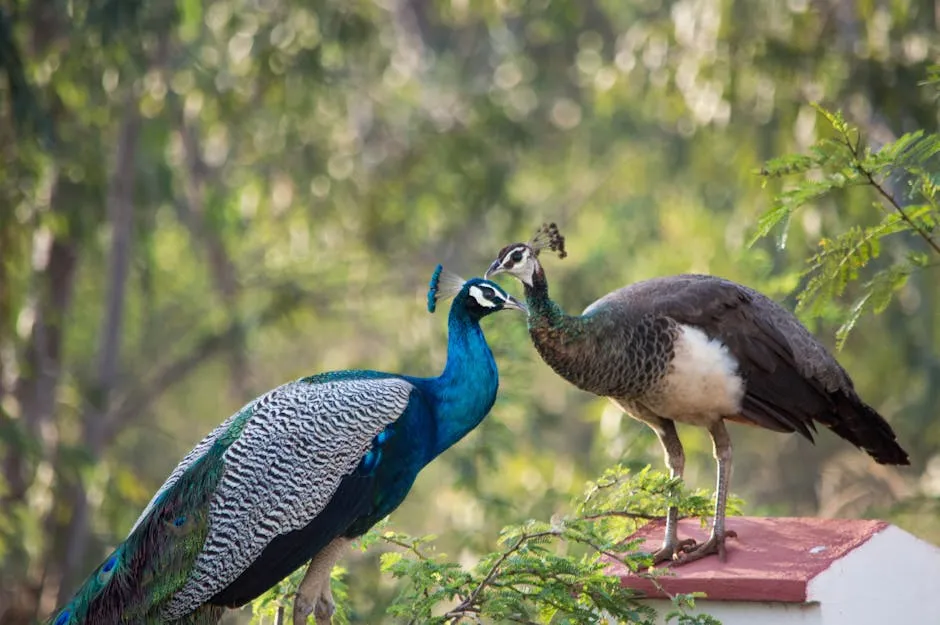
"image of two peacocks interacting in the wild, Tamil Nadu, India." by Amol Mande / Pexels.
Reproductive success is the process by which living organisms pass their genes to the next generation. In every environment, plants and animals face challenges to survive and produce offspring. The ability to reproduce successfully is vital because it ensures that a species can continue over time. Scientists observe many ways organisms increase their reproductive success, leading to the evolution of new features and behaviors.
Mechanisms of Reproductive Success
Organisms develop adaptations—traits that improve survival and reproduction in their environment. For example, many flowering plants have bright petals that attract pollinators like bees or birds. Once pollinated, plants may form fruit, which animals eat, helping spread seeds to new locations. A fruit’s sweet taste and bright color encourage animals to carry seeds far from the parent plant. Additionally, a protective seed coat shields seeds from damage and dehydration. In animals, adaptations like camouflage help offspring avoid predators. Some animals use mimicry or warning coloration—for instance, a caterpillar may resemble a poisonous species or display bright colors that signal danger to predators. These adaptations raise the chances that young will survive and reproduce.
Reproductive Strategies and Trade-offs
Different organisms use different reproductive strategies. r-strategists, such as many fish or insects, produce a large number of offspring but invest little parental care. Most offspring do not survive, but a few will reach adulthood. In contrast, K-strategists—like elephants or humans—have fewer offspring but provide extensive parental care, increasing each one’s survival rate. Both strategies involve trade-offs: energy spent producing many offspring means less energy for each individual, while caring for fewer young requires more effort over time. These trade-offs are shaped by natural selection and depend on environmental conditions.
Adaptation, Natural Selection, and Evolution
Natural selection is the process where individuals with advantageous traits are more likely to survive and reproduce, passing those traits on. Over many generations, this leads to evolution—the change in populations over time. For example, if brighter flowers consistently attract more pollinators, plants with those traits become more common. Similarly, animal populations with better camouflage are more likely to avoid predators and produce offspring. Scientists measure reproductive success by observing offspring numbers and survival rates, often using data collected over years or decades.
Understanding reproductive success and adaptation helps explain the diversity of life on Earth. These concepts are central to ecology, conservation, and even agriculture, where selecting for certain traits can improve crop yields or animal health.
Interesting Fact: Some orchids trick insects into pollinating them by mimicking the appearance and scent of female insects, increasing their reproductive success!
Comprehension quiz (10 questions)
1. What is reproductive success?
2. Which adaptation helps plants attract pollinators?
3. What is one benefit of a protective seed coat?
4. Why do some animals use mimicry?
5. Which statement best describes the difference between r-strategists and K-strategists?
6. In the passage, what is the main function of fruit in plant reproduction?
7. What process causes helpful traits to become more common in a population over time?
8. Which is NOT an example of an adaptation for reproductive success mentioned in the passage?
9. True or False: K-strategists produce many offspring with little parental care.
10. True or False: Adaptations like mimicry and warning coloration can help animals avoid predators.
Perfect for the way you teach
- Build comprehension skills
- Auto-graded quiz
- Differentiated reading
- Read together at home
- Improve fluency
- Quiet reading time
- Reading curriculum support
- Independent practice
- Track Lexile growth