Cytokinesis and Cell Growth — Reading Comprehension
Rate this
Premium Resource
Present
Present in classroom. No work saved
Assign
Classroom with student accounts, Track progress
Quick Play
No student accounts, assign with a link
Grades
5
6
7
8
Standards
MS-LS1-4
PRINT+DIGITAL RESOURCE
This learning resource is available in interactive and printable formats. The interactive worksheet can be played online and assigned to students. The Printable PDF version can be downloaded and printed for completion by hand.
This middle school science reading passage explores the essential biological process of cytokinesis, the division of a cell's cytoplasm following mitosis. Designed for grades 6-8 and aligned with NGSS standard MS-LS1-4, it examines the mechanisms behind cytokinesis in both animal and plant cells, emphasizing the importance of cell division for healthy growth and function. Students will learn why cells divide instead of simply growing larger, focusing on the surface area to volume ratio and efficient transport of materials. The passage also addresses how cells regulate division through checkpoints and signaling, and discusses the consequences of failed regulation, such as cancer. Vocabulary is highlighted and supported by a glossary, and the resource includes a Spanish translation, differentiated version for accessibility, multiple-choice and writing activities, and science-focused graphic organizers. Audio integration ensures accessibility for diverse learners. This resource supports inquiry into life science systems and the relationship between structure and function in living organisms.
CONTENT PREVIEW
Expand content preview
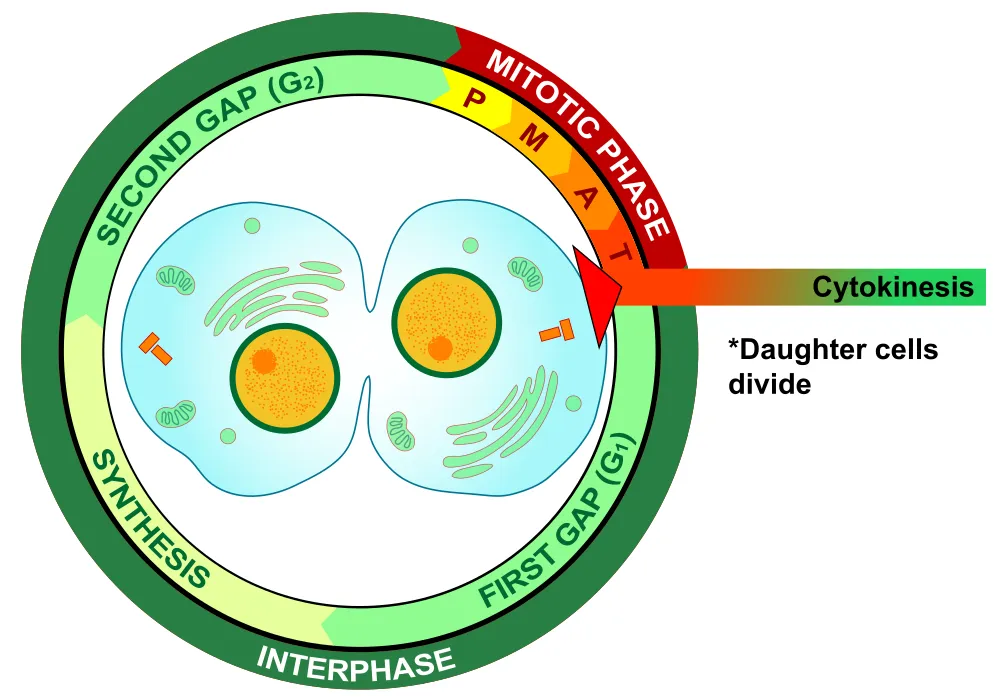
Cytokinesis is a critical stage in the life of all cells. Source: Wikimedia Commons (Public domain).
Cytokinesis is a critical stage in the life of all cells. It is the process that divides the cytoplasm of a cell after mitosis, leading to the formation of two separate daughter cells. While mitosis ensures each new cell gets a complete set of DNA, cytokinesis makes sure each cell has enough cytoplasm and organelles to survive. This process is essential for growth, repair, and reproduction in multicellular organisms. Without proper cytokinesis, an organism's cells would not function efficiently or could become damaged.
How Cytokinesis Works in Animal and Plant Cells
In animal cells, cytokinesis occurs through the formation of a cleavage furrow. This furrow forms when the cell membrane pinches inward, gradually deepening until the cell splits in two. In contrast, plant cells have rigid cell walls, so they cannot pinch in the same way. Instead, a cell plate forms in the center of the dividing cell. The cell plate grows outward until it fuses with the cell wall, dividing the cell into two. Both methods ensure that each new cell contains all the necessary components to function normally. Scientists have observed these processes under powerful microscopes, measuring the speed and pattern of division in different species.
Why Cells Divide: Surface Area to Volume Ratio
Cells must divide instead of only growing larger due to the relationship between their surface area and volume. As a cell grows, its volume increases faster than its surface area. This means a larger cell has less membrane area for its size, making it harder to transport nutrients in and waste out efficiently. For example, experiments show that when cell diameter doubles, volume increases eight times, but surface area only increases four times. This imbalance can cause cells to starve or accumulate toxic waste. By dividing, cells maintain an optimal surface area-to-volume ratio, allowing them to function properly.
Regulation of Cell Division and What Happens When It Fails
Cells do not divide randomly; they rely on signals and checkpoints to decide when division should occur. These checkpoints are like quality control stations in the cell cycle, ensuring the DNA is correct and the cell is ready to divide. Chemical signals, such as growth factors, tell cells when to start or stop dividing. If these regulatory systems fail, cells can divide uncontrollably. This leads to the development of cancer, a disease where abnormal cells multiply without control, often forming tumors. Scientists study cancer to understand how cell cycle checkpoints can be restored or targeted for treatment.
Understanding cytokinesis and cell growth helps us appreciate the balance and control within living things. These processes are fundamental to development, healing, and maintaining healthy tissues. Advances in our knowledge of cell division have improved medicine and biotechnology, offering hope for treating diseases like cancer in the future.
Interesting Fact: Some single-celled organisms, like bacteria, can divide in as little as 20 minutes, making them some of the fastest-replicating life forms on Earth!
What is cytokinesis?
The division of a cell's cytoplasm after mitosisThe copying of DNA before mitosisThe process of forming a new cell wallThe movement of molecules across the cell membrane
How does cytokinesis differ between animal and plant cells?
Animal cells use a cleavage furrow; plant cells form a cell plateBoth use a cleavage furrowAnimal cells form a cell plate; plant cells pinch inwardPlant cells do not divide
Why do cells need to divide instead of just growing larger?
To maintain a healthy surface area to volume ratioBecause DNA cannot be copiedSo they can move fasterTo create new organelles
What happens if cell division is not properly regulated?
Cells can begin dividing uncontrollably, leading to cancerCells never divideMitosis does not occurCells stop growing
What does the term 'checkpoints' mean in the context of cell division?
Control points where the cell checks if it is ready to divideA type of cell wallA chemical signal for plant cellsA type of DNA sequence
What is a 'growth factor'?
A chemical that tells cells when to start or stop dividingA part of the cell membraneA type of cancer cellA structure in plant cells
If the surface area to volume ratio gets too small, what might happen to the cell?
It may not transport materials efficientlyIt will divide more slowlyIt will become multicellularIt will make more DNA
How does the passage support the idea that regulation of cell division is important?
It explains that loss of regulation can cause diseases like cancerIt says all cells divide at the same timeIt describes bacteria replicating quicklyIt shows plant and animal cells are the same
True or False: Plant cells divide using a cleavage furrow.
TrueFalse
True or False: Cancer develops when cell division is not properly controlled.
TrueFalse
Perfect For:
👩🏫 Teachers
• Reading comprehension practice
• Auto-graded assessments
• Literacy skill development
👨👩👧👦 Parents
• Reading practice at home
• Comprehension improvement
• Educational reading time
🏠 Homeschoolers
• Reading curriculum support
• Independent reading practice
• Progress monitoring
Reading Features:
📖
Reading Passage
Engaging fiction or nonfiction text
❓
Comprehension Quiz
Auto-graded questions
📊
Instant Feedback
Immediate results and scoring
📄
Printable Version
Download for offline reading
🔊
Read Aloud
Voice-over with word highlighting
Reviews & Ratings
No reviews yet. Be the first to share your experience!
Related Content
Venus Flytrap Facts
This passage explains where Venus flytraps live in North Carolina bogs, how their snap traps work, and their unique way ...
MS-LS1-4RI.6.3RI.7.3RI.8.8
Pitcher Plants: Reproduction Facts
This passage describes tropical and North American pitcher plants, their liquid-filled traps, and how they get nutrients...
MS-LS1-4RI.6.3RI.7.3RI.8.8
What Is the Floor of an Aquatic Biome Called?
This NGSS-aligned science reading passage explains the benthic zone, which is the floor of an aquatic biome such as ocea...
MS-LS1-4
Echidna Puggle
This interactive science reading passage, titled "Echidna Life: From Egg to Puggle," delves into the fascinating reprodu...
MS-LS1-4
Seed Dispersal
This middle school science passage examines the fascinating process of seed dispersal and the diverse strategies plants ...
MS-LS1-4
Cell Division: Mitosis
This comprehensive science passage for middle school students explores the key concept of mitosis, the division of the n...
MS-LS1-4
Desert Birds
This informational passage for grades 6-8 examines how desert birds survive and thrive in some of the harshest environme...
MS-LS2-1MS-LS2-2MS-LS1-4
Asexual vs Sexual Reproduction
This NGSS-aligned passage for grades 6-8 explores sexual and asexual reproduction, comparing their underlying mechanisms...
MS-LS1-4MS-LS3-2
Reproductive System
This passage provides a comprehensive overview of the human reproductive system for middle school students, aligning wit...
MS-LS1-3MS-LS1-4
Fertilization and Early Development
This passage explores the scientific process of fertilization and early human development, aligning with NGSS standards ...
MS-LS1-4MS-LS3-2
Plant Reproduction
This comprehensive passage for grades 6-8 explores the fascinating world of plant reproduction, aligning with NGSS stand...
MS-LS1-4MS-LS3-2
Mammal Migration
This comprehensive passage on mammal migration, designed for grades 6-8 and aligned with NGSS standards MS-LS2-2 and MS-...
MS-LS2-2MS-LS1-4
How Animals Navigate
This engaging science passage for grades 6-8 examines the fascinating world of navigation strategies. Aligned with NGSS ...
MS-LS1-4MS-ESS3-3MS-ETS1-1
Growth and Development of Organisms
This middle school science passage, aligned with NGSS standards MS-LS1-4 and MS-LS1-5, provides an in-depth look at the ...
MS-LS1-4MS-LS1-5
What Is a Tropical Savanna?
This NGSS-aligned science passage for grades 6-8 explores the rich animal diversity of the savanna ecosystem. Students w...
MS-LS2-1MS-LS2-2MS-LS2-4MS-LS1-4
The Cell Cycle
This middle school science reading passage introduces the cell cycle as the life of a cell from formation to division. A...
MS-LS1-4
Animal Survival Behaviors
This passage, aligned with NGSS standards MS-LS1-4 and MS-LS1-5, explores the complex and fascinating world of animal be...
MS-LS1-4MS-LS1-5
Reproductive Success
This middle school science passage explores the essential concepts of reproductive success and adaptation in plants and ...