This learning resource is available in interactive and printable formats. The interactive worksheet can be played online and assigned to students. The Printable PDF version can be downloaded and printed for completion by hand.
This middle school science reading passage introduces the cell cycle as the life of a cell from formation to division. Aligned to NGSS standard MS-LS1-4, it explains the three main stages—interphase, mitosis, and cytokinesis—using accessible language, scientific vocabulary, and real-world examples. Students learn about the mechanisms, importance, and variation in cell cycle length, with connections to health and society. Included are a glossary, multiple-choice and writing activities, and graphic organizers to support comprehension. This resource is suitable for grades 6-8, supports science literacy, and includes audio integration for diverse learners. The passage helps students build foundational understanding of cell biology and prepares them for advanced life science topics.
CONTENT PREVIEW
Expand content preview
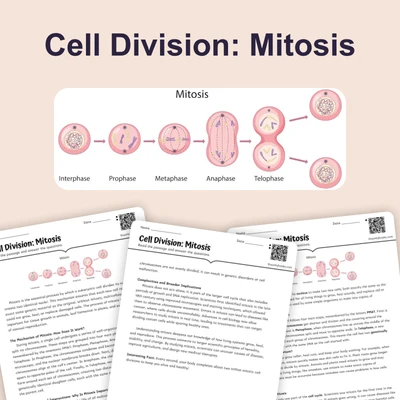
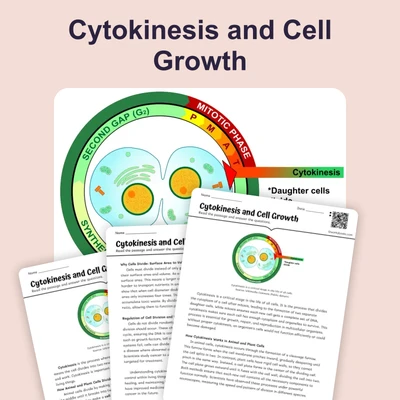
Simple diagram of the cell cycle phases
The cell cycle describes the series of changes a cell undergoes from the moment it forms until it divides to create new cells. This process is vital for growth, repair, and reproduction in all living organisms. Cells in your skin, blood, and organs are constantly going through the cell cycle to keep your body healthy and functioning. Understanding the cell cycle helps scientists learn how diseases like cancer develop when this process goes wrong.
Stages of the Cell Cycle
The cell cycle consists of three main stages: interphase, mitosis, and cytokinesis. Most of a cell’s life is spent in interphase, which includes three phases: G1 (growth), S (DNA synthesis or replication), and G2 (preparation for division). During G1, the cell grows and carries out its normal functions. In the S phase, the cell copies its DNA, ensuring that each new cell will have a complete set of genetic information. During G2, the cell prepares all the components needed for division. Next, mitosis begins. Mitosis is the process by which the cell’s nucleus divides, with the duplicated chromosomes being carefully separated into two identical groups. Finally, cytokinesis divides the cell’s cytoplasm, forming two new daughter cells.
Variation and Importance in the Cell Cycle
The length and timing of the cell cycle can vary widely. For example, some bacteria complete the cell cycle in about 20 minutes, while human skin cells take about 24 hours. Nerve cells in adults may never divide again after maturing. These differences are crucial for the health and efficiency of tissues. If cells divide too quickly or uncontrollably, as in cancer, the organism can be harmed. Scientists use techniques like microscopes and DNA-staining to observe cells at different stages of the cycle, which helps them understand normal development and disease.
Applications and Broader Connections
Knowledge of the cell cycle has real-world applications. Medical researchers study how drugs can target cancer cells by interrupting their cycle. Technological advances in genetics and biotechnology rely on manipulating the cell cycle for cloning or repairing tissues. In agriculture, understanding cell division can improve crop yields. The cell cycle is a central concept in biology, showing how structure and function are connected and how living systems maintain balance.
In summary, the cell cycle is an organized, step-by-step process that allows cells to grow, replicate their DNA, and divide, ensuring the continuation and health of all living things. By studying the cell cycle, scientists can develop new ways to improve medicine, agriculture, and technology.
Interesting Fact: Some cells, like those in your brain, can remain in a resting phase for decades, never dividing again after they mature!
What is the main purpose of the cell cycle?
To allow cells to grow, replicate their DNA, and divideTo make cells rest for long periodsTo help cells move around the bodyTo provide energy for the cell
Which phase does a cell spend most of its life in?
InterphaseMitosisCytokinesisResting phase
What happens during the S phase of interphase?
The cell copies its DNAThe cell divides its cytoplasmThe nucleus disappearsThe chromosomes move to the center
What is mitosis?
The process when the nucleus dividesThe step where the cell growsThe splitting of cytoplasmThe resting phase
What are daughter cells?
The two new cells formed after cell divisionCells that never divideCells that only growCells in the resting phase
Which word in the passage means the process of copying DNA?
DNA replicationInterphaseCytokinesisChromosomes
How do scientists observe different stages of the cell cycle?
By using microscopes and DNA-stainingBy using only their eyesBy listening to cell soundsBy counting the number of cells
Why is it dangerous if cells divide too quickly?
It can lead to diseases like cancerIt causes cells to shrinkIt makes cells lose their DNAIt stops cells from growing
True or False: All cells in the human body divide at the same rate.
TrueFalse
True or False: The cell cycle is important for the growth and repair of all living things.
TrueFalse
Perfect For:
👩🏫 Teachers
• Reading comprehension practice
• Auto-graded assessments
• Literacy skill development
👨👩👧👦 Parents
• Reading practice at home
• Comprehension improvement
• Educational reading time
🏠 Homeschoolers
• Reading curriculum support
• Independent reading practice
• Progress monitoring
Reading Features:
📖
Reading Passage
Engaging fiction or nonfiction text
❓
Comprehension Quiz
Auto-graded questions
📊
Instant Feedback
Immediate results and scoring
📄
Printable Version
Download for offline reading
🔊
Read Aloud
Voice-over with word highlighting
Reviews & Ratings
No reviews yet. Be the first to share your experience!
Related Content
Venus Flytrap Facts
This passage explains where Venus flytraps live in North Carolina bogs, how their snap traps work, and their unique way ...
MS-LS1-4RI.6.3RI.7.3RI.8.8
Pitcher Plants: Reproduction Facts
This passage describes tropical and North American pitcher plants, their liquid-filled traps, and how they get nutrients...
MS-LS1-4RI.6.3RI.7.3RI.8.8
What Is the Floor of an Aquatic Biome Called?
This NGSS-aligned science reading passage explains the benthic zone, which is the floor of an aquatic biome such as ocea...
MS-LS1-4
Echidna Puggle
This interactive science reading passage, titled "Echidna Life: From Egg to Puggle," delves into the fascinating reprodu...
MS-LS1-4
Seed Dispersal
This middle school science passage examines the fascinating process of seed dispersal and the diverse strategies plants ...
MS-LS1-4
Cell Division: Mitosis
This comprehensive science passage for middle school students explores the key concept of mitosis, the division of the n...
MS-LS1-4
Desert Birds
This informational passage for grades 6-8 examines how desert birds survive and thrive in some of the harshest environme...
MS-LS2-1MS-LS2-2MS-LS1-4
Asexual vs Sexual Reproduction
This NGSS-aligned passage for grades 6-8 explores sexual and asexual reproduction, comparing their underlying mechanisms...
MS-LS1-4MS-LS3-2
Reproductive System
This passage provides a comprehensive overview of the human reproductive system for middle school students, aligning wit...
MS-LS1-3MS-LS1-4
Fertilization and Early Development
This passage explores the scientific process of fertilization and early human development, aligning with NGSS standards ...
MS-LS1-4MS-LS3-2
Cytokinesis and Cell Growth
This middle school science reading passage explores the essential biological process of cytokinesis, the division of a c...
MS-LS1-4
Plant Reproduction
This comprehensive passage for grades 6-8 explores the fascinating world of plant reproduction, aligning with NGSS stand...
MS-LS1-4MS-LS3-2
Mammal Migration
This comprehensive passage on mammal migration, designed for grades 6-8 and aligned with NGSS standards MS-LS2-2 and MS-...
MS-LS2-2MS-LS1-4
How Animals Navigate
This engaging science passage for grades 6-8 examines the fascinating world of navigation strategies. Aligned with NGSS ...
MS-LS1-4MS-ESS3-3MS-ETS1-1
Growth and Development of Organisms
This middle school science passage, aligned with NGSS standards MS-LS1-4 and MS-LS1-5, provides an in-depth look at the ...
MS-LS1-4MS-LS1-5
What Is a Tropical Savanna?
This NGSS-aligned science passage for grades 6-8 explores the rich animal diversity of the savanna ecosystem. Students w...
MS-LS2-1MS-LS2-2MS-LS2-4MS-LS1-4
Animal Survival Behaviors
This passage, aligned with NGSS standards MS-LS1-4 and MS-LS1-5, explores the complex and fascinating world of animal be...
MS-LS1-4MS-LS1-5
Reproductive Success
This middle school science passage explores the essential concepts of reproductive success and adaptation in plants and ...