Cherokee Nation v Georgia
Interactive passage with audio narration, comprehension questions, and printable PDF.
By completing this purchase you agree to our Terms of Use and Privacy Policy. Your subscription renews automatically until you cancel. You can cancel anytime from your account settings. All sales are final and non-refundable. Digital content is available for download in your account immediately upon purchase.
What's included
Cherokee Nation v Georgia preview and details
About this printable Cherokee Nation v Georgia reading passage (Grades 6-8)
Sample passage and quiz from Cherokee Nation v Georgia
Reading passage and comprehension quiz preview
Cherokee Nation v Georgia
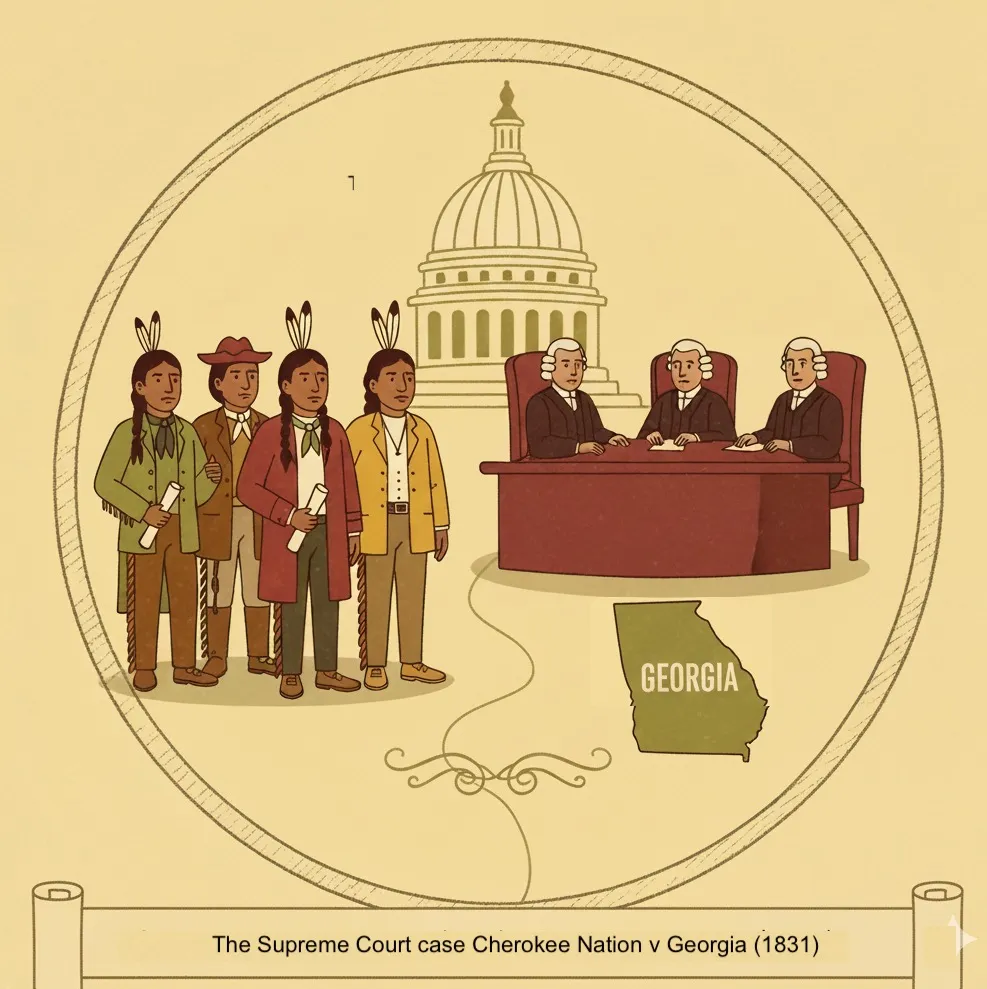
The Supreme Court case Cherokee Nation v Georgia in 1831 was a turning point in U.S. history. This case addressed whether the Cherokee Nation, a sovereign Native American nation, could use the Supreme Court to defend its land rights against actions by the state of Georgia. The legal conflict emerged during a period of westward expansion, when American settlers and states sought new lands, often at the expense of Native peoples.
The problem began when Georgia passed laws to control Cherokee territory, ignoring previous treaties between the United States and the Cherokee Nation. These treaties had recognized Cherokee lands and their sovereignty, or the right of a nation to govern itself. However, Georgia claimed legal power or jurisdiction over these lands, seeking to seize them for white settlers. The Cherokee Nation, led by Principal Chief John Ross, responded by seeking protection from the Supreme Court. They hoped the court would declare Georgia’s actions illegal and defend their rights as an independent nation.
The Supreme Court faced a difficult question: did the Cherokee Nation have the legal status to sue in a U.S. federal court? Chief Justice John Marshall recognized the uniqueness of the Cherokee situation. He acknowledged the Cherokee as a "distinct political society" with their own government and laws. However, the Court decided that the Cherokee Nation was not a "foreign nation" as defined by the U.S. Constitution, but rather a "domestic dependent nation." This meant that, while the Cherokee had some rights to self-government, they did not have the full ability to bring a lawsuit as a foreign country could.
As a result, the Supreme Court did not rule directly on the legality of Georgia’s actions. The court dismissed the case, saying it lacked jurisdiction. This left the Cherokee in a vulnerable position. Although the Court recognized them as a unique nation, it did not protect their land rights. The decision highlighted the tension between federal and state authority, as well as the limits of the legal system in defending Native American sovereignty.
The following year, in Worcester v Georgia, the Supreme Court ruled in favor of the Cherokee, stating that Georgia had no authority over Cherokee lands. However, President Andrew Jackson and Georgia ignored the decision. This refusal to enforce the court’s ruling showed the complex relationship between the branches of government and the challenges of upholding Native American rights during westward expansion.
Ultimately, the legal battles failed to stop the forced removal of the Cherokee people, known as the Trail of Tears. Despite their efforts to use the U.S. legal system, the Cherokee were forced to leave their ancestral lands. The cases of Cherokee Nation v Georgia and Worcester v Georgia remain important for understanding the struggles over sovereignty, legal status, and justice in American history.
Interesting Fact: The phrase "domestic dependent nation" created by the Supreme Court is still used today in legal discussions about tribal sovereignty and Native American rights.
Comprehension quiz (8 questions)
1. When did Cherokee Nation v Georgia occur?
2. Who led the Cherokee Nation in the case?
3. What was the Trail of Tears?
4. Why did the Cherokee go to the Supreme Court?
5. What did the Court call the Cherokee Nation?
6. What was the effect of the Supreme Court's decision?
7. Cherokee Nation v Georgia protected Cherokee rights. True or false?
8. What does "sovereignty" mean?
Common Core standards for Cherokee Nation v Georgia
Explain events, procedures, ideas, or concepts in a historical, scientific, or technical text, including what happened and why, based on specific information in the text.
Determine the meaning of general academic and domain-specific words or phrases in a text relevant to a grade 4 topic or subject area.
Write informative/explanatory texts to examine a topic and convey ideas and information clearly.
Perfect for the way you teach
- Build comprehension skills
- Auto-graded quiz
- Differentiated reading
- Read together at home
- Improve fluency
- Quiet reading time
- Reading curriculum support
- Independent practice
- Track Lexile growth