This learning resource is available in interactive and printable formats. The interactive worksheet can be played online and assigned to students. The Printable PDF version can be downloaded and printed for completion by hand.
This engaging passage examines the origins of the Cold War, focusing on the rivalry between the United States and the Soviet Union after World War II. Students will learn how conflicting ideologies, the pursuit of global influence, and the development of nuclear weapons contributed to decades of tension—without direct military conflict—between two emerging superpowers. The text uses a compare-and-contrast structure to highlight differences in government, economics, and beliefs, while modeling historical reasoning and the use of evidence. Vocabulary words such as 'ideology', 'superpower', and 'tension' are woven into the narrative, with a glossary provided for deeper understanding. The resource is aligned to HSS 11.9.1 and CCSS.RI.6-8.1, RI.6-8.3. Additional features include a Spanish translation, a differentiated version for developing readers, multiple-choice and writing activities, graphic organizers, a timeline, and a relevant public domain image. Audio support is available for read-aloud accessibility.
CONTENT PREVIEW
Expand content preview
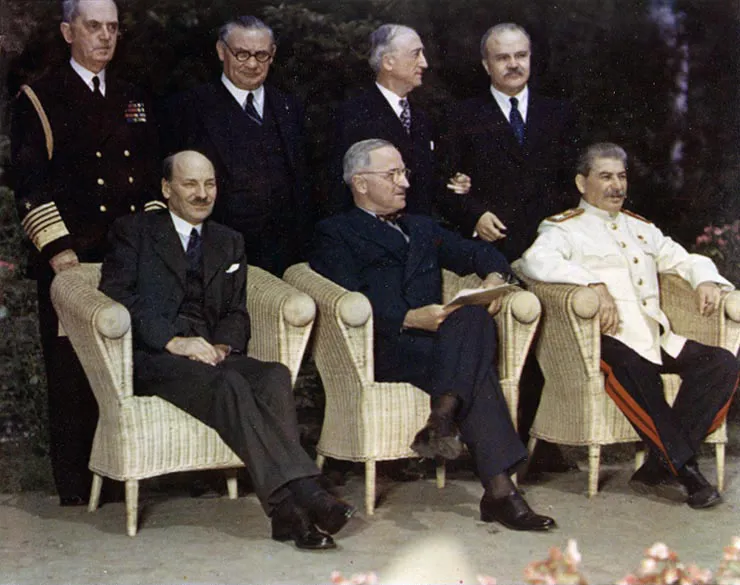
Potsdam conference 1945-8.jpg Source: Wikimedia Commons - Army Signal Corps Collection in the U.S. National Archives.
The Cold War began shortly after the end of World War II, as the United States and the Soviet Union emerged as rival superpowers. Although they had worked together to defeat Nazi Germany, their differences quickly led to growing tension. The Cold War was not a traditional war with armies fighting directly. Instead, it was a period of political, economic, and military rivalry that lasted for decades.
The main cause of the Cold War was the conflict between two different ideologies. The United States believed in democracy and capitalism, where people could vote for their leaders and own private property. The Soviet Union supported communism, where the government controlled the economy and one political party made most decisions. These opposing systems created deep suspicion and distrust.
After World War II, both countries wanted to shape the world according to their own ideas. The United States promoted freedom and economic growth in Western Europe, while the Soviet Union spread its influence in Eastern Europe. The division of Germany and the city of Berlin into separate zones controlled by different countries became a symbol of this struggle. The Iron Curtain described the dividing line between democratic Western Europe and communist Eastern Europe.
As tension increased, the United States and Soviet Union entered an arms race. Both sides built up large numbers of nuclear weapons, trying to stay ahead and prevent the other from gaining an advantage. This competition was dangerous and led to fears of worldwide destruction. Although the two superpowers never fought each other directly, they became involved in conflicts in other countries, such as Korea and Vietnam, by supporting opposing sides.
The Cold War also featured propaganda campaigns, espionage (spying), and efforts to gain allies around the globe. Each side tried to prove its system was better. The United States formed alliances like NATO, while the Soviet Union created the Warsaw Pact. These alliances increased the sense of division between East and West.
Despite the dangers, the Cold War had some positive effects, such as advances in science, technology, and space exploration. However, the competition also caused anxiety and affected daily life for millions of people. The Cold War shaped international relations for nearly half a century, ending only with the collapse of the Soviet Union in 1991.
Interesting Fact: The term "Cold War" was first used by writer George Orwell in 1945 to describe a world living in the shadow of nuclear weapons and political conflict.
When did the Cold War begin?
After World War IIBefore World War IIn 1991During the Vietnam War
Which two countries were superpowers?
United States and Soviet UnionFrance and BritainGermany and JapanChina and India
What divided Western and Eastern Europe?
Iron CurtainBerlin WallGreat WallPacific Ocean
Why did the US and Soviet Union mistrust each other?
Different ideologiesSame leadersBoth were democraciesShared a language
What is an arms race?
Building more weaponsRunning a marathonTrading goodsSharing technology
How did the Cold War affect daily life?
Caused anxietyNo effectMade people happyCreated new countries
The Cold War featured direct fighting. True or false?
TrueFalse
What does 'ideology' mean?
A set of beliefsA kind of weaponA famous leaderA secret code
Perfect For:
👩🏫 Teachers
• Reading comprehension practice
• Auto-graded assessments
• Literacy skill development
👨👩👧👦 Parents
• Reading practice at home
• Comprehension improvement
• Educational reading time
🏠 Homeschoolers
• Reading curriculum support
• Independent reading practice
• Progress monitoring
Reading Features:
📖
Reading Passage
Engaging fiction or nonfiction text
❓
Comprehension Quiz
Auto-graded questions
📊
Instant Feedback
Immediate results and scoring
📄
Printable Version
Download for offline reading
🔊
Read Aloud
Voice-over with word highlighting
Reviews & Ratings
No reviews yet. Be the first to share your experience!
Related Content
Native American Tribes Across America
This engaging history reading passage introduces students to Native American tribes across America, focusing on their da...
D2.HIS.1.3-5D2.HIS.2.3-5RI.4.1RI.4.2
Teepees: Homes on the Great Plains
This engaging history reading passage introduces students to teepees, the unique homes of Native American tribes on the ...
D2.HIS.2.3-5D2.HIS.14.3-5RI.4.1RI.4.2RI.4.4
Traditional Native American Clothing
This engaging history passage explores traditional Native American clothing and how it reflected the environment, values...
D2.HIS.2.3-5D2.HIS.3.3-5RI.4.3RI.4.4
The Iroquois Confederacy: A System of Peace
This engaging U.S. History reading passage introduces students to the Iroquois Confederacy, a powerful alliance of Nativ...
D2.HIS.2.3-5D2.HIS.3.3-5RI.4.3RI.4.4
The Cherokee Nation: History and Culture
This reading passage explores the rich history and culture of the Cherokee Nation, one of the largest Native American tr...
D2.HIS.2.3-5D2.HIS.14.3-5RI.4.3RI.4.4RI.4.10
The Sioux: Warriors and Tribal Leaders
This history reading passage explores the Sioux Nation, focusing on their roles as warriors and tribal leaders. Students...
D2.HIS.1.3-5D2.HIS.2.3-5RI.4.1RI.4.3
Native American Respect for Nature
This engaging history reading passage explores Native American respect for nature, emphasizing the close relationship be...
D2.HIS.2.3-5D2.HIS.3.3-5RI.4.3RI.4.4
Jamestown: The First Permanent English Colony
This engaging history passage explores the founding of Jamestown, the first permanent English colony in America. Aligned...
D2.HIS.1.3-5D2.HIS.2.3-5RI.4.3RI.4.4
Pocahontas and the Powhatan People
This engaging reading passage explores the life of Pocahontas and the Powhatan people and their important role in early ...
D2.HIS.1.3-5D2.HIS.2.3-5RI.4.1RI.4.3
Colonial Children: School and Chores
This reading passage explores the daily lives of colonial children, focusing on their experiences at school and their ma...
D2.HIS.2.3-5D2.HIS.3.3-5RI.4.1RI.4.2RI.4.4
Colonial Clothing and Homemade Goods
This engaging U.S. history passage explores the daily life of early American colonists with a focus on colonial clothing...
D2.HIS.2.3-5RI.4.3RI.4.4
Colonial Jobs: Blacksmiths, Bakers, and Craftsmen
This engaging history reading passage explores the vital roles of blacksmiths, bakers, and craftsmen in colonial America...
D2.HIS.2.3-5D2.HIS.3.3-5RI.4.3RI.4.4
Colonial Towns and Village Life
This engaging history reading passage explores the daily life, work, and unity found in colonial towns and villages. Ali...
D2.HIS.1.3-5D2.HIS.2.3-5RI.4.3RI.4.4
Colonial Trade with England and Africa
This history reading passage explores colonial trade between the American colonies, England, and Africa, focusing on the...
D2.HIS.2.3-5D2.HIS.14.3-5RI.4.3RI.4.4
Benjamin Franklin: Printer, Inventor, and Leader
This history reading passage explores the life and achievements of Benjamin Franklin, one of America's most important ea...
D2.HIS.2.3-5D2.HIS.3.3-5RI.4.1RI.4.3
George Washington Leads the Army
This engaging history reading passage explores how George Washington bravely led the Continental Army during the America...
D2.HIS.1.3-5D2.HIS.2.3-5RI.4.3RI.4.4
Women and Children During the Revolutionary War
This reading passage explores the important roles women and children played during the Revolutionary War. Students will ...
D2.HIS.2.3-5RI.4.3RI.5.3
African Americans Fight for Freedom
This educational passage explores the brave and inspiring story of how African Americans fought for freedom in the Unite...
D2.HIS.2.3-5D2.HIS.3.3-5RI.4.3RI.4.4
The Battle of Yorktown Ends War
This engaging U.S. history reading passage explores the Battle of Yorktown, a key event that ended the American Revoluti...
D2.HIS.1.3-5D2.HIS.2.3-5RI.4.1RI.4.3
Loyalists vs. Patriots: Divided Families
This engaging U.S. history reading passage explores the division between Loyalists and Patriots during the American Revo...