Compounds vs. Mixtures
Interactive passage with audio narration, comprehension questions, and printable PDF.
By completing this purchase you agree to our Terms of Use and Privacy Policy. Your subscription renews automatically until you cancel. You can cancel anytime from your account settings. All sales are final and non-refundable. Digital content is available for download in your account immediately upon purchase.
What's included
Compounds vs. Mixtures preview and details
About this printable Compounds vs. Mixtures science reading passage, NGSS-aligned (Grades 5-8)
Sample passage and quiz from Compounds vs. Mixtures
Reading passage and comprehension quiz preview
Compounds vs. Mixtures
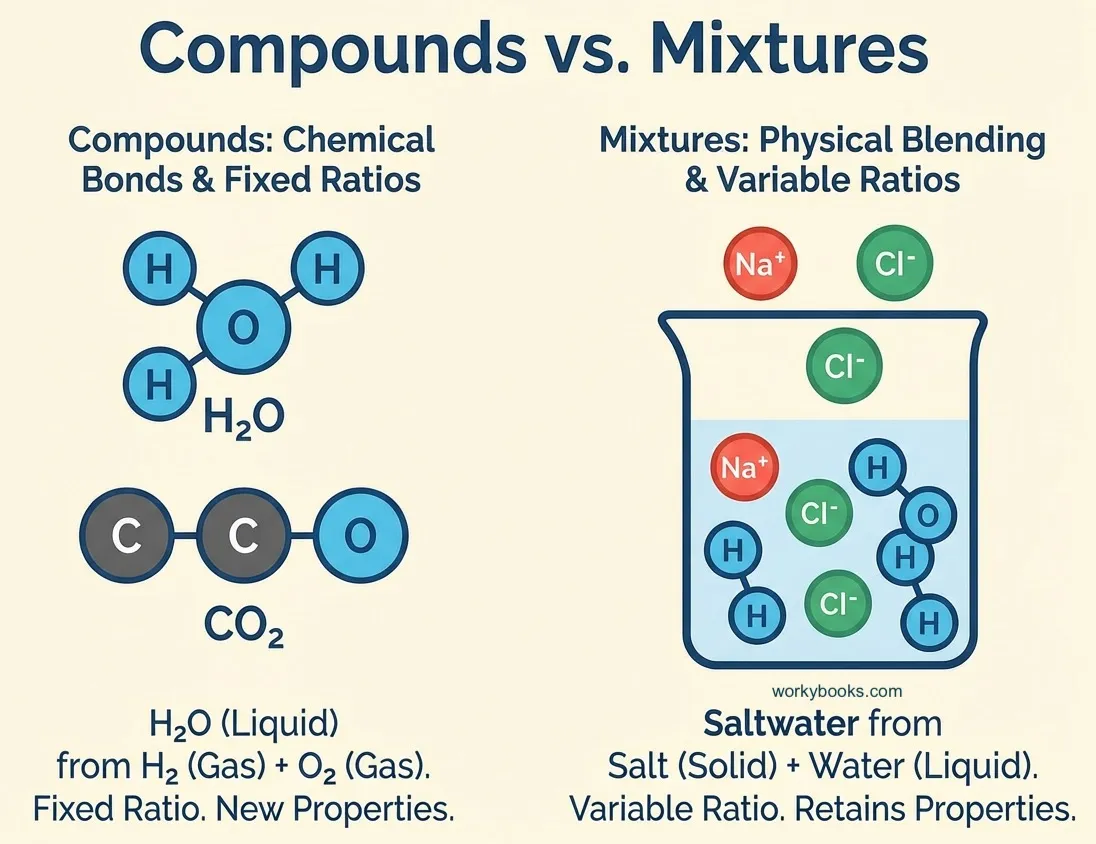
Compounds and mixtures are two fundamental ways matter is organized in the natural and human-made world. When a scientist examines water and salt water, the difference comes down to how the substances are combined and the properties that result. Understanding the distinction between compounds and mixtures is essential for chemistry and for practical applications like water purification or making medicines. This passage explores how compounds form through chemical bonding and have fixed properties, while mixtures are physically blended and can be separated by physical methods.
How Compounds Form and Their Properties
A compound is a substance made when two or more different elements join together by forming chemical bonds. These bonds are strong connections that involve sharing or transferring electrons. In a compound, the elements always combine in a specific, fixed ratio. For example, water (H₂O) always contains two hydrogen atoms for every one oxygen atom. This fixed ratio gives compounds unique, new properties that are different from the elements that formed them. For instance, hydrogen and oxygen are both gases at room temperature, but when combined as water, they make a liquid essential for life. Another example is carbon dioxide (CO₂), a colorless gas formed from carbon and oxygen. The specific ratio and chemical bonds mean you cannot separate compounds into their original elements using physical methods like filtering or boiling. Only a chemical reaction can break them apart.
Mixtures: Physical Blending and Variable Ratios
In contrast, a mixture is made by physically combining two or more substances, which can be elements or compounds. The substances in a mixture keep their own properties and are not chemically bonded. The ratio of parts in a mixture can vary. For example, salt water is a mixture: you can have a little salt or a lot, and the water and salt keep their original properties. Air is another example—a mixture of nitrogen, oxygen, carbon dioxide, and other gases. Because the parts of a mixture are not chemically bonded, they can often be separated by physical means. Methods like filtration (using a filter to separate solids from liquids), evaporation (letting a liquid turn to gas and leave solids behind), or distillation (using boiling and condensation to separate substances) are all ways to separate mixtures.
Why the Difference Matters: Applications and Implications
The distinction between compounds and mixtures is crucial in science and technology. For example, when engineers design medicines, they need exact compounds with reliable properties. If they used mixtures, the results could be unpredictable because the ratio of ingredients could change. Environmental scientists use separation techniques to clean pollutants from water, relying on the fact that mixtures can be separated by physical methods. Understanding the fixed properties of compounds helps scientists predict how substances will behave in reactions, while knowing about mixtures allows for flexibility in creating new materials or solutions. These concepts connect to broader scientific ideas, such as the conservation of mass and the structure of matter.
Recognizing whether something is a compound or a mixture helps us make better decisions in daily life, industry, and environmental protection. It also deepens our understanding of how the world is built at the molecular level and how we can interact with it using science.
Interesting Fact: The air you breathe is a mixture, not a compound, because its composition can change from place to place—unlike water, which is always H₂O everywhere on Earth.
Comprehension quiz (10 questions)
1. Which of the following best describes a compound?
2. What is a key difference between mixtures and compounds?
3. Which example is a compound?
4. What method would you use to separate salt from salt water?
5. What does 'chemical bond' mean in the context of compounds?
6. In the passage, what does 'properties' mean?
7. Why can't you separate a compound into its elements by filtering or boiling?
8. A student wants to separate a mixture of sand and water. Which method should they use?
9. True or False: The ratio of elements in a compound can change depending on where it is found.
10. True or False: Air is a compound because it always has the same ratio of gases everywhere.
Perfect for the way you teach
- Build comprehension skills
- Auto-graded quiz
- Differentiated reading
- Read together at home
- Improve fluency
- Quiet reading time
- Reading curriculum support
- Independent practice
- Track Lexile growth