Nucleus of the Atom
Interactive passage with audio narration, comprehension questions, and printable PDF.
By completing this purchase you agree to our Terms of Use and Privacy Policy. Your subscription renews automatically until you cancel. You can cancel anytime from your account settings. All sales are final and non-refundable. Digital content is available for download in your account immediately upon purchase.
What's included
Nucleus of the Atom preview and details
About this printable Nucleus of the Atom science reading passage, NGSS-aligned (Grades 5-8)
Sample passage and quiz from Nucleus of the Atom
Reading passage and comprehension quiz preview
Nucleus of the Atom
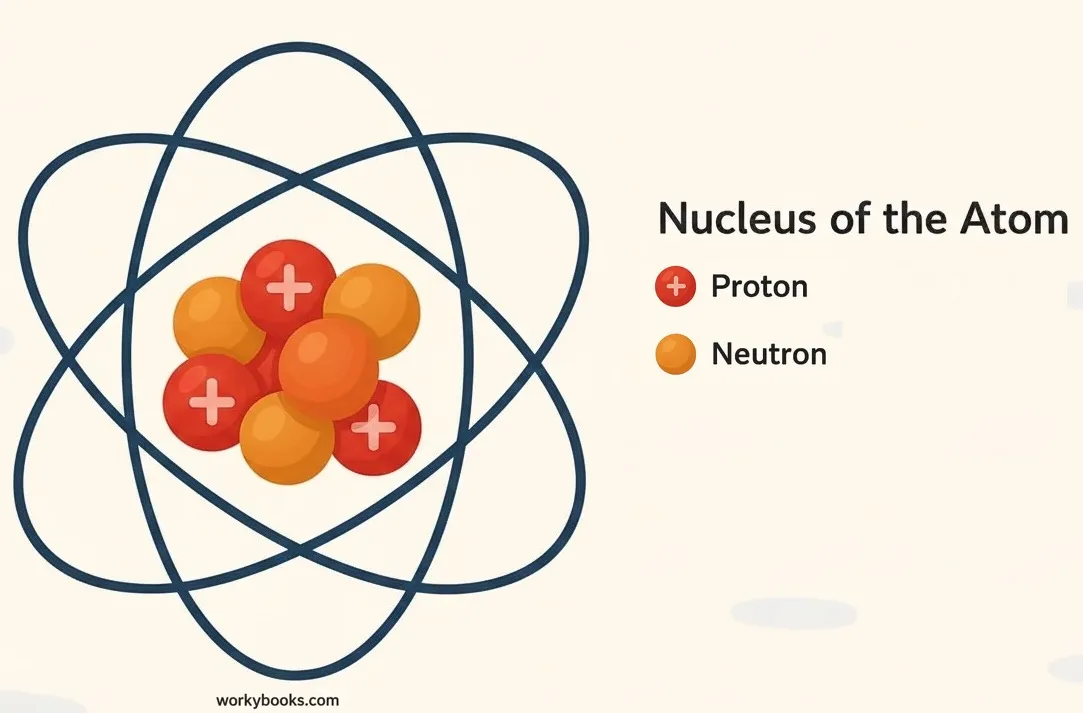
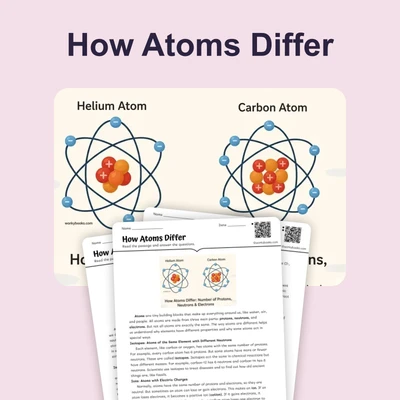
Atoms are the building blocks of all matter in the universe, from the air we breathe to the stars in distant galaxies. At the center of every atom lies the nucleus, a tiny region that holds almost all the atom's mass. Although the nucleus is extremely small compared to the entire atom, it is packed with positively charged protons and neutral neutrons. This dense core is what gives each atom its unique identity and determines how it interacts with other atoms.
Structure and Composition of the Nucleus
The nucleus is made up of two main particles: protons and neutrons. Protons carry a positive electrical charge, while neutrons have no charge at all. These particles are held together by the strong nuclear force, one of the four fundamental forces in nature, which is much stronger than the repulsive force between positive charges. Even though the number of protons and neutrons varies between elements, the nucleus always contains nearly all of the atom's mass. For example, in a hydrogen atom, the nucleus is about 100,000 times smaller than the whole atom, yet it accounts for more than 99.9% of its mass. If the atom were the size of a sports stadium, the nucleus would be the size of a marble at the center of the field.
Function and Importance of the Nucleus
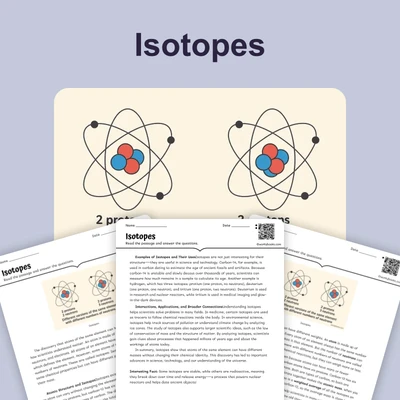
The arrangement of protons in the nucleus determines the atomic number of the element, which defines what kind of atom it is (like hydrogen, carbon, or oxygen). The number of neutrons can vary, creating different isotopes of the same element. Changes in the nucleus, such as the splitting (fission) or combining (fusion) of nuclei, release enormous amounts of energy. This nuclear energy powers the sun and can be harnessed for electricity in nuclear power plants. The stability of the nucleus also plays a key role in radioactive decay, a process used in medicine and archaeology to date ancient materials.
Scientific Discovery and Broader Implications
Scientists have learned about the nucleus through experiments like the famous gold foil experiment, which showed that most of the atom is empty space with a dense center. Understanding the nucleus has led to advances in technology, from nuclear medicine that treats diseases to smoke detectors that keep homes safe. The study of nuclei also connects to larger scientific principles, such as the conservation of mass and energy, and helps explain the origin of elements in stars.
In summary, the nucleus is a small but mighty part of the atom, responsible for its mass, structure, and many properties. Its discovery and study have shaped our understanding of the universe and continue to inspire scientific breakthroughs.
Interesting Fact: If the atom were blown up to the size of a football stadium, the nucleus would still be no bigger than a marble—yet it would contain nearly all the atom’s mass!
Comprehension quiz (10 questions)
1. What is located at the center of every atom?
2. Which particles are found in the nucleus?
3. What percentage of an atom’s mass is in the nucleus?
4. What force holds protons and neutrons together in the nucleus?
5. In the passage, what analogy is used to describe the size of the nucleus compared to the atom?
6. What determines the identity (element) of an atom?
7. Which process involves the splitting of a nucleus to release energy?
8. The term 'isotope' refers to atoms of the same element that have:
9. True or False: The nucleus of an atom contains electrons.
10. True or False: Nuclear energy can be used to generate electricity.
Perfect for the way you teach
- Build comprehension skills
- Auto-graded quiz
- Differentiated reading
- Read together at home
- Improve fluency
- Quiet reading time
- Reading curriculum support
- Independent practice
- Track Lexile growth