What are Ions
Interactive passage with audio narration, comprehension questions, and printable PDF.
By completing this purchase you agree to our Terms of Use and Privacy Policy. Your subscription renews automatically until you cancel. You can cancel anytime from your account settings. All sales are final and non-refundable. Digital content is available for download in your account immediately upon purchase.
What's included
What are Ions preview and details
About this printable What are Ions science reading passage, NGSS-aligned (Grades 5-8)
Sample passage and quiz from What are Ions
Reading passage and comprehension quiz preview
What are Ions
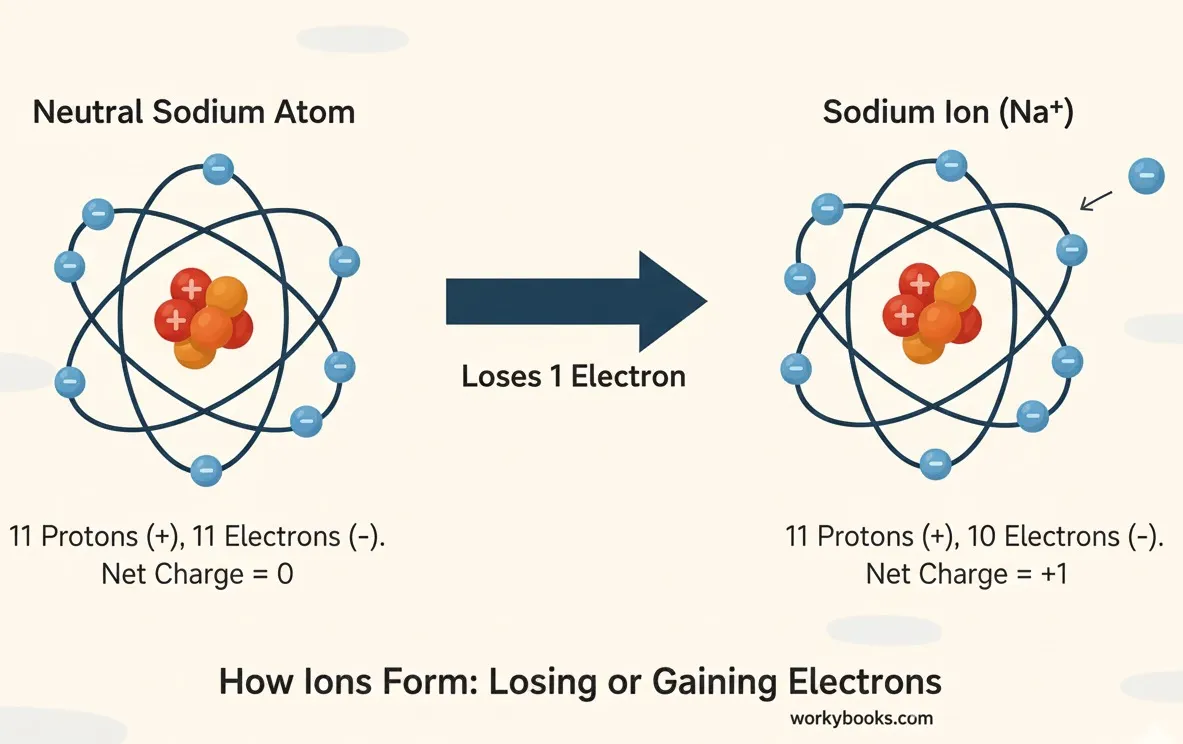
In table salt, sodium and chlorine atoms combine to form a substance essential for life. This combination happens because of a process called ion formation. Ions are atoms or molecules that carry an electric charge after gaining or losing electrons. Understanding how ions form helps explain many natural phenomena, from how electricity works in your body to the formation of minerals in rocks.
How Ions Form: The Role of Valence Electrons
Atoms are made of protons, neutrons, and electrons. The electrons move in regions called shells, with the outermost shell containing the valence electrons. Atoms are most stable when their outer shell is full. For many elements, this means having 8 valence electrons, a state known as the octet rule. However, most atoms do not start with a full outer shell. To reach stability, atoms can either lose or gain electrons. When an atom loses one or more electrons, it becomes a positively charged cation. For example, a sodium atom (Na) has one valence electron. If it loses this electron, it becomes Na+, a cation. Conversely, when an atom gains electrons, it becomes a negatively charged anion. Chlorine (Cl) has seven valence electrons and needs one more to complete its shell. When a chlorine atom gains an extra electron, it becomes Cl−, an anion. This transfer of electrons is called ionic bonding, and it results in charged particles that can interact with each other.
Examples and Applications: Ions in Action
Ion formation is not limited to sodium and chlorine. Calcium (Ca) atoms can lose two electrons to become Ca2+, which is important for bone health and nerve function. In your body, ions help transmit electrical signals in nerves and muscles. For example, the movement of potassium (K+) and sodium (Na+) ions across cell membranes is essential for your heartbeat. In nature, ions dissolved in water make it possible for plants to absorb nutrients from soil. The ability to form ions also allows metals to conduct electricity, making them useful in technology and engineering.
Connecting Ions to Chemical Reactions and Stability
The formation of ions is a fundamental part of many chemical reactions. When ions of opposite charges come together, they form ionic compounds with unique properties, such as high melting points and the ability to dissolve in water. The stability achieved through ion formation explains why elements react in predictable ways. For instance, elements in the same group on the periodic table tend to form similar ions due to their similar number of valence electrons. This pattern helps chemists predict how substances will behave during reactions and when designing new materials.
Understanding ion formation connects basic atomic structure to larger scientific ideas about the behavior of matter. It helps explain everyday phenomena, from why salt dissolves in water to how your nerves send signals. As researchers develop new batteries and medical technologies, knowledge about ions continues to shape innovation and discovery.
Interesting Fact:
Every time you taste something salty, you are experiencing ions in action—sodium and chloride ions trigger taste receptors on your tongue!
Comprehension quiz (10 questions)
1. What is an ion?
2. What do we call ions with a positive charge?
3. Which part of an atom is involved in forming ions?
4. What is the main function of sodium (Na⁺) and potassium (K⁺) ions in the body?
5. Why do atoms form ions?
6. What happens when a chlorine atom (Cl) gains an electron?
7. In the passage, what is an example of an ionic compound?
8. True or False: Metals conduct electricity because their ions can move freely.
9. True or False: All atoms start with a full outer shell of electrons.
10. Which term describes the tendency of atoms to want 8 electrons in their outer shell?
Perfect for the way you teach
- Build comprehension skills
- Auto-graded quiz
- Differentiated reading
- Read together at home
- Improve fluency
- Quiet reading time
- Reading curriculum support
- Independent practice
- Track Lexile growth