This learning resource is available in interactive and printable formats. The interactive worksheet can be played online and assigned to students. The Printable PDF version can be downloaded and printed for completion by hand.
This middle school science reading passage, aligned with NGSS standard MS-PS1-1, explores the fundamental differences among atoms. Students will learn the scientific mechanisms behind isotopes—atoms of the same element with different numbers of neutrons—and ions, which are atoms that have gained or lost electrons and become charged. The passage explains why atoms of different elements behave uniquely, focusing on how their atomic structure determines chemical properties and reactions. Real-world examples, such as carbon isotopes and sodium ions, are included to connect the science to everyday life and technology. The resource also features a glossary, differentiated reading versions, Spanish translations, multiple-choice questions, writing prompts, and graphic organizers. Audio integration is available to support diverse learners. This comprehensive resource helps students understand the foundational concepts of atomic structure and prepares them for deeper explorations in chemistry and physical science.
CONTENT PREVIEW
Expand content preview
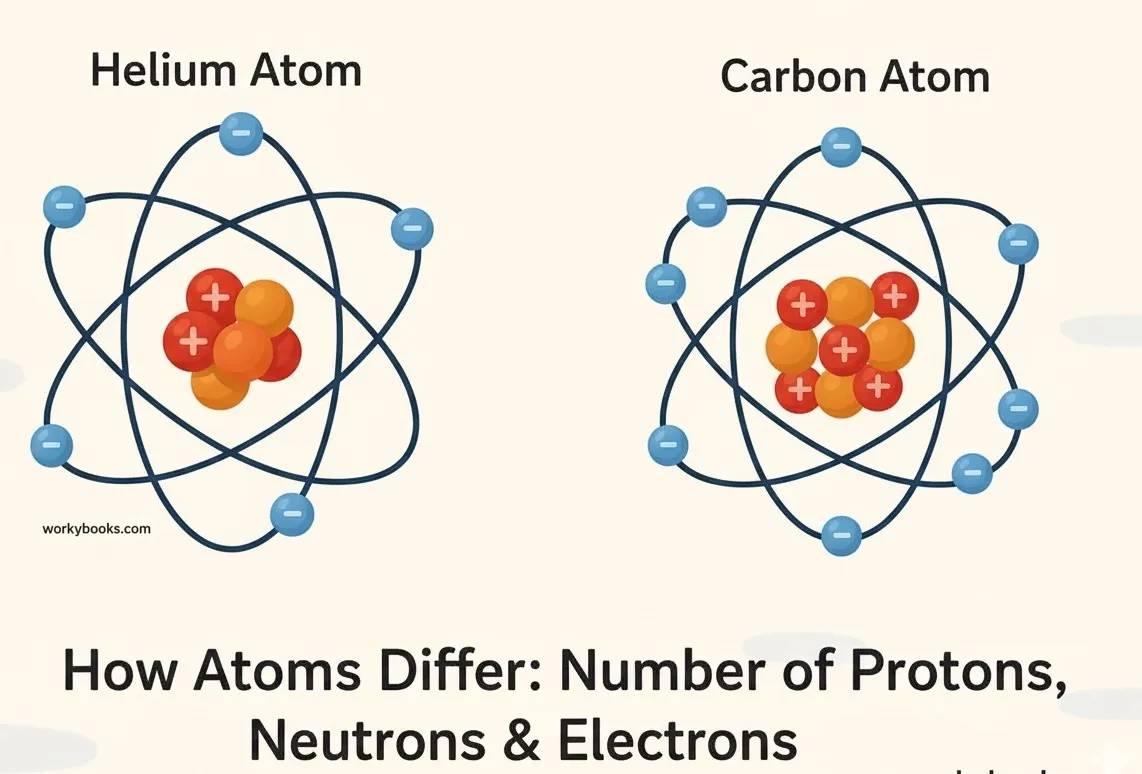
Atoms make up everything in the universe, from the air we breathe to the water we drink. Even though all atoms are built from the same three particles—protons, neutrons, and electrons—not all atoms are identical. The differences between atoms help explain why elements have unique properties and why some atoms behave in special ways. Understanding these differences is crucial for exploring the structure and behavior of matter.
Isotopes: Same Element, Different Neutrons
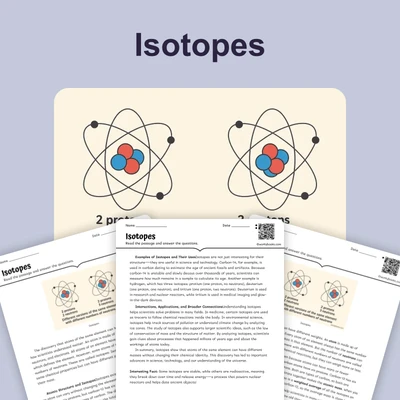
Atoms of the same element always have the same number of protons. For example, every carbon atom has 6 protons. However, atoms can have different numbers of neutrons. These variations are called isotopes. Isotopes of an element have the same chemical behavior because they have the same number of protons and electrons, but their mass is different. For example, carbon-12 and carbon-14 are both forms of carbon, but carbon-12 has 6 neutrons while carbon-14 has 8 neutrons. Scientists use isotopes in fields like medicine (for cancer treatment) and archaeology (for dating ancient objects using radioactive carbon).
Ions: When Atoms Gain or Lose Electrons
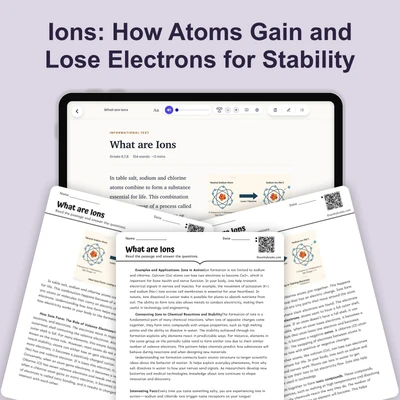
Atoms are normally neutral, with equal numbers of protons and electrons. Sometimes, an atom can gain or lose electrons. This process creates ions, which are atoms with an electric charge. If an atom loses one or more electrons, it becomes a positively charged ion (cation). If it gains electrons, it becomes a negatively charged ion (anion). For example, a sodium atom (Na) loses one electron to become Na+, which is essential for nerve signals in your body. Chlorine gains an electron to become Cl-, making table salt (NaCl) when it joins with sodium ions.
Why Different Elements Behave Differently
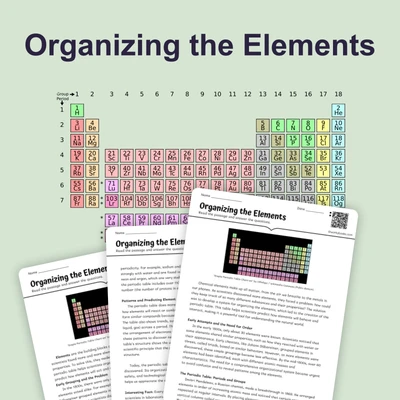
The number of protons in an atom's nucleus determines its element. Each element has a unique number of protons, called its atomic number. This difference in atomic number causes different arrangements of electrons, which affect how atoms interact in chemical reactions. For example, oxygen atoms can attract electrons more strongly than hydrogen atoms. This property helps water form and gives it unique characteristics. Elements like helium are stable because their outer electron shells are full, while others, like sodium, are more reactive. These behaviors are explained by the periodic table, which organizes elements by their atomic structure and properties.
In summary, atoms differ in the number of neutrons (isotopes) and in their electric charge (ions). These differences help explain why elements react differently and why the world is made up of such a variety of materials. Scientists continue to study atoms to unlock new technologies, improve healthcare, and understand our universe on the smallest scale.
Interesting Fact: Some isotopes are unstable and release energy as radiation. Carbon-14 is used by archaeologists to date fossils and ancient remains up to 50,000 years old!
What are the three main particles that make up an atom?
Protons, neutrons, and electronsNeutrons, molecules, and ionsElectrons, elements, and compoundsProtons, molecules, and anions
What do all atoms of the same element have in common?
The same number of protonsThe same number of neutronsThe same massThe same electric charge
Which of the following best describes an isotope?
Atoms with different numbers of protonsAtoms with different numbers of electronsAtoms with different numbers of neutronsAtoms with different atomic numbers
What is an ion?
An atom with no chargeAn atom that has gained or lost electronsAn atom with more protons than neutronsAn atom with the same number of protons as electrons
How does the periodic table organize elements?
By their atomic number and propertiesBy their colorBy their massBy their size
In the passage, what is a cation?
A positively charged ionA negatively charged ionA type of isotopeAn atom with extra neutrons
Why do sodium and chlorine form table salt?
Because both are isotopesBecause sodium loses an electron and chlorine gains it, making ions that join togetherBecause both are neutral atomsBecause they have the same number of protons
Which statement is supported by the passage?
Atoms of the same element can have different numbers of neutronsAll atoms have the same number of protons and neutronsElectrons are found in the nucleusIsotopes have different chemical properties
Atoms can become ions by gaining or losing electrons. (True/False)
TrueFalse
All isotopes of an element have the same number of protons. (True/False)
TrueFalse
Perfect For:
👩🏫 Teachers
• Reading comprehension practice
• Auto-graded assessments
• Literacy skill development
👨👩👧👦 Parents
• Reading practice at home
• Comprehension improvement
• Educational reading time
🏠 Homeschoolers
• Reading curriculum support
• Independent reading practice
• Progress monitoring
Reading Features:
📖
Reading Passage
Engaging fiction or nonfiction text
❓
Comprehension Quiz
Auto-graded questions
📊
Instant Feedback
Immediate results and scoring
📄
Printable Version
Download for offline reading
🔊
Read Aloud
Voice-over with word highlighting
Reviews & Ratings
No reviews yet. Be the first to share your experience!
Related Content
Atomic Structure
This reading passage on Atomic Structure provides middle school students with an accessible explanation of the fundament...
MS-PS1-1RI.6.3RI.7.1
Parts of an Atom
This reading passage on Parts of an Atom provides middle school students with a structured and accessible explanation of...
MS-PS1-1RI.6.3RI.7.1
Chemical Bonds
This reading passage on Chemical Bonds provides middle school students with a clear explanation of how and why atoms con...
MS-PS1-1RI.6.3RI.7.1
The Freezing Point of Water
This science reading passage, titled 'The Freezing Point of Water', introduces students to a key physical science concep...
MS-PS1-1RI.6.3RI.7.1
Physical Properties of Matter
This comprehensive reading passage introduces grades 6-8 students to the concept of physical properties of matter, perfe...
MS-PS1-1
Mixtures and Pure Substances
This middle school science passage provides an in-depth exploration of mixtures and pure substances, directly aligned to...
MS-PS1-1
Types of Mixtures
This comprehensive science passage for grades 6-8 introduces students to the concept of mixtures, focusing on distinguis...
MS-PS1-1
Solutions, Suspensions, and Colloids
This comprehensive science passage explores the differences between solutions, suspensions, and colloids, focusing on ho...
MS-PS1-1
The Nature of Science
This passage explores the nature of science for middle school students, aligning with NGSS standards MS-ETS1-4, MS-PS1-1...
MS-ETS1-4MS-PS1-1MS-LS1-1
Scientific Theories
This reading passage for grades 6-8 introduces students to the concept of scientific theories, emphasizing that these ar...
MS-PS1-1MS-PS1-4MS-PS3-4SCIENCE AND ENGINEERING PRACTICES
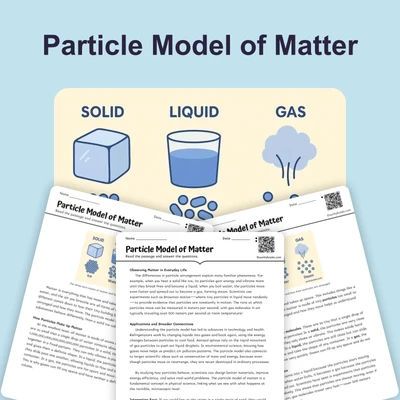
Particle Model of Matter
This comprehensive science reading passage for grades 6-8 explores the particle model of matter, aligning with NGSS stan...
MS-PS1-1MS-PS1-4
Valence Electrons
This middle school science passage introduces students to the concept of valence electrons, the outermost electrons that...
MS-PS1-1
The Idea of the Atom
This informational science passage introduces middle school students (grades 6-8) to the concept that all matter is made...
MS-PS1-1
Protons, Neutrons, and Electrons
This comprehensive middle school science passage explores the roles of protons, neutrons, and electrons, the three main ...
MS-PS1-1
What are Ions
This passage introduces middle school students to the concept of ions, explaining the processes by which atoms gain or l...
MS-PS1-1
Nucleus of the Atom
This comprehensive passage for grades 6-8 introduces students to the nucleus of the atom, the dense center that contains...
MS-PS1-1
Isotopes
This middle school science passage explores the concept of isotopes, which are atoms of the same element with different ...
MS-PS1-1
Compounds vs. Mixtures
This educational passage for grades 6-8 explores the fundamental differences between compounds and mixtures, aligning wi...
MS-PS1-1
Organizing the Elements
This passage for middle school science explores how scientists organized the elements as more were discovered, leading t...