This learning resource is available in interactive and printable formats. The interactive worksheet can be played online and assigned to students. The Printable PDF version can be downloaded and printed for completion by hand.
This middle school science passage explores the concept of isotopes, which are atoms of the same element with different numbers of neutrons. Aligned to NGSS standard MS-PS1-1, the text defines isotopes, explains how differences in neutron numbers affect atomic mass, and illustrates these ideas with examples such as carbon-12, carbon-14, and the hydrogen isotopes protium, deuterium, and tritium. Students will learn how isotopes are used in real-world applications like carbon dating and medical imaging, and how scientists use evidence to understand atomic structure. The resource features a main passage, a differentiated version for struggling readers, Spanish translations, glossary, comprehension quiz, writing prompts, and graphic organizers. Audio integration supports diverse learners. This lesson builds foundational knowledge of atomic structure and connects to broader scientific principles, preparing students for deeper study in chemistry and the physical sciences.
CONTENT PREVIEW
Expand content preview
Isotopes
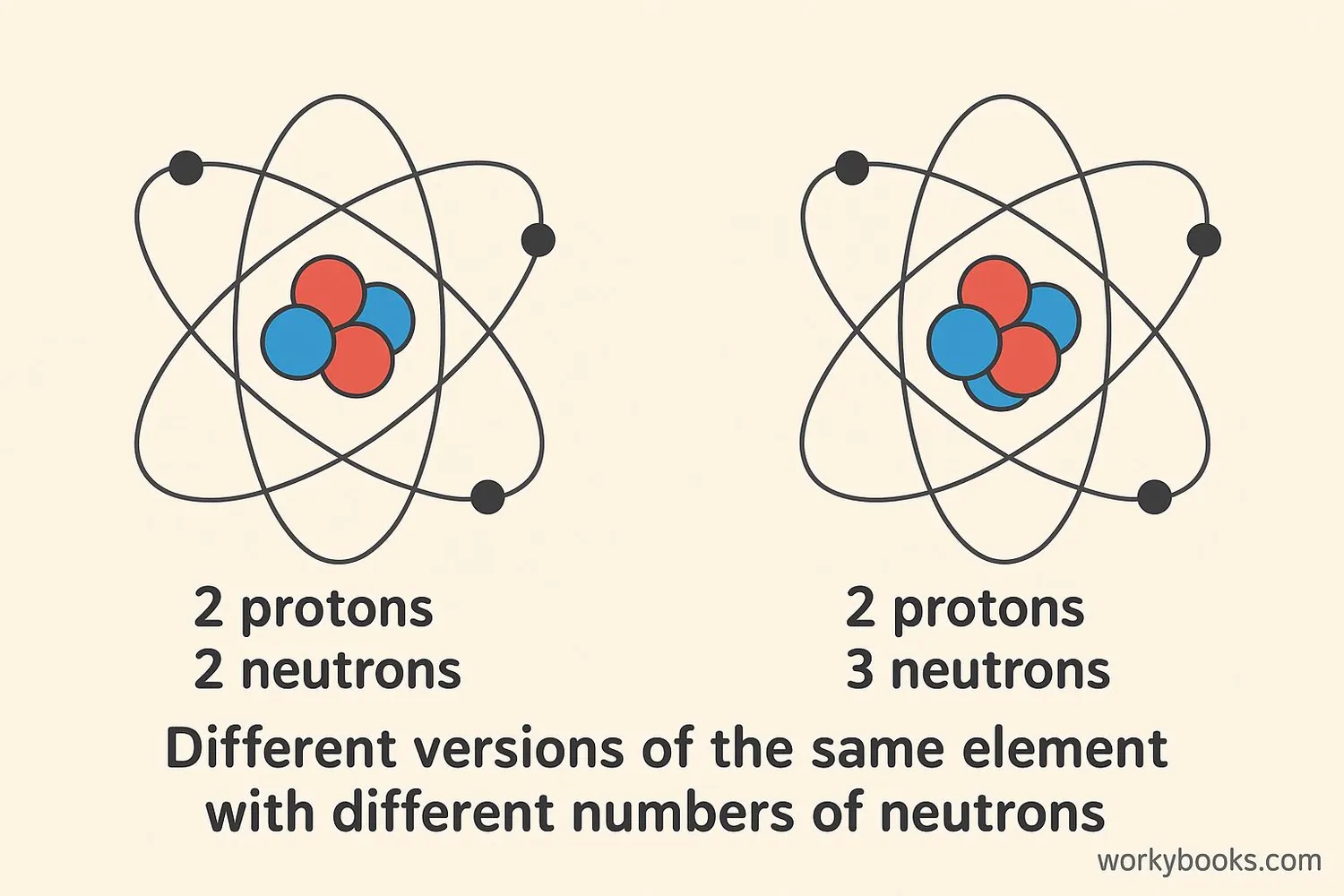
The discovery that atoms of the same element can have different masses changed how scientists understood matter. An atom is made of three main parts: protons, neutrons, and electrons. All atoms of an element have the same number of protons, which defines the element. However, some atoms of the same element have different numbers of neutrons. These are called isotopes. Isotopes of an element share the same chemical properties but can have different physical properties because of their mass.
Atomic Structure and Isotopes Isotopes exist because the number of neutrons in an atom can vary without changing the element's identity. For example, all carbon atoms have six protons, but carbon-12 has six neutrons, while carbon-14 has eight neutrons. Both are isotopes of carbon. The difference in neutron number causes a difference in atomic mass, which is the total number of protons and neutrons in an atom. The atomic mass listed on the periodic table is a weighted average of all the naturally occurring isotopes of an element, based on how common each isotope is. For carbon, about 98.9% of all atoms are carbon-12, so the average atomic mass is close to 12 atomic mass units (amu).
Examples of Isotopes and Their Uses Isotopes are not just interesting for their structure—they are useful in science and technology. Carbon-14, for example, is used in carbon dating to estimate the age of ancient fossils and artifacts. Because carbon-14 is unstable and slowly decays over thousands of years, scientists can measure how much remains in a sample to calculate its age. Another example is hydrogen, which has three isotopes: protium (one proton, no neutrons), deuterium (one proton, one neutron), and tritium (one proton, two neutrons). Deuterium is used in research and nuclear reactors, while tritium is used in medical imaging and glow-in-the-dark devices.
Interactions, Applications, and Broader Connections Understanding isotopes helps scientists solve problems in many fields. In medicine, certain isotopes are used as tracers to follow chemical reactions inside the body. In environmental science, isotopes help track sources of pollution or understand climate change by analyzing ice cores. The study of isotopes also supports larger scientific ideas, such as the law of conservation of mass and the structure of matter. By analyzing isotopes, scientists gain clues about processes that happened millions of years ago and about the workings of atoms today.
In summary, isotopes show that atoms of the same element can have different masses without changing their chemical identity. This discovery has led to important advances in science, technology, and our understanding of the universe.
Interesting Fact: Some isotopes are stable, while others are radioactive, meaning they break down over time and release energy—a process that powers nuclear reactors and helps date ancient objects!
What defines the identity of an element?
The number of protons in its atomsThe number of neutrons in its atomsThe total mass of its atomsThe number of electrons in its atoms
What is an isotope?
An atom with a different number of protonsAn atom with a different number of neutronsAn atom with more electrons than protonsAn atom with no nucleus
How is the atomic mass of an element on the periodic table determined?
It is the mass of the most common isotope only.It is the sum of all proton numbers for the element.It is a weighted average of all naturally occurring isotopes.It is the total number of elements in nature.
In the passage, what is one use of carbon-14?
Making glow-in-the-dark devicesEstimating the age of ancient objectsProducing food energyPowering nuclear reactors
What does the word 'tracers' mean as used in the passage?
Atoms that are very largeIsotopes used to follow chemical reactionsAtoms with no neutronsAtoms that decay quickly
What does 'weighted average' mean in this context?
An average that counts only the largest isotopeAn average that considers how common each isotope isAn average with no math involvedThe same as the most massive isotope
Why do isotopes of an element have different physical properties?
Because they have a different number of neutrons, changing their massBecause they have different numbers of protonsBecause they have different numbers of electronsBecause they are different elements
If a scientist finds a sample mostly containing carbon-12, what does this mean?
Carbon-12 is the most common isotope of carbonCarbon-14 is the most common isotope of carbonThe sample is not made of carbonThe atomic mass is more than 14 amu
True or False: All isotopes of an element have the same number of protons.
TrueFalse
True or False: Deuterium and tritium are both isotopes of hydrogen.
TrueFalse
Perfect For:
👩🏫 Teachers
• Reading comprehension practice
• Auto-graded assessments
• Literacy skill development
👨👩👧👦 Parents
• Reading practice at home
• Comprehension improvement
• Educational reading time
🏠 Homeschoolers
• Reading curriculum support
• Independent reading practice
• Progress monitoring
Reading Features:
📖
Reading Passage
Engaging fiction or nonfiction text
❓
Comprehension Quiz
Auto-graded questions
📊
Instant Feedback
Immediate results and scoring
📄
Printable Version
Download for offline reading
🔊
Read Aloud
Voice-over with word highlighting
Reviews & Ratings
No reviews yet. Be the first to share your experience!
Related Content
Atomic Structure
This reading passage on Atomic Structure provides middle school students with an accessible explanation of the fundament...
MS-PS1-1RI.6.3RI.7.1
Parts of an Atom
This reading passage on Parts of an Atom provides middle school students with a structured and accessible explanation of...
MS-PS1-1RI.6.3RI.7.1
Chemical Bonds
This reading passage on Chemical Bonds provides middle school students with a clear explanation of how and why atoms con...
MS-PS1-1RI.6.3RI.7.1
The Freezing Point of Water
This science reading passage, titled 'The Freezing Point of Water', introduces students to a key physical science concep...
MS-PS1-1RI.6.3RI.7.1
Physical Properties of Matter
This comprehensive reading passage introduces grades 6-8 students to the concept of physical properties of matter, perfe...
MS-PS1-1
Mixtures and Pure Substances
This middle school science passage provides an in-depth exploration of mixtures and pure substances, directly aligned to...
MS-PS1-1
Types of Mixtures
This comprehensive science passage for grades 6-8 introduces students to the concept of mixtures, focusing on distinguis...
MS-PS1-1
Solutions, Suspensions, and Colloids
This comprehensive science passage explores the differences between solutions, suspensions, and colloids, focusing on ho...
MS-PS1-1
The Nature of Science
This passage explores the nature of science for middle school students, aligning with NGSS standards MS-ETS1-4, MS-PS1-1...
MS-ETS1-4MS-PS1-1MS-LS1-1
Scientific Theories
This reading passage for grades 6-8 introduces students to the concept of scientific theories, emphasizing that these ar...
MS-PS1-1MS-PS1-4MS-PS3-4SCIENCE AND ENGINEERING PRACTICES
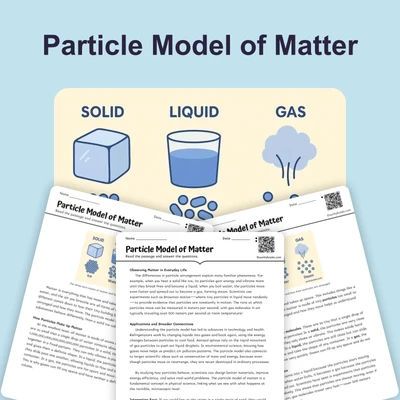
Particle Model of Matter
This comprehensive science reading passage for grades 6-8 explores the particle model of matter, aligning with NGSS stan...
MS-PS1-1MS-PS1-4
Valence Electrons
This middle school science passage introduces students to the concept of valence electrons, the outermost electrons that...
MS-PS1-1
The Idea of the Atom
This informational science passage introduces middle school students (grades 6-8) to the concept that all matter is made...
MS-PS1-1
Protons, Neutrons, and Electrons
This comprehensive middle school science passage explores the roles of protons, neutrons, and electrons, the three main ...
MS-PS1-1
What are Ions
This passage introduces middle school students to the concept of ions, explaining the processes by which atoms gain or l...
MS-PS1-1
Nucleus of the Atom
This comprehensive passage for grades 6-8 introduces students to the nucleus of the atom, the dense center that contains...
MS-PS1-1
How Atoms Differ
This middle school science reading passage, aligned with NGSS standard MS-PS1-1, explores the fundamental differences am...
MS-PS1-1
Compounds vs. Mixtures
This educational passage for grades 6-8 explores the fundamental differences between compounds and mixtures, aligning wi...
MS-PS1-1
Organizing the Elements
This passage for middle school science explores how scientists organized the elements as more were discovered, leading t...