Periodic Table of Elements
Interactive passage with audio narration, comprehension questions, and printable PDF.
By completing this purchase you agree to our Terms of Use and Privacy Policy. Your subscription renews automatically until you cancel. You can cancel anytime from your account settings. All sales are final and non-refundable. Digital content is available for download in your account immediately upon purchase.
What's included
Periodic Table of Elements preview and details
About this printable Periodic Table of Elements science reading passage, NGSS-aligned (Grades 5-8)
Sample passage and quiz from Periodic Table of Elements
Reading passage and comprehension quiz preview
Organizing the Elements
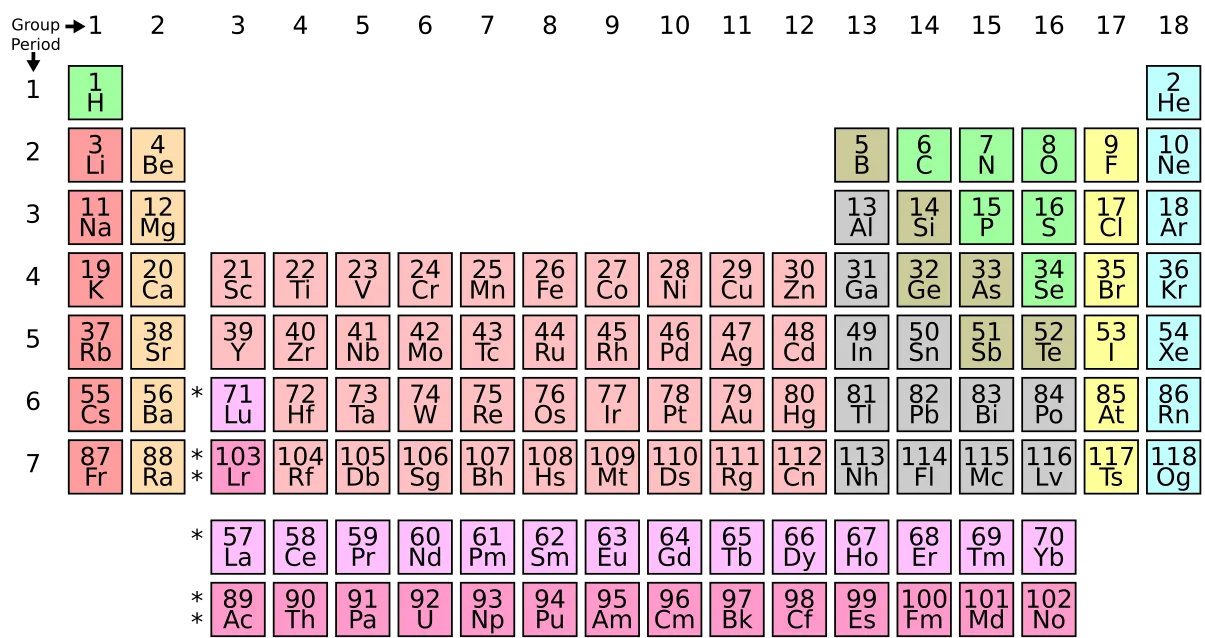
"Simple Periodic Table Chart-en" by Offnfopt / Wikimedia Commons (Public domain).
Chemical elements make up all matter, from the air we breathe to the metals in our phones. As scientists discovered more elements, they faced a problem: how could they keep track of so many different substances and their properties? The solution was to develop a system for organizing the elements, which led to the creation of the periodic table. This table helps scientists predict how elements will behave and interact, making it a powerful tool for understanding the natural world.
Early Attempts and the Need for Order
In the early 1800s, only about 30 elements were known. Scientists noticed that some elements shared similar properties, such as how they reacted with water or their appearance. Early chemists, like Johann Döbereiner, grouped elements in threes, called triads, based on similar behaviors. However, as more elements were discovered, these simple groupings became less effective. By the mid-1800s, over 60 elements had been identified, each with different atomic masses and characteristics. The need for a comprehensive organizational system became urgent to avoid confusion and to reveal patterns among the elements.
The Periodic Table: Periods and Groups
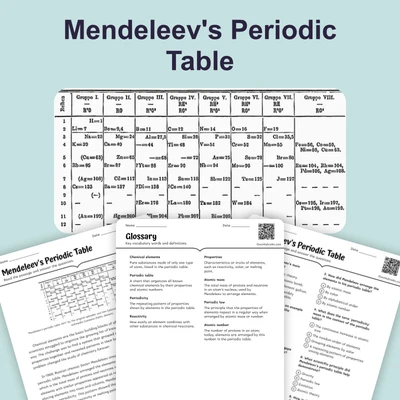
Dmitri Mendeleev, a Russian chemist, made a breakthrough in 1869. He arranged elements in order of increasing atomic mass and noticed that certain properties repeated at regular intervals. By placing elements with similar properties into vertical columns called groups or families, and horizontal rows called periods, Mendeleev’s periodic table revealed a repeating pattern—what scientists call periodicity. For example, sodium and potassium are both shiny metals that react strongly with water and are found in the same group. In contrast, noble gases like neon and argon, which are very stable and unreactive, form another group. Today, the periodic table includes over 110 elements, arranged by their increasing atomic number (the number of protons in each atom).
Patterns and Predicting Element Behavior
The periodic table does more than organize elements; it helps scientists predict how elements will react or combine. For example, elements in the same group often form similar compounds because they have the same number of valence electrons. The table also shows trends, such as increasing reactivity or changes in state (solid, liquid, gas) across a period. These patterns are not random—they are caused by the arrangement of electrons and the structure of atoms. Modern scientists use these patterns to discover new materials and design safer medicines. The periodic table’s structure shows the underlying system in nature and connects to the broader scientific principle that the properties of matter are determined by atomic structure.
Today, the periodic table is a living document, updated as new elements are discovered. Its organization continues to guide scientific research, environmental safety, and technological innovation. Understanding how the elements are arranged helps us appreciate the order and predictability found in the natural world.
Interesting Fact: Every element heavier than uranium (element 92) has been made by scientists in laboratories, not found naturally on Earth.
Comprehension quiz (10 questions)
1. What problem did scientists face as more elements were discovered?
2. Who created the first widely accepted version of the periodic table?
3. What is a group (or family) in the periodic table?
4. What does 'periodicity' mean in the context of the periodic table?
5. Which property do elements in the same group usually share?
6. What is the main benefit of organizing elements in the periodic table?
7. Which of the following is an example of a group mentioned in the passage?
8. True or False: The periodic table is only useful for chemistry, not for technology or medicine.
9. True or False: Every element heavier than uranium is found naturally on Earth.
10. What are periods in the periodic table?
Perfect for the way you teach
- Build comprehension skills
- Auto-graded quiz
- Differentiated reading
- Read together at home
- Improve fluency
- Quiet reading time
- Reading curriculum support
- Independent practice
- Track Lexile growth