Protons, Neutrons, and Electrons — Reading Comprehension
Rate this
Premium Resource
Present
Present in classroom. No work saved
Assign
Classroom with student accounts, Track progress
Quick Play
No student accounts, assign with a link
Grades
5
6
7
8
Standards
MS-PS1-1
PRINT+DIGITAL RESOURCE
This learning resource is available in interactive and printable formats. The interactive worksheet can be played online and assigned to students. The Printable PDF version can be downloaded and printed for completion by hand.
This comprehensive middle school science passage explores the roles of protons, neutrons, and electrons, the three main subatomic particles that make up atoms. Aligned with NGSS standard MS-PS1-1, the resource explains how protons determine element identity, neutrons add mass, and electrons influence chemical behavior. The passage integrates real-world applications, a relative mass and charge comparison chart, and connects atomic structure to larger scientific principles. It includes a glossary, multiple-choice quiz, writing prompts, and graphic organizers to support diverse learners. Audio integration makes this resource accessible for all students. This resource is perfect for teaching atomic structure in grades 6-8 and supports inquiry-based science instruction.
CONTENT PREVIEW
Expand content preview
Protons, Neutrons, and Electrons
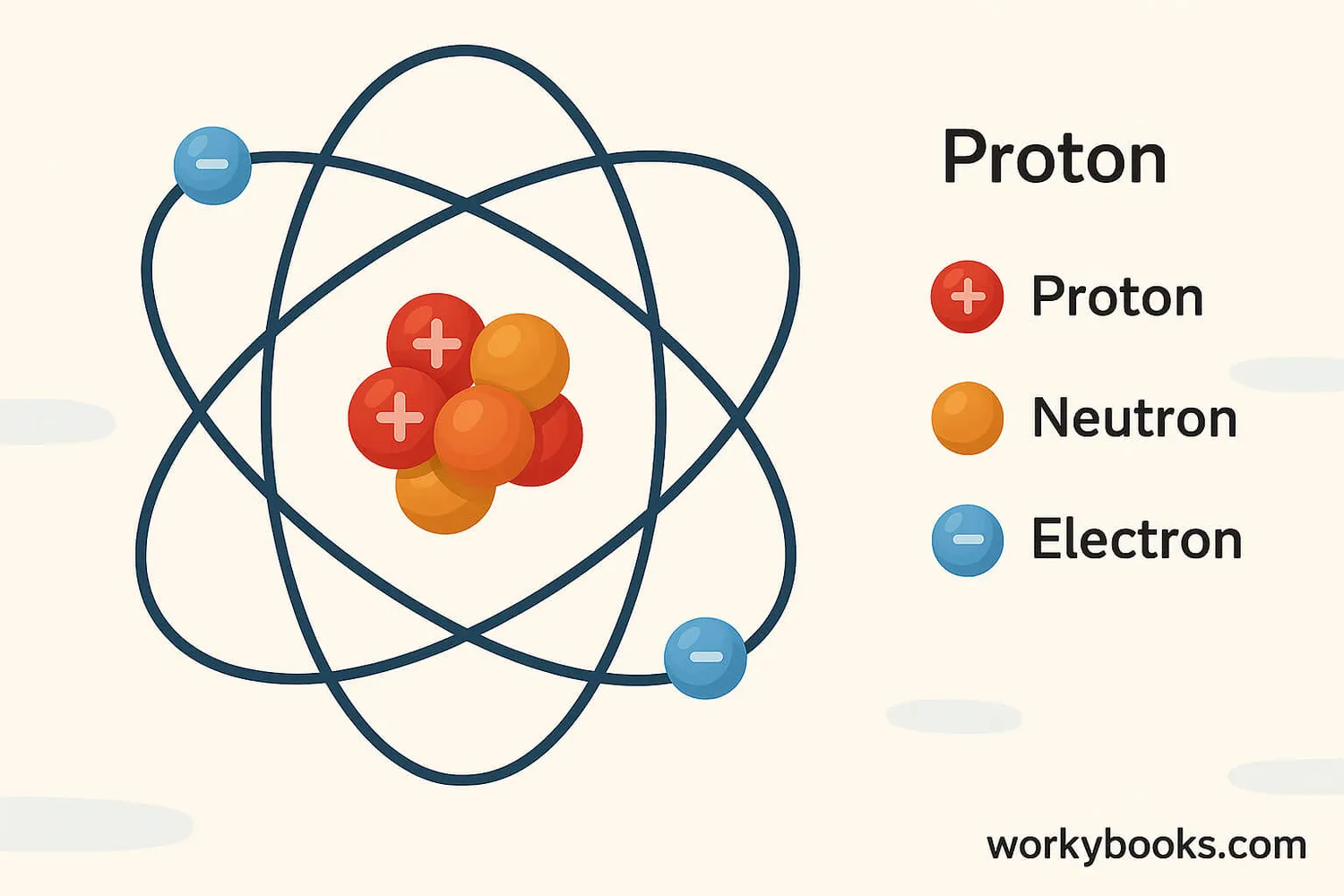
Atoms are the basic units of matter, and everything we see around us is made up of them. At the center of each atom is a dense nucleus, which contains two types of subatomic particles: protons and neutrons. Outside the nucleus, much farther away, are tiny, rapidly moving electrons. Understanding how these three particles interact is essential to explaining the structure and behavior of all matter.
Subatomic Particles and Their Roles
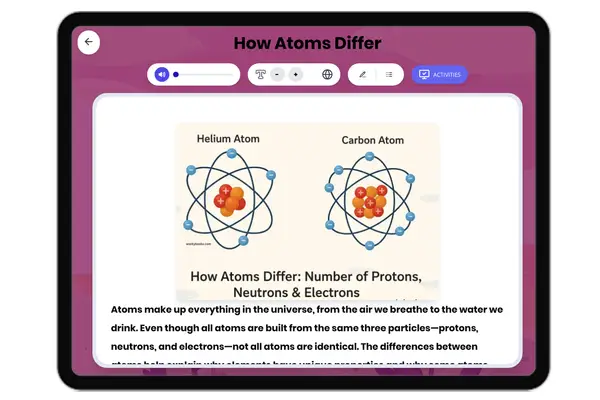
Protons are positively charged particles located in the nucleus of every atom. The number of protons in an atom determines which element it is. For example, every hydrogen atom has one proton, while every carbon atom has six. Neutrons are also found in the nucleus, but they have no electric charge—they are neutral. Neutrons add mass to the atom and help stabilize the nucleus. Electrons are negatively charged and are found in regions called energy levels or shells around the nucleus. Although electrons have much less mass than protons or neutrons, their arrangement determines the atom’s chemical behavior. The interactions between electrons of different atoms allow for the formation of molecules and chemical reactions.
How Do We Know About Subatomic Particles?
Scientists used experiments and technology, such as the gold foil experiment and particle accelerators, to discover and study subatomic particles. For example, the discovery of the proton was made when Ernest Rutherford observed that some particles bounced back when fired at gold atoms. Later, the neutron’s existence was confirmed by James Chadwick. Modern technology allows scientists to measure the mass and charge of each particle. Protons and neutrons each have a mass of about 1 atomic mass unit (amu), while electrons are about 1/1,836 the mass of a proton. The chart below summarizes their properties:
Relative Mass and Charge of Subatomic Particles
Particle
Charge
Relative Mass
Location
Proton
+1
1 amu
Nucleus
Neutron
0
1 amu
Nucleus
Electron
-1
~0.0005 amu
Outside nucleus
Interactions and Applications
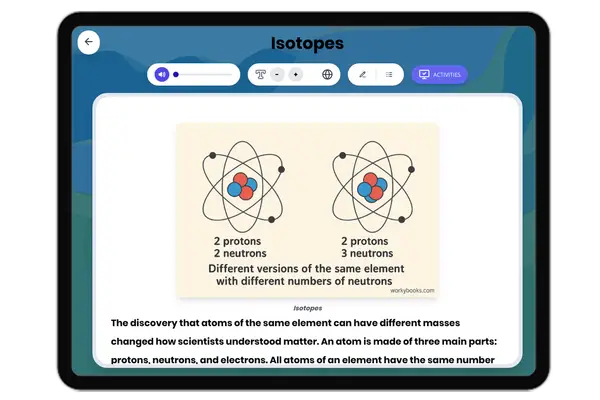
The number of protons defines the atomic number and identity of an element. Neutrons influence the atom’s mass and can create isotopes, which are atoms of the same element with different numbers of neutrons. Electrons, especially those in the outermost shell, determine how atoms bond and react with each other. For instance, sodium (with one electron in its outer shell) readily reacts with chlorine (which needs one electron) to form table salt. These interactions explain why chemical reactions happen and allow us to develop new materials, medicines, and technologies.
On a larger scale, understanding subatomic particles helps explain natural phenomena, such as why certain elements are radioactive or how stars produce energy. The principles of atomic structure connect to larger scientific ideas, including the conservation of matter and the periodic table’s organization.
Interesting Fact: All the atoms in your body—including their protons, neutrons, and electrons—were formed billions of years ago in the cores of stars!
What is found at the center of every atom?
NucleusElectronMoleculeShell
Which subatomic particle determines the identity of an element?
ProtonNeutronElectronMolecule
Where are electrons located in an atom?
Inside the nucleusIn the outer energy levels or shellsBetween protons and neutronsIn the atomic core
What is the relative mass of a neutron?
1 amu0 amu0.0005 amu10 amu
In the passage, what does 'chemical behavior' mean?
How an atom interacts and reacts with other atomsThe color of an atomThe amount of protons in an atomWhere the nucleus is located
What is an isotope?
Atoms of the same element with different numbers of neutronsAtoms with extra electronsA type of moleculeA charged nucleus
Why do electrons play a key role in chemical reactions?
They decide how atoms bond and react with each otherThey add mass to the atomThey are found in the nucleusThey have the same charge as protons
True or False: Protons and neutrons have about the same mass.
TrueFalse
True or False: Electrons are much heavier than protons.
TrueFalse
If an atom has 8 protons, what element is it?
OxygenCarbonHydrogenSodium
Perfect For:
👩🏫 Teachers
• Reading comprehension practice
• Auto-graded assessments
• Literacy skill development
👨👩👧👦 Parents
• Reading practice at home
• Comprehension improvement
• Educational reading time
🏠 Homeschoolers
• Reading curriculum support
• Independent reading practice
• Progress monitoring
Reading Features:
📖
Reading Passage
Engaging fiction or nonfiction text
❓
Comprehension Quiz
Auto-graded questions
📊
Instant Feedback
Immediate results and scoring
📄
Printable Version
Download for offline reading
🔊
Read Aloud
Voice-over with word highlighting
Reviews & Ratings
No reviews yet. Be the first to share your experience!
Related Content
Atomic Structure
This reading passage on Atomic Structure provides middle school students with an accessible explanation of the fundament...
MS-PS1-1RI.6.3RI.7.1
Parts of an Atom
This reading passage on Parts of an Atom provides middle school students with a structured and accessible explanation of...
MS-PS1-1RI.6.3RI.7.1
Chemical Bonds
This reading passage on Chemical Bonds provides middle school students with a clear explanation of how and why atoms con...
MS-PS1-1RI.6.3RI.7.1
The Freezing Point of Water
This science reading passage, titled 'The Freezing Point of Water', introduces students to a key physical science concep...
MS-PS1-1RI.6.3RI.7.1
Physical Properties of Matter
This comprehensive reading passage introduces grades 6-8 students to the concept of physical properties of matter, perfe...
MS-PS1-1
Mixtures and Pure Substances
This middle school science passage provides an in-depth exploration of mixtures and pure substances, directly aligned to...
MS-PS1-1
Types of Mixtures
This comprehensive science passage for grades 6-8 introduces students to the concept of mixtures, focusing on distinguis...
MS-PS1-1
Solutions, Suspensions, and Colloids
This comprehensive science passage explores the differences between solutions, suspensions, and colloids, focusing on ho...
MS-PS1-1
The Nature of Science
This passage explores the nature of science for middle school students, aligning with NGSS standards MS-ETS1-4, MS-PS1-1...
MS-ETS1-4MS-PS1-1MS-LS1-1
Scientific Theories
This reading passage for grades 6-8 introduces students to the concept of scientific theories, emphasizing that these ar...
MS-PS1-1MS-PS1-4MS-PS3-4SCIENCE AND ENGINEERING PRACTICES
Particle Model of Matter
This comprehensive science reading passage for grades 6-8 explores the particle model of matter, aligning with NGSS stan...
MS-PS1-1MS-PS1-4
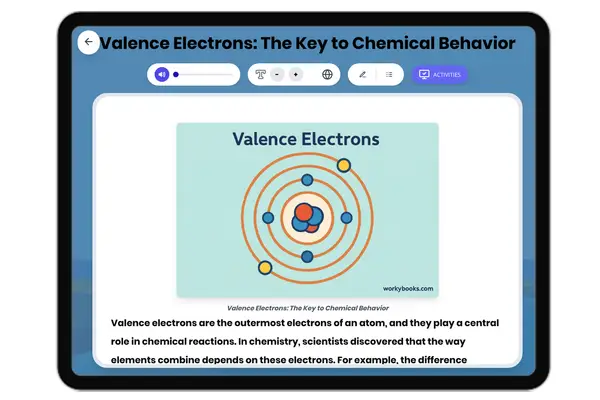
Valence Electrons
This middle school science passage introduces students to the concept of valence electrons, the outermost electrons that...
MS-PS1-1
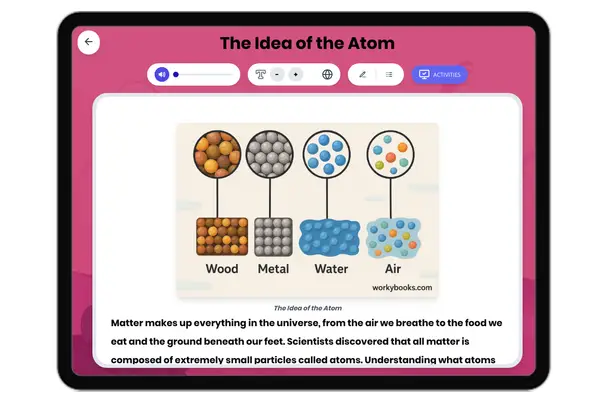
The Idea of the Atom
This informational science passage introduces middle school students (grades 6-8) to the concept that all matter is made...
MS-PS1-1
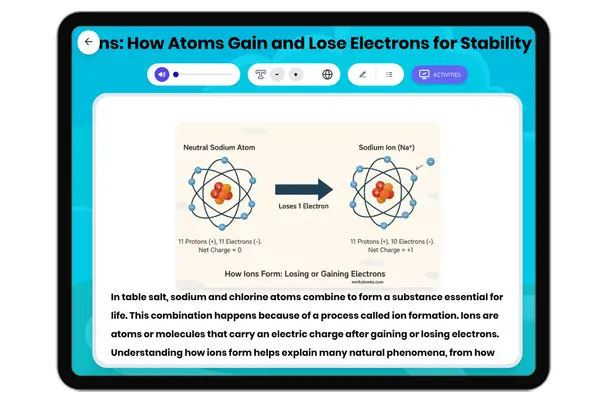
What are Ions
This passage introduces middle school students to the concept of ions, explaining the processes by which atoms gain or l...
MS-PS1-1
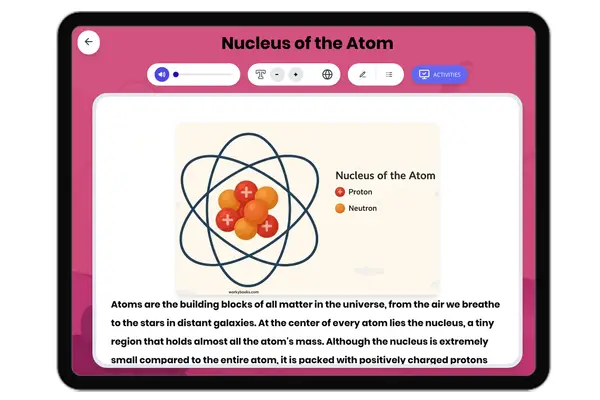
Nucleus of the Atom
This comprehensive passage for grades 6-8 introduces students to the nucleus of the atom, the dense center that contains...
MS-PS1-1
How Atoms Differ
This middle school science reading passage, aligned with NGSS standard MS-PS1-1, explores the fundamental differences am...
MS-PS1-1
Isotopes
This middle school science passage explores the concept of isotopes, which are atoms of the same element with different ...
MS-PS1-1
Compounds vs. Mixtures
This educational passage for grades 6-8 explores the fundamental differences between compounds and mixtures, aligning wi...
MS-PS1-1
Organizing the Elements
This passage for middle school science explores how scientists organized the elements as more were discovered, leading t...