This learning resource is available in interactive and printable formats. The interactive worksheet can be played online and assigned to students. The Printable PDF version can be downloaded and printed for completion by hand.
This engaging U.S. history reading passage explores the Compromise of 1850 and the heated debate over slavery in new American territories. Students will analyze the causes, perspectives, and consequences of this pivotal event, with special attention to the roles of key figures like Henry Clay and the impact of the Fugitive Slave Act. The passage models historical reasoning and evidence, weaving in a primary source quote and nuanced explanation of sectional conflict. Activities include a multiple-choice quiz, writing prompts, a graphic organizer, and a timeline to strengthen critical thinking and textual analysis skills. The resource aligns with standards D2.His.2.3-5, D2.His.3.3-5, RI.4.3, RI.4.4, and W.4.2, and features read aloud audio and a Spanish translation for broader accessibility. Designed to support deep inquiry and cross-curricular learning, this passage is ideal for fostering understanding of American history and the complexities of compromise.
CONTENT PREVIEW
Expand content preview
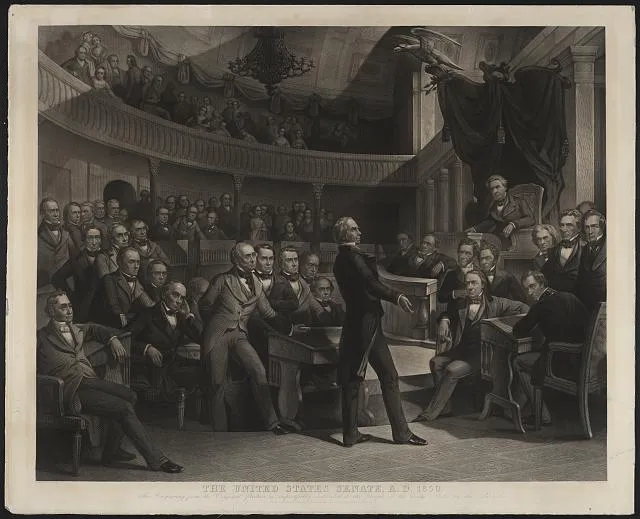
"The United States Senate, A.D. 1850" by Whitechurch, Robert, 1814-approximately 1880 / Library of Congress.
The Compromise of 1850 was a series of five laws passed by the United States Congress in 1850 to address growing tensions between the North and South. These tensions centered on whether slavery would be allowed in new territories gained after the Mexican-American War. Many Americans worried that the nation was becoming divided, or sectional, over the issue of slavery. The North generally opposed expanding slavery, while the South wanted to protect it.
One major problem was the question of how to organize the vast lands acquired from Mexico. California applied to join the Union as a free state, meaning slavery would not be allowed there. This upset many Southerners, who feared losing influence in Congress if more free states were added. The South wanted the balance of power between slave and free states to remain equal. If one side gained too much control, it could pass legislation that threatened the other’s interests.
To solve these disputes, leaders such as Henry Clay and Daniel Webster worked to create a compromise. The resulting Compromise of 1850 had several key parts. First, it admitted California as a free state, pleasing many Northerners. Second, it allowed the territories of Utah and New Mexico to decide for themselves whether to allow slavery, using a principle called popular sovereignty. Third, the Compromise ended the slave trade—but not slavery itself—in Washington, D.C. Lastly, it included a much stronger Fugitive Slave Law, requiring citizens to help return escaped enslaved people to their owners, even in free states.
These new laws were intended to ease sectionalism and keep the Union together. However, the solutions created new problems. The stricter Fugitive Slave Law angered many in the North, who felt it forced them to participate in slavery. Meanwhile, Southerners were dissatisfied because the Compromise did not guarantee slavery’s expansion. The idea of popular sovereignty also led to violence in some territories as settlers argued over slavery.
The Compromise of 1850 temporarily reduced the threat of disunion, but it did not resolve the underlying conflict over slavery. Debates about states’ rights and the expansion of slavery continued to grow. Only a decade later, these arguments would help lead the nation into the Civil War. The Compromise of 1850 is important because it shows how Americans tried to address deep disagreements through negotiation and compromise, even when solutions were imperfect.
Interesting Fact: Senator Henry Clay, known as the "Great Compromiser," played a leading role in crafting the Compromise of 1850, and his speeches were so popular that the Senate chamber was packed with listeners when he spoke.
When was the Compromise of 1850 passed?
1850177618651800
Which state joined as a free state?
CaliforniaTexasUtahNew Mexico
Who was called the 'Great Compromiser'?
Henry ClayAbraham LincolnDaniel WebsterStephen Douglas
Why did Southerners fear losing power?
More free states in CongressFewer territoriesEnd of the Mexican WarNew taxes
What did the Fugitive Slave Law require?
Return escaped enslaved peopleAllow women to voteOutlaw slavery everywhereGive land to settlers
What was popular sovereignty?
People decide on slaveryPresident chooses lawsOnly Congress votesOnly free states decide
The Compromise of 1850 ended slavery in the U.S.
TrueFalse
What does 'legislation' mean?
Laws made by a governmentA type of governmentA group of citizensA map of the U.S.
Perfect For:
👩🏫 Teachers
• Reading comprehension practice
• Auto-graded assessments
• Literacy skill development
👨👩👧👦 Parents
• Reading practice at home
• Comprehension improvement
• Educational reading time
🏠 Homeschoolers
• Reading curriculum support
• Independent reading practice
• Progress monitoring
Reading Features:
📖
Reading Passage
Engaging fiction or nonfiction text
❓
Comprehension Quiz
Auto-graded questions
📊
Instant Feedback
Immediate results and scoring
📄
Printable Version
Download for offline reading
🔊
Read Aloud
Voice-over with word highlighting
Reviews & Ratings
No reviews yet. Be the first to share your experience!
Related Content
Native American Tribes Across America
This engaging history reading passage introduces students to Native American tribes across America, focusing on their da...
D2.HIS.1.3-5D2.HIS.2.3-5RI.4.1RI.4.2
Teepees: Homes on the Great Plains
This engaging history reading passage introduces students to teepees, the unique homes of Native American tribes on the ...
D2.HIS.2.3-5D2.HIS.14.3-5RI.4.1RI.4.2RI.4.4
Traditional Native American Clothing
This engaging history passage explores traditional Native American clothing and how it reflected the environment, values...
D2.HIS.2.3-5D2.HIS.3.3-5RI.4.3RI.4.4
The Iroquois Confederacy: A System of Peace
This engaging U.S. History reading passage introduces students to the Iroquois Confederacy, a powerful alliance of Nativ...
D2.HIS.2.3-5D2.HIS.3.3-5RI.4.3RI.4.4
The Cherokee Nation: History and Culture
This reading passage explores the rich history and culture of the Cherokee Nation, one of the largest Native American tr...
D2.HIS.2.3-5D2.HIS.14.3-5RI.4.3RI.4.4RI.4.10
The Sioux: Warriors and Tribal Leaders
This history reading passage explores the Sioux Nation, focusing on their roles as warriors and tribal leaders. Students...
D2.HIS.1.3-5D2.HIS.2.3-5RI.4.1RI.4.3
Native American Respect for Nature
This engaging history reading passage explores Native American respect for nature, emphasizing the close relationship be...
D2.HIS.2.3-5D2.HIS.3.3-5RI.4.3RI.4.4
Jamestown: The First Permanent English Colony
This engaging history passage explores the founding of Jamestown, the first permanent English colony in America. Aligned...
D2.HIS.1.3-5D2.HIS.2.3-5RI.4.3RI.4.4
Pocahontas and the Powhatan People
This engaging reading passage explores the life of Pocahontas and the Powhatan people and their important role in early ...
D2.HIS.1.3-5D2.HIS.2.3-5RI.4.1RI.4.3
Colonial Children: School and Chores
This reading passage explores the daily lives of colonial children, focusing on their experiences at school and their ma...
D2.HIS.2.3-5D2.HIS.3.3-5RI.4.1RI.4.2RI.4.4
Colonial Clothing and Homemade Goods
This engaging U.S. history passage explores the daily life of early American colonists with a focus on colonial clothing...
D2.HIS.2.3-5RI.4.3RI.4.4
Colonial Jobs: Blacksmiths, Bakers, and Craftsmen
This engaging history reading passage explores the vital roles of blacksmiths, bakers, and craftsmen in colonial America...
D2.HIS.2.3-5D2.HIS.3.3-5RI.4.3RI.4.4
Colonial Towns and Village Life
This engaging history reading passage explores the daily life, work, and unity found in colonial towns and villages. Ali...
D2.HIS.1.3-5D2.HIS.2.3-5RI.4.3RI.4.4
Colonial Trade with England and Africa
This history reading passage explores colonial trade between the American colonies, England, and Africa, focusing on the...
D2.HIS.2.3-5D2.HIS.14.3-5RI.4.3RI.4.4
Benjamin Franklin: Printer, Inventor, and Leader
This history reading passage explores the life and achievements of Benjamin Franklin, one of America's most important ea...
D2.HIS.2.3-5D2.HIS.3.3-5RI.4.1RI.4.3
George Washington Leads the Army
This engaging history reading passage explores how George Washington bravely led the Continental Army during the America...
D2.HIS.1.3-5D2.HIS.2.3-5RI.4.3RI.4.4
Women and Children During the Revolutionary War
This reading passage explores the important roles women and children played during the Revolutionary War. Students will ...
D2.HIS.2.3-5RI.4.3RI.5.3
African Americans Fight for Freedom
This educational passage explores the brave and inspiring story of how African Americans fought for freedom in the Unite...
D2.HIS.2.3-5D2.HIS.3.3-5RI.4.3RI.4.4
The Battle of Yorktown Ends War
This engaging U.S. history reading passage explores the Battle of Yorktown, a key event that ended the American Revoluti...
D2.HIS.1.3-5D2.HIS.2.3-5RI.4.1RI.4.3
Loyalists vs. Patriots: Divided Families
This engaging U.S. history reading passage explores the division between Loyalists and Patriots during the American Revo...