Compromise of 1877: Ending Reconstruction
Interactive passage with audio narration, comprehension questions, and printable PDF.
By completing this purchase you agree to our Terms of Use and Privacy Policy. Your subscription renews automatically until you cancel. You can cancel anytime from your account settings. All sales are final and non-refundable. Digital content is available for download in your account immediately upon purchase.
What's included
Compromise of 1877: Ending Reconstruction preview and details
About this printable Compromise of 1877: Ending Reconstruction reading passage (Grades 6-8)
Sample passage and quiz from Compromise of 1877: Ending Reconstruction
Reading passage and comprehension quiz preview
Compromise of 1877: Ending Reconstruction
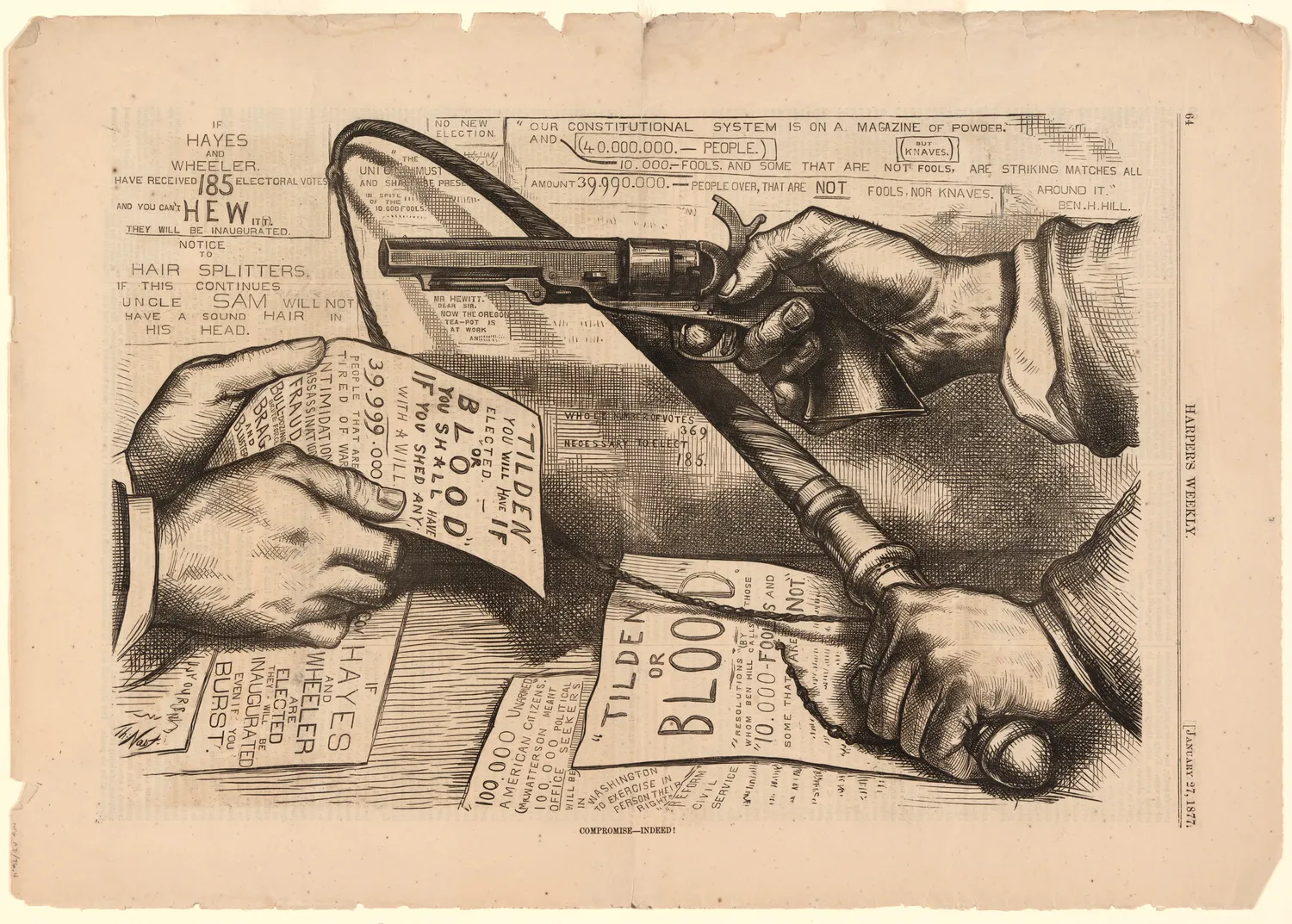
"Tilden or Blood Compromise - Indeed!" by Thomas Nast.
Source: Wikimedia Commons (CC0)
The Compromise of 1877 was a major turning point in United States history. After the Civil War, the country entered a period called Reconstruction. During this era, the federal government tried to rebuild the Southern states and protect the rights of formerly enslaved people. However, by the late 1870s, conflict and disagreement about how to move forward had grown intense.
The presidential election of 1876 increased tensions. Republican Rutherford B. Hayes and Democrat Samuel J. Tilden both claimed victory, leading to a disputed result. Several Southern states sent in conflicting election returns, and no clear winner could be decided. This deadlock threatened to create a national crisis and possibly even more violence.
To resolve the situation, leaders from both parties negotiated an agreement known as the Compromise of 1877. In this deal, Democrats accepted Hayes as president. In exchange, Republicans promised the withdrawal of federal troops from the South. These troops had been enforcing Reconstruction laws and protecting African American rights. Their removal marked the official end of Reconstruction.
The effects of this political agreement were significant and long-lasting. Once federal troops left, former Confederate leaders and Southern Democrats regained control of state governments. Many African Americans lost the protections they had briefly enjoyed. Harsh new laws, known as Jim Crow laws, were soon passed to limit their rights and enforce racial segregation.
The Compromise of 1877 represents a complex moment in American history. It solved the immediate problem of a disputed election and preserved peace at the national level. However, it also came at a great cost to African Americans in the South, who faced discrimination and violence for decades afterward. The decision shows how negotiation in politics can have both positive and negative consequences, depending on whose interests are protected.
Historians continue to debate whether the Compromise was necessary or fair. Some argue it was vital to prevent more conflict, while others believe it abandoned the promise of equal rights. Studying the Compromise of 1877 helps us understand how American democracy sometimes involves difficult trade-offs, and why the struggle for justice and equality did not end with the Civil War.
Interesting Fact: Rutherford B. Hayes secretly took the presidential oath in a private ceremony at the White House the night before his public inauguration, due to fears of unrest.
Comprehension quiz (8 questions)
1. Who became president after the Compromise?
2. What period followed the Civil War?
3. What did the Compromise of 1877 end?
4. Why were federal troops in the South?
5. What resulted from the troops' withdrawal?
6. How did the Compromise affect African Americans?
7. The Compromise solved the disputed election.
8. What does compromise mean in this passage?
Common Core standards for Compromise of 1877: Ending Reconstruction
Explain events, procedures, ideas, or concepts in a historical, scientific, or technical text, including what happened and why, based on specific information in the text.
Determine the meaning of general academic and domain-specific words or phrases in a text relevant to a grade 4 topic or subject area.
Write informative/explanatory texts to examine a topic and convey ideas and information clearly.
Perfect for the way you teach
- Build comprehension skills
- Auto-graded quiz
- Differentiated reading
- Read together at home
- Improve fluency
- Quiet reading time
- Reading curriculum support
- Independent practice
- Track Lexile growth