Dawes Act 1887: Breaking Up Tribal Lands
Interactive passage with audio narration, comprehension questions, and printable PDF.
By completing this purchase you agree to our Terms of Use and Privacy Policy. Your subscription renews automatically until you cancel. You can cancel anytime from your account settings. All sales are final and non-refundable. Digital content is available for download in your account immediately upon purchase.
What's included
Dawes Act 1887: Breaking Up Tribal Lands preview and details
About this printable Dawes Act 1887: Breaking Up Tribal Lands reading passage (Grades 6-8)
Sample passage and quiz from Dawes Act 1887: Breaking Up Tribal Lands
Reading passage and comprehension quiz preview
Dawes Act 1887: Breaking Up Tribal Lands
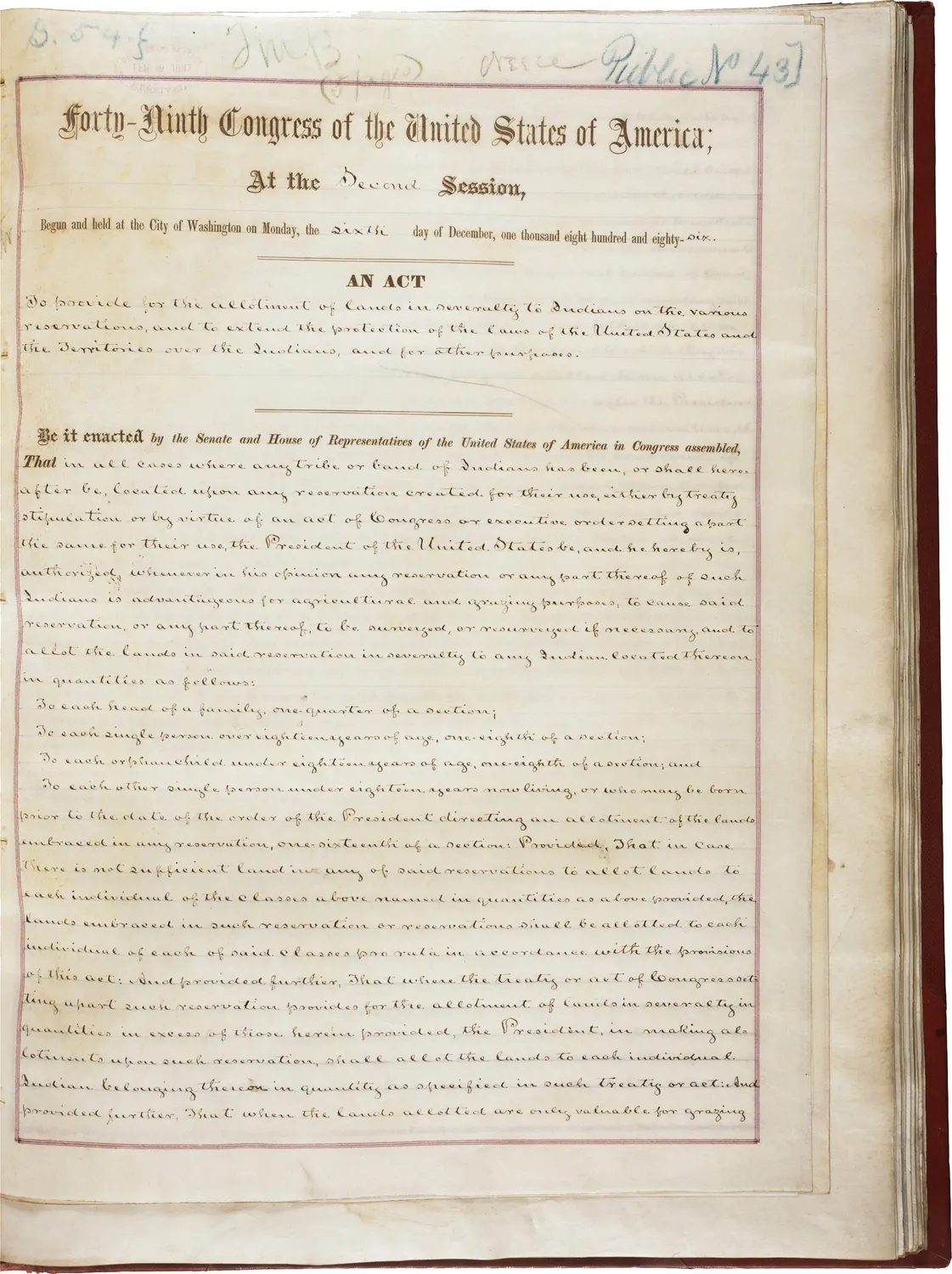
"Dawes Act - First Page" by 49th Congress of the U.S. / Wikimedia Commons (Public domain).
The Dawes Act of 1887 was a significant piece of legislation in U.S. history that changed the way Native American lands were managed. Before the law, Native Americans held their land collectively as a community on reservations. These lands were governed by tribal leaders and based on traditional Native customs. However, the U.S. government saw this communal land ownership as an obstacle to Westward Expansion and its vision of American progress.
To address this, Congress passed the Dawes Act, sometimes called the General Allotment Act. The law created a policy that divided reservation lands into individual allotments. Each Native American family was assigned a specific plot, usually 80 to 160 acres, while the rest of the land was declared “surplus” and opened up to non-Native settlers. This approach aimed to break up the collective system and promote private land ownership, which the government believed would help Native Americans adapt to American society.
The Dawes Act presented several problems. For many Native communities, land was not just property—it was central to their culture, traditions, and social systems. The sudden shift from communal to individual ownership disrupted these ways of life. Additionally, the implementation of the law was often unfair. The surveyors who divided the land did not always recognize traditional boundaries, and some families received poor-quality plots. This made farming and self-sufficiency more difficult for many Native Americans.
As a result of the Dawes Act, Native tribes lost a large portion of their land. By 1934, Native Americans had lost about two-thirds of their original reservation lands. The policy led to the fragmentation of tribal communities and made it harder for them to maintain their cultural identity. It also opened up millions of acres to white settlers and businesses, accelerating Westward Expansion but at a great cost to Native peoples.
Supporters of the Dawes Act argued that it would help Native Americans become self-reliant and integrate into American society. However, most Native leaders opposed the law. They saw it as a way to force them to give up their traditions and weaken their communities. Over time, many historians have recognized the Dawes Act as a policy that caused long-term harm to Native American societies.
Today, the legacy of the Dawes Act is still felt in Native American communities. Tribal leaders and activists continue to work to restore land and preserve traditions lost during this period. The Dawes Act serves as a reminder of how federal policies can have complex and lasting consequences for entire cultures.
Interesting Fact: The Dawes Act was reversed in 1934 by the Indian Reorganization Act, which aimed to restore tribal self-governance and some land to Native peoples.
Comprehension quiz (8 questions)
1. When was the Dawes Act passed?
2. What did the Dawes Act divide?
3. Who received 'surplus' land after allotments?
4. Why did the U.S. want to change tribal land ownership?
5. How did the Dawes Act affect Native culture?
6. What was a main effect of the law?
7. The Dawes Act was reversed in 1934. True or false?
8. What is an allotment?
Common Core standards for Dawes Act 1887: Breaking Up Tribal Lands
Explain events, procedures, ideas, or concepts in a historical, scientific, or technical text, including what happened and why, based on specific information in the text.
Determine the meaning of general academic and domain-specific words or phrases in a text relevant to a grade 4 topic or subject area.
Write informative/explanatory texts to examine a topic and convey ideas and information clearly.
Perfect for the way you teach
- Build comprehension skills
- Auto-graded quiz
- Differentiated reading
- Read together at home
- Improve fluency
- Quiet reading time
- Reading curriculum support
- Independent practice
- Track Lexile growth