Divided Kingdom of Israel
Interactive passage with audio narration, comprehension questions, and printable PDF.
By completing this purchase you agree to our Terms of Use and Privacy Policy. Your subscription renews automatically until you cancel. You can cancel anytime from your account settings. All sales are final and non-refundable. Digital content is available for download in your account immediately upon purchase.
What's included
Part of this bundle

Divided Kingdom of Israel preview and details
About this printable Divided Kingdom of Israel reading passage (Grades 5-8)
Sample passage and quiz from Divided Kingdom of Israel
Reading passage and comprehension quiz preview
Divided Kingdom of Israel
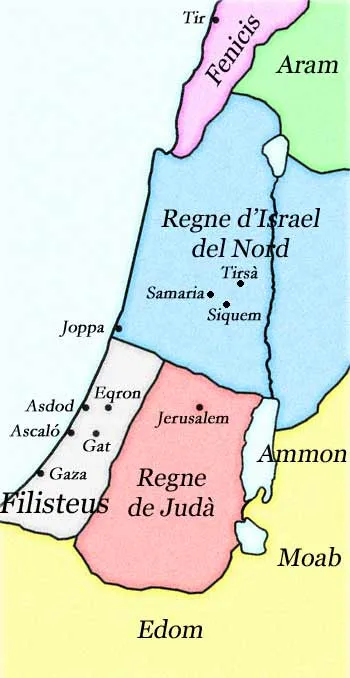
"Israel i Judà" by Selfmade / Wikimedia Commons
The ancient kingdom of Israel split into two separate kingdoms, Israel and Judah, around 930 BCE after the death of King Solomon. This division shaped the political and religious history of the region for centuries. The causes of this split reveal how leadership, geography, and social tensions can transform a nation.
King Solomon, known for his wisdom and grand building projects, ruled a united Israel with its capital in Jerusalem. However, his policies burdened the people with heavy taxes and forced labor. After Solomon died, his son Rehoboam became king. According to the Hebrew Bible, representatives from the northern tribes asked Rehoboam to lighten their labor and taxes. Rehoboam refused, insisting on even harsher treatment. This decision angered the northern tribes, leading to a major revolt.
Jeroboam, a former official under Solomon, became the leader of the northern tribes. The ten northern tribes broke away and formed a new kingdom called Israel, with its capital at Shechem and later Samaria. The southern tribes, mainly Judah and Benjamin, remained loyal to Rehoboam and kept Jerusalem as their capital. Archaeological evidence, such as ancient city walls in Samaria and Jerusalem, supports the existence of these two distinct kingdoms. The division also created religious tensions. Jeroboam established new centers of worship at Bethel and Dan to keep his people from traveling to Jerusalem, which led to controversies over religious practices.
The split between Israel and Judah had long-lasting consequences. Both kingdoms faced threats from powerful neighbors, such as Egypt and Assyria. The Kingdom of Israel fell to the Assyrians in 722 BCE, and many Israelites were exiled. Judah survived longer, but it was eventually conquered by the Babylonians in 586 BCE. Despite these challenges, both kingdoms maintained unique cultural and religious identities. Primary sources like the Hebrew Bible, Assyrian records, and archaeological discoveries help historians piece together this complex period.
The division of Israel and Judah demonstrates how internal conflict and external pressures can reshape history. It shows the importance of leadership choices, social unity, and geography in the fate of civilizations. This story connects to broader themes of ancient history, such as the rise and fall of kingdoms, the role of religion, and the struggles of ordinary people.
Interesting Fact: The term "Ten Lost Tribes" refers to the Israelites from the northern kingdom who disappeared from history after the Assyrian conquest.
Comprehension quiz (8 questions)
1. Who was king after Solomon?
2. What city was the capital of Judah?
3. Who conquered the kingdom of Israel?
4. Why did the northern tribes rebel?
5. What was a result of the split?
6. What did Jeroboam do for worship?
7. The split happened after Solomon's death. (True/False)
8. What does 'exile' mean?
Perfect for the way you teach
- Build comprehension skills
- Auto-graded quiz
- Differentiated reading
- Read together at home
- Improve fluency
- Quiet reading time
- Reading curriculum support
- Independent practice
- Track Lexile growth