DNA as Genetic Material
Interactive passage with audio narration, comprehension questions, and printable PDF.
By completing this purchase you agree to our Terms of Use and Privacy Policy. Your subscription renews automatically until you cancel. You can cancel anytime from your account settings. All sales are final and non-refundable. Digital content is available for download in your account immediately upon purchase.
What's included
DNA as Genetic Material preview and details
About this printable DNA as Genetic Material science reading passage, NGSS-aligned (Grades 5-8)
Sample passage and quiz from DNA as Genetic Material
Reading passage and comprehension quiz preview
DNA as Genetic Material
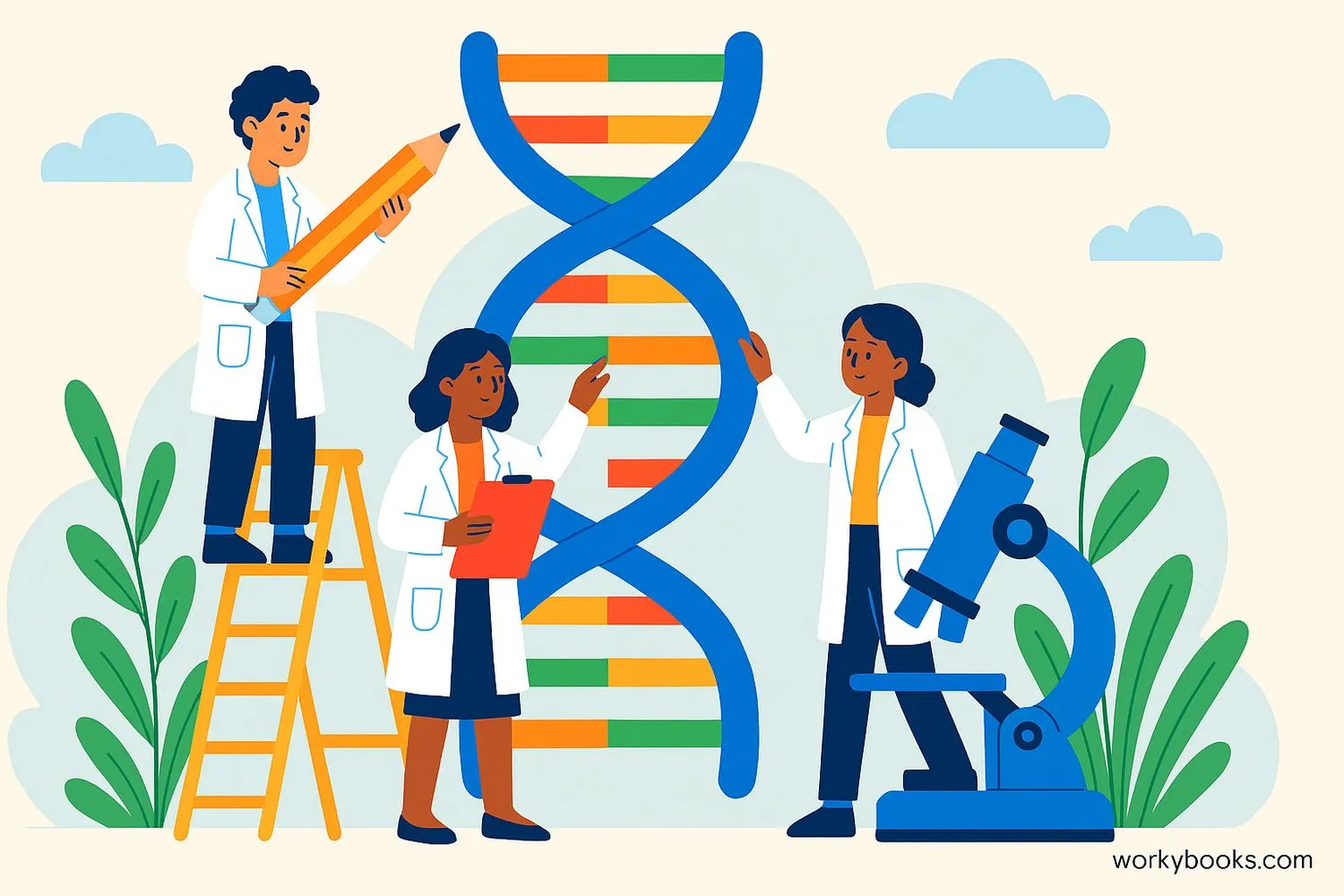
DNA is essential to life because it acts as the instruction manual for building and running every living organism. Within each cell's nucleus, this molecule determines how living things look, grow, and function. Scientists have revealed that all the unique traits we observe, such as eye color or blood type, are controlled by specific instructions coded in DNA. Understanding DNA’s structure and function is crucial to fields like medicine, agriculture, and forensic science.
Structure of DNA: The Double Helix
The structure of DNA is known as a double helix, which looks like a twisted ladder. The sides of the ladder are formed by a sugar-phosphate backbone. The rungs are made from four chemical bases: adenine (A), thymine (T), guanine (G), and cytosine (C). These bases always pair in a specific way: A with T, and G with C. This specific pairing is crucial because it ensures that DNA can be accurately copied during cell division. For example, if one strand has the sequence A-T-G-C, the matching strand will be T-A-C-G. This structure allows DNA to store vast amounts of information in a compact form.
DNA Replication and Inheritance
Before a cell divides, it must make an exact copy of its DNA through a process called replication. During replication, the double helix unwinds and the two strands separate. Each original strand acts as a template for a new, complementary strand. Enzymes help attach the correct bases to form two identical DNA molecules. This process is highly accurate—mistakes occur in less than 1 out of every billion bases. Accurate replication is essential for inheritance, as it ensures that genetic information is passed from parent to offspring without significant errors. However, rare mistakes, called mutations, can introduce new traits or diseases.
Discovery and Applications of DNA
The discovery of DNA’s structure was a major scientific breakthrough. Rosalind Franklin’s X-ray images provided key evidence for the double helix shape. James Watson and Francis Crick used Franklin’s data, along with help from Maurice Wilkins, to build the first accurate model of DNA in 1953. Since then, scientists have used DNA knowledge to develop genetic testing, treat diseases, and even solve crimes. In agriculture, DNA technology allows for crops that are resistant to pests or drought. The study of DNA connects to the larger principle that structure determines function in biology.
DNA research continues to shape technology, healthcare, and our understanding of life. Every discovery brings us closer to understanding how traits are passed on and how living things respond to their environments.
Interesting Fact: If all the DNA in your body were stretched out, it would reach from the Earth to the Sun and back more than 600 times!
Comprehension quiz (10 questions)
1. Where in the cell is DNA located?
2. What is the shape of a DNA molecule called?
3. Which of the following is NOT a base found in DNA?
4. What is the correct base pairing in DNA?
5. What does the sugar-phosphate backbone do in DNA?
6. What is the purpose of DNA replication?
7. Who provided key X-ray images that helped discover the structure of DNA?
8. What might happen if a mistake occurs during DNA replication?
9. True or False: All living things use DNA to store genetic information.
10. True or False: DNA replication is always perfect and never has mistakes.
Perfect for the way you teach
- Build comprehension skills
- Auto-graded quiz
- Differentiated reading
- Read together at home
- Improve fluency
- Quiet reading time
- Reading curriculum support
- Independent practice
- Track Lexile growth