DNA Replication: The Blueprint for Life — Reading Comprehension
Rate this
Premium Resource
Present
Present in classroom. No work saved
Assign
Classroom with student accounts, Track progress
Quick Play
No student accounts, assign with a link
Grades
5
6
7
8
Standards
MS-LS3-1
PRINT+DIGITAL RESOURCE
This learning resource is available in interactive and printable formats. The interactive worksheet can be played online and assigned to students. The Printable PDF version can be downloaded and printed for completion by hand.
This passage breaks down DNA replication into key steps—unwinding, strand synthesis, and proofreading—while highlighting its biological importance. Aligned with NGSS MS-LS3-1, it uses analogies (e.g., 'spiral staircase unzipping') and real-world connections (forensics, cancer). Designed for middle school life science, it emphasizes the precision and mechanisms that maintain genetic fidelity across generations.
CONTENT PREVIEW
Expand content preview
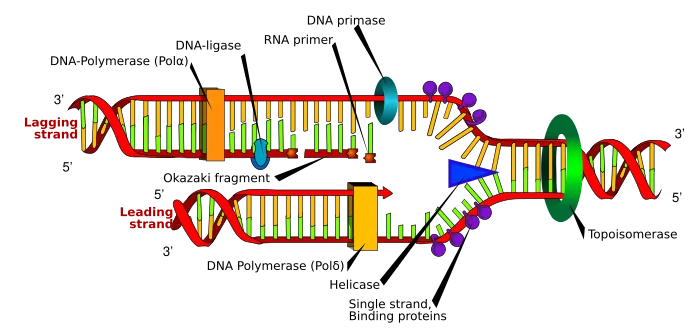
"DNA replication en" by LadyofHats Mariana Ruiz / Wikimedia Commons.
DNA replication is the process by which a cell makes an exact copy of its DNA before cell division. This remarkable mechanism ensures that every new cell receives identical genetic information, allowing organisms to grow, repair tissues, and reproduce. Without accurate DNA replication, life as we know it could not exist.
How DNA Replication Works
Unwinding:
○ The DNA double helix unzips like a spiral staircase, thanks to the enzyme helicase.
○ Single-strand binding proteins prevent the strands from rewinding.
Building New Strands:
○ DNA polymerase adds complementary nucleotides to each original (template) strand.
○ Leading strand: Synthesized continuously in the 5'→3' direction.
○ Lagging strand: Synthesized in short Okazaki fragments (later joined by DNA ligase).
Proofreading:
○ DNA polymerase corrects errors, ensuring near-perfect accuracy (~1 mistake per billion bases).
Key Features
● Semi-conservative: Each new DNA molecule has one original and one new strand.
● Bidirectional: Replication proceeds in both directions from origins of replication.
● High Fidelity: Multiple mechanisms prevent and fix errors.
Real-World Importance
● Growth & Healing: Enables skin, blood, and other cells to regenerate.
● Disease: Errors can cause mutations linked to cancer or genetic disorders.
● Forensics: PCR (polymerase chain reaction) copies DNA for crime scene analysis.
Fun Fact: Your cells replicate ~3 billion DNA base pairs in just 6–8 hours—equivalent to copying 1,000 books the size of Harry Potter without missing a letter!
What is the primary purpose of DNA replication?
To create energyTo copy DNA for new cellsTo break down proteinsTo remove mutations
Which enzyme unwinds the DNA helix?
HelicaseDNA polymeraseLigasePrimase
Why is the lagging strand synthesized in fragments?
DNA polymerase only works 5'→3'To slow down replicationHelicase stops workingThe DNA is too short
What ensures replication accuracy?
DNA polymerase proofreadingRandom nucleotide selectionRNA interferenceMethylation
How is replication semi-conservative?
Each new DNA has one old strandOnly half the DNA is copiedIt uses RNA templatesIt happens twice per cell
What happens if replication errors aren’t fixed?
Mutations may occurThe cell explodesDNA turns into RNANothing