Dust Bowl 1930s
Interactive passage with audio narration, comprehension questions, and printable PDF.
By completing this purchase you agree to our Terms of Use and Privacy Policy. Your subscription renews automatically until you cancel. You can cancel anytime from your account settings. All sales are final and non-refundable. Digital content is available for download in your account immediately upon purchase.
What's included
Dust Bowl 1930s preview and details
About this printable Dust Bowl 1930s reading passage (Grades 6-8)
Sample passage and quiz from Dust Bowl 1930s
Reading passage and comprehension quiz preview
Dust Bowl 1930s
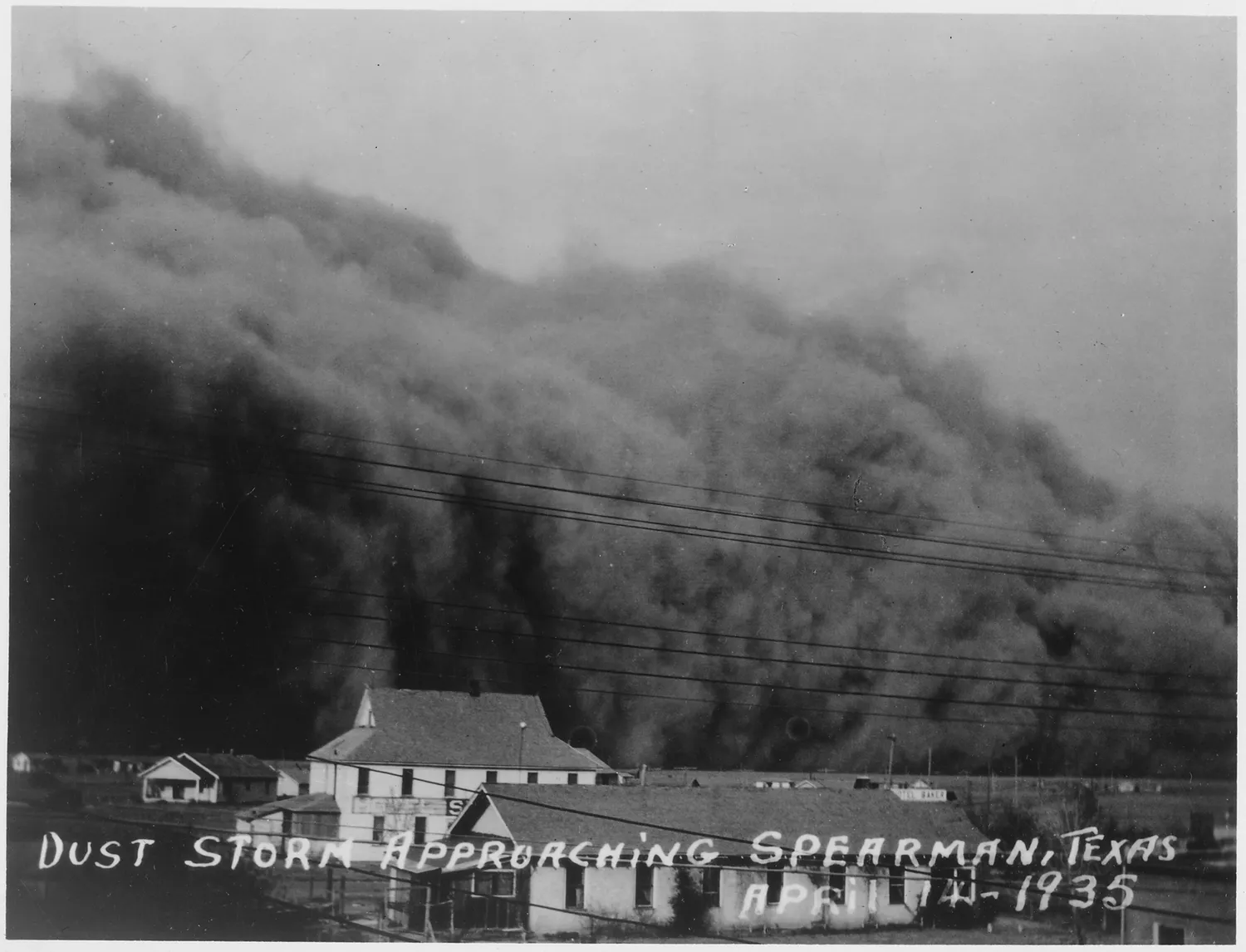
"Dust Storm, "Dust Storm Approaching Spearman, Texas." / Wikimedia Commons (Public domain).
The Dust Bowl was a severe environmental disaster that struck the Great Plains region of the United States during the 1930s. This area, which includes parts of Oklahoma, Texas, Kansas, Colorado, and New Mexico, was known for its rich farmland. However, a combination of natural and human causes led to a crisis that changed American life and history.
One of the major causes of the Dust Bowl was a prolonged drought. For nearly a decade, the region received much less rain than normal, causing the soil to dry out. Farmers, eager to grow more crops, had also removed the native grasses that once anchored the soil. Instead, they used farming methods that left fields bare after harvest. Without roots to hold the dirt in place, the land became vulnerable to erosion by wind.
Massive dust storms, sometimes called "black blizzards," swept across the plains. These storms could block out the sun and cover homes, farms, and towns in thick layers of dust. Crops were destroyed, livestock died, and people suffered from breathing problems. The environmental crisis was made even worse by the economic hardship of the Great Depression, which meant that many families had little money to recover or rebuild.
As conditions worsened, thousands of families were forced to leave their homes in search of better opportunities. This migration mainly took people west, especially to California, where they hoped to find work as farm laborers. The journey was difficult, and many encountered prejudice and poverty along the way. These migrants became known as "Okies," regardless of which state they came from, because so many were from Oklahoma.
Government agencies like the Soil Conservation Service eventually stepped in to help. They taught farmers new techniques, such as crop rotation and planting windbreaks, to prevent future erosion. These conservation efforts, along with the return of rainfall, gradually restored the land. Although the Dust Bowl ended, its impact on agriculture, migration patterns, and environmental policy lasted for decades.
The Dust Bowl is a powerful example of how human actions and environmental conditions can combine to create lasting challenges. By examining its causes and solutions, historians and scientists have learned valuable lessons about land use and the importance of caring for natural resources.
Interesting Fact: During the height of the Dust Bowl, some dust storms carried soil as far east as New York City and Washington, D.C.
Comprehension quiz (8 questions)
1. When did the Dust Bowl occur?
2. Which region was most affected?
3. What forced many families to move?
4. Why did erosion happen?
5. What did government agencies teach?
6. What was one long-term impact?
7. The Dust Bowl ended quickly. True or false?
8. What does 'drought' mean?
Common Core standards for Dust Bowl 1930s
Explain events, procedures, ideas, or concepts in a historical, scientific, or technical text, including what happened and why, based on specific information in the text.
Determine the meaning of general academic and domain-specific words or phrases in a text relevant to a grade 4 topic or subject area.
Write informative/explanatory texts to examine a topic and convey ideas and information clearly.
Perfect for the way you teach
- Build comprehension skills
- Auto-graded quiz
- Differentiated reading
- Read together at home
- Improve fluency
- Quiet reading time
- Reading curriculum support
- Independent practice
- Track Lexile growth