This learning resource is available in interactive and printable formats. The interactive worksheet can be played online and assigned to students. The Printable PDF version can be downloaded and printed for completion by hand.
This engaging science passage, 'The Moon: Earth's Companion,' is designed for Grade 4-5 students and aligns with NGSS general science standards. The passage explores the Moon's role as Earth's only natural satellite, explaining key concepts such as orbit, gravity, phases, and eclipses. Scientific vocabulary words are highlighted and defined, making complex ideas accessible to young learners. Real-world examples, like how the Moon affects ocean tides and nighttime light, help students connect science to everyday life. The content also includes a fun 'Did You Know?' fact to spark curiosity. Students can test their understanding with a multiple-choice quiz and deepen their learning through writing activities that promote explanation, connection, and analysis. All materials are audio integrated for accessibility. This resource is ideal for classroom instruction, homework, or independent study, providing a complete science learning experience on the fascinating topic of the Moon.
CONTENT PREVIEW
Expand content preview
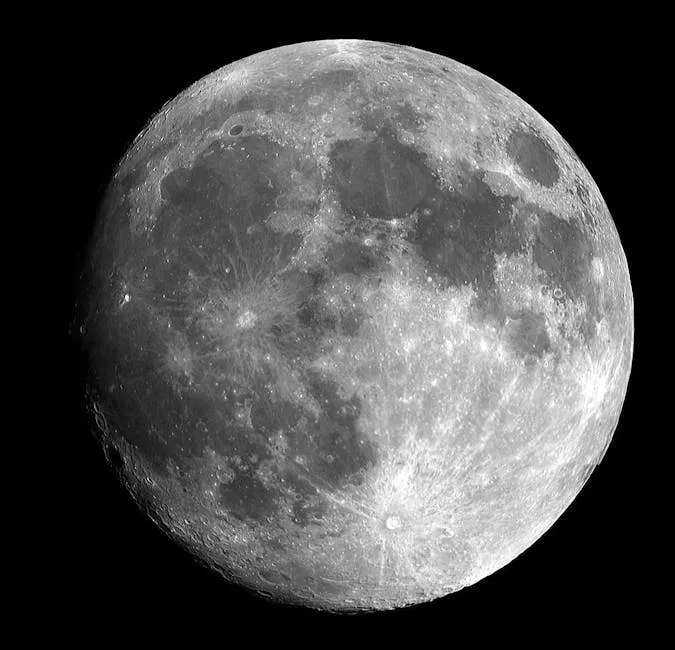
"Captivating black and white image of the full moon showcasing intricate lunar details." by Pixabay / Pexels.
The Moon is Earth's only natural satellite. A satellite is an object that moves around a planet in space. The Moon is about one-fourth the size of Earth and is much smaller than our planet.
The Moon does not make its own light. Instead, it reflects light from the Sun. When we look up at night, we see the Moon shining because sunlight bounces off its surface. The Moon's surface is covered with craters, which are holes made by rocks called meteoroids that crash into it.
The Moon orbits, or moves around, Earth about once every 27 days. As it moves, the shape of the Moon we see changes. These different shapes are called phases. Some common phases are the full moon, new moon, and crescent moon. The changing phases happen because of the way sunlight hits the Moon as it moves around Earth.
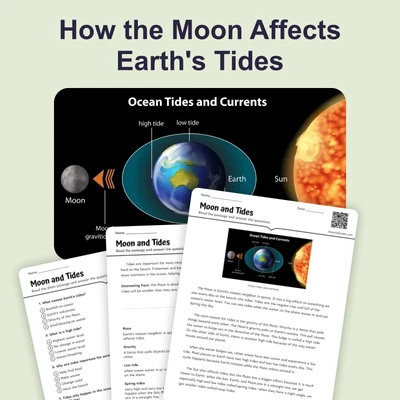
The Moon has a strong effect on Earth. Its gravity helps control the tides in our oceans. When the Moon is overhead, it pulls on the water and causes the ocean level to rise. This is called high tide. The Moon also makes the night sky brighter and helps animals like sea turtles know when to lay their eggs.
Sometimes, the Moon blocks the Sun or passes into Earth's shadow. This is called an eclipse. During a solar eclipse, the Moon covers the Sun from our view. During a lunar eclipse, Earth’s shadow falls on the Moon, making it look dark or reddish.
Interesting Fact: The Moon is slowly moving away from Earth by about 3.8 centimeters each year!
What is the Moon?
Earth's natural satelliteA planetA starA comet
What causes the Moon to shine?
Reflected sunlightIts own lightStreetlightsStarlight
What are craters?
Holes from meteoroidsClouds on EarthMountainsOceans
Why do we see Moon phases?
Moon's movement around EarthClouds cover the MoonSun changes sizeEarth moves away
How does the Moon affect tides?
Gravity pulls ocean waterHeats the waterMakes it rainStops the wind
Which animals use the Moon’s light?
Sea turtlesCatsBearsFrogs
The Moon orbits Earth in 27 days.
TrueFalse
What does gravity mean?
Force pulling things togetherMaking lightCreating soundChanging colors
Perfect For:
👩🏫 Teachers
• Reading comprehension practice
• Auto-graded assessments
• Literacy skill development
👨👩👧👦 Parents
• Reading practice at home
• Comprehension improvement
• Educational reading time
🏠 Homeschoolers
• Reading curriculum support
• Independent reading practice
• Progress monitoring
Reading Features:
📖
Reading Passage
Engaging fiction or nonfiction text
❓
Comprehension Quiz
Auto-graded questions
📊
Instant Feedback
Immediate results and scoring
📄
Printable Version
Download for offline reading
🔊
Read Aloud
Voice-over with word highlighting
Reviews & Ratings
No reviews yet. Be the first to share your experience!
Related Content
Earth: Our Home in Space
This engaging Grade 4-5 science passage, aligned to NGSS, introduces students to Earth's special place in the solar syst...
Tools and Technology in Earth Science
This middle school science reading passage explores the wide range of tools and technologies used in Earth science, from...
MS-ESS2-2MS-ESS3-2MS-ETS1-1MS-PS4-3
Earth's Place in the Universe
This reading passage explains Earth's place in the universe, supporting NGSS 1-ESS1-1. It describes how Earth is one of ...
1-ESS1-1
Scientific Inquiry in Earth Science
This passage explores scientific inquiry in Earth science for grades 6-8, aligned with NGSS standards MS-ESS1-4, MS-ESS2...
MS-ESS1-4MS-ESS2-1MS-ESS3-5SEP
What Is Space Weather and How Does It Affect the Earth?
This NGSS-aligned science passage for middle school explains what space weather is and how it affects Earth. Students le...
MS-ESS2-2
Escape Velocity and Space Travel
This middle school science passage introduces students to the concept of escape velocity—the minimum speed required to b...
MS-ESS1-2MS-PS2-4
Space Stations
This informational science reading passage for grades 6-8 explores the complex systems and technology behind space stati...
MS-ESS1-3MS-ETS1-1
What Is Earth Science?
This engaging middle school science passage introduces students to the field of Earth science, aligning with NGSS standa...
MS-ESS1MS-ESS2MS-ESS3SEP
The Space Garden
This innovative passage combines plant science with space exploration, aligning with NGSS standards for life sciences an...
RL.3.1RL.2.1RL.4.9
Measuring Distances in Space
This middle school science passage explores how astronomers measure the vast distances in space, aligning with NGSS stan...
MS-ESS1-3
Earth: Our Home Planet
This comprehensive science passage for grades 6-8 explores Earth’s unique characteristics and the interconnected systems...
MS-ESS1-2
Meteorite Impacts on Earth
This engaging science reading passage for Grades 4-5 explores meteorite impacts on Earth, aligning with NGSS standards. ...
Earth's Rotation
This middle school science passage, aligned with NGSS standard MS-ESS1-1, focuses on Earth's rotation—how Earth spins on...
MS-ESS1-1
Exploring Space: Rockets and Spacecraft
Space exploration has been one of humanity's greatest achievements, made possible by rockets and spacecraft. Rockets act...
RI.4.4RI.4.2
Facts About Earth
This engaging science reading passage introduces Grade 4 and 5 students to Earth, our home planet. Aligned with NGSS sta...
Venus: Earth's Twin?
This comprehensive science passage for grades 6-8 examines Venus—often called Earth's twin—by exploring its similarities...
MS-ESS1-2MS-ESS1-3
Earth's Seasons
This comprehensive reading passage for grades 6-8 explains why Earth has seasons, revealing the scientific mechanisms be...
MS-ESS1-1
International Space Station
Discover the wonders of the International Space Station with this informative coloring page showcasing the orbiting outpost where astronauts live and work in space. As children color the complex modul...
What Makes Earth Perfect for Life?
This Grade 4-5 science passage, aligned with NGSS standards, explores the essential features that make Earth the perfect...