Earthquake Safety and Preparedness — Reading Comprehension
Rate this
Premium Resource
Present
Present in classroom. No work saved
Assign
Classroom with student accounts, Track progress
Quick Play
No student accounts, assign with a link
Grades
5
6
7
8
Standards
MS-ESS3-2
PRINT+DIGITAL RESOURCE
This learning resource is available in interactive and printable formats. The interactive worksheet can be played online and assigned to students. The Printable PDF version can be downloaded and printed for completion by hand.
This comprehensive middle school science passage explores the critical topic of earthquake safety and preparedness, aligning with NGSS standard MS-ESS3-2. Students will learn not only about the causes and effects of earthquakes, but also the science behind building codes, seismic design, and retrofitting older structures. The passage explains personal safety strategies like 'Drop, Cover, Hold On,' the importance of identifying safe spots, and what to do before, during, and after an earthquake. It also covers the role of emergency kits, family communication plans, and community actions such as drills and early warning systems. Emphasizing systems thinking, the passage shows how scientific understanding leads to improved safety and resilience, and addresses the current limitations of earthquake prediction. All materials are accessible for grades 6-8, with Spanish translations, a differentiated version, and integrated audio support. Keywords include earthquake, safety, preparedness, building codes, seismic design, and community drills.
CONTENT PREVIEW
Expand content preview
Earthquake Safety and Preparedness
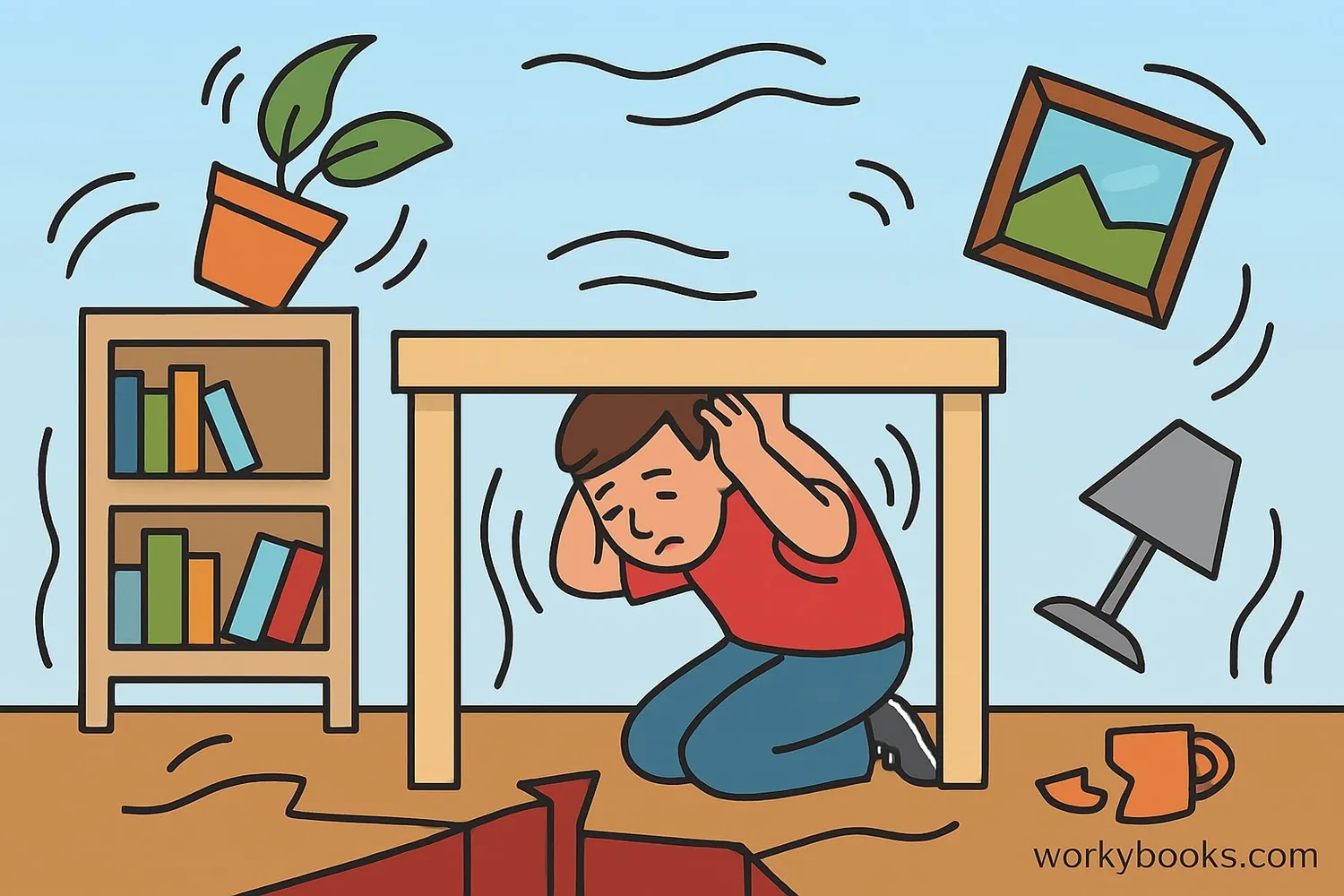
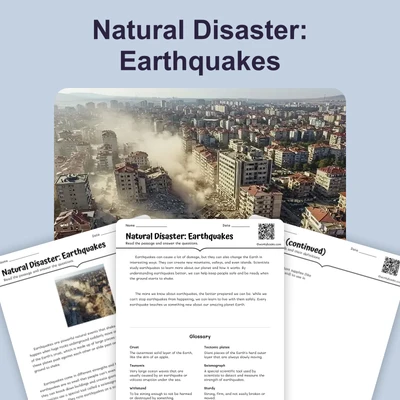
Earthquakes are a major natural hazard that can strike without warning, shaking the ground and causing damage to buildings, roads, and infrastructure. The risk of injury and destruction is highest in regions where tectonic plates meet, but people everywhere must understand how to reduce the impact of earthquakes. Earthquake safety and preparedness involve personal actions, community planning, and scientific design. Understanding these systems helps protect lives and property when disaster strikes.
How Building Codes and Seismic Design Reduce Risk
One of the most effective ways to reduce earthquake damage is through strong building codes. These are regulations that require new structures to be designed for earthquake forces. Engineers use seismic design to help buildings withstand shaking. For example, base isolation systems use flexible pads or bearings to separate a building from the ground, allowing it to move independently during an earthquake. Retrofitting older structures involves adding supports, braces, or shock absorbers to make them safer. Studies show that in areas with modern building codes, injuries and fatalities can be reduced by more than 50% during a major quake. However, not all buildings are up to current standards, so communities work to update and improve existing structures.
Personal and Community Preparedness
Individual actions are also critical for earthquake safety. The recommended response during shaking is 'Drop, Cover, and Hold On.' This means dropping to the ground, taking cover under a sturdy table or desk, and holding on until the shaking stops. Identifying safe spots away from windows, glass, and heavy objects can prevent injuries from falling debris. Preparedness also involves assembling an emergency kit with essentials such as water, non-perishable food, a flashlight, and a first aid kit. Families should have a communication plan to reconnect after a quake, and heavy furniture should be secured to walls to prevent tipping. After an earthquake, people must check for injuries, watch for hazards like gas leaks, expect aftershocks, and listen to local authorities for guidance. Community preparedness includes regular earthquake drills and supporting early warning systems, which can provide seconds of advance notice to take protective action.
Earthquake Prediction and Scientific Challenges
Despite advances in science, it is currently impossible to predict exactly when and where an earthquake will occur. Scientists use historical data and probability models to estimate the likelihood of earthquakes over time. For example, researchers might forecast a 60% chance of a major earthquake along a fault line within the next 30 years. Early warning systems use seismic sensors to detect the first signs of ground movement, sending alerts before the strongest shaking arrives. However, these tools do not predict earthquakes in advance; they only provide rapid notification once an event has begun. Understanding the limits of earthquake prediction helps communities focus on preparation and resilience rather than waiting for warnings.
Earthquake safety is a shared responsibility that combines science, engineering, and personal action. By strengthening buildings, preparing emergency plans, and participating in community drills, people can greatly reduce the risks posed by earthquakes. Scientific research continues to improve our understanding of earthquakes, leading to better preparedness and safer communities.
Interesting Fact: The tallest building in the world, the Burj Khalifa in Dubai, uses special seismic design features to withstand earthquakes, even though Dubai rarely experiences strong quakes.
What is the main purpose of building codes related to earthquakes?
To ensure buildings can withstand earthquake forcesTo make buildings look more attractiveTo reduce the cost of constructionTo increase the number of buildings in a city
What is the recommended safety action during an earthquake?
Run outside immediatelyStand near a windowDrop, Cover, and Hold OnStay on your bed
Which of the following items should NOT be near your safe spot during an earthquake?
Heavy objects that could fallA sturdy tableA flashlightFirst aid kit
According to the passage, why is it important to secure heavy furniture?
To prevent it from tipping and causing injuries during shakingTo make rooms look more organizedTo keep furniture cleanTo increase the value of the home
What does 'retrofitting' a building mean?
Adding supports or improvements to make an older building saferTaking down a building completelyPainting the outside of a buildingAdding extra floors to a building
What is the role of an emergency kit in earthquake preparedness?
It provides supplies needed during and after an earthquakeIt is used only for cooking mealsIt helps predict when an earthquake will occurIt is only for use by emergency workers
What does the passage say about the ability to predict earthquakes?
Earthquakes cannot be exactly predictedScientists can always predict the day and timeAnimals can predict earthquakes accuratelyPrediction is not needed if you have an emergency kit
Why do communities hold earthquake drills?
To practice safety actions so people know what to do during a real earthquakeTo increase the number of earthquakesTo test how strong buildings areTo teach people how to build furniture
True or False: Early warning systems can give people several days to prepare for an earthquake.
TrueFalse
True or False: Earthquake preparedness is only the responsibility of scientists and engineers.
TrueFalse
Perfect For:
👩🏫 Teachers
• Reading comprehension practice
• Auto-graded assessments
• Literacy skill development
👨👩👧👦 Parents
• Reading practice at home
• Comprehension improvement
• Educational reading time
🏠 Homeschoolers
• Reading curriculum support
• Independent reading practice
• Progress monitoring
Reading Features:
📖
Reading Passage
Engaging fiction or nonfiction text
❓
Comprehension Quiz
Auto-graded questions
📊
Instant Feedback
Immediate results and scoring
📄
Printable Version
Download for offline reading
🔊
Read Aloud
Voice-over with word highlighting
Reviews & Ratings
No reviews yet. Be the first to share your experience!
Related Content
Natural Disaster: Earthquake
Earthquakes occur when tectonic plates move, causing the ground to shake. Understanding earthquakes helps us prepare and...
RI.3.1RI.4.4RI.4.2RI.5.2
Volcanic Eruptions: Causes, Types, and Key Features
This science passage explains volcanic eruptions, aligned with NGSS MS-ESS3-2 (natural hazards) and ESS2-2 (Earth’s syst...
MS-ESS3-2MS-ESS2-2RST.6-8.3
Obsidian: The Natural Glass Rock
This science reading passage explores obsidian, a volcanic glass that forms when lava cools so rapidly that crystals can...
MS-ESS2-3MS-ESS3-2RST.6-8.4
Kīlauea Volcano: Hawaii’s Ever-Changing Landscape
This passage details Kīlauea's volcanic history and status, aligned with NGSS MS-ESS3-2 (natural hazards) and ESS2-3 (Ea...
MS-ESS3-2MS-ESS2-3RST.6-8.2
All About Seismometers
This informational science passage explores seismometers and their role in measuring earthquakes, designed specifically ...
MS-ESS3-2MS-ESS2-3RST.6-8.2
What Is the Difference Between Magma and Lava?
This educational reading passage explains the critical difference between magma and molten rock beneath Earth's surface ...
MS-ESS2-3MS-ESS3-2RST.6-8.4
Measuring Hurricane Intensity – The Saffir-Simpson Hurricane Wind Scale
This NGSS-aligned science reading passage explains how the Saffir-Simpson Hurricane Wind Scale is used to measure the in...
MS-ESS3-2
Tools and Technology in Earth Science
This middle school science reading passage explores the wide range of tools and technologies used in Earth science, from...
MS-ESS2-2MS-ESS3-2MS-ETS1-1MS-PS4-3
Types of Maps
This engaging science passage for grades 6-8 introduces students to the various types of maps and their uses, supporting...
MS-ESS2-2MS-ESS3-2MS-ETS1-1MS-ETS1-4
Mass Movements
This NGSS-aligned passage introduces middle school students to the science of mass movements—gravity-driven motions of r...
MS-ESS2-1MS-ESS3-2
What Causes Earthquakes?
This middle school science passage explains what causes earthquakes, focusing on the interactions between tectonic plate...
MS-ESS2-2MS-ESS3-2
Floods: Causes and Types
This middle school science passage provides a comprehensive look at floods, their causes, types, and impacts, addressing...
MS-ESS3-2
Hurricanes and Tropical Cyclones
This in-depth passage for grades 6-8 covers hurricanes and tropical cyclones, aligning with NGSS standards MS-ESS3-2 and...
MS-ESS3-2MS-ESS2-5
Hurricane Preparedness and Safety
This passage explores the science and practical strategies of hurricane preparedness and safety, designed for middle sch...
MS-ESS3-2MS-ETS1-1
Tornadoes
This informational science passage for grades 6-8 explores the science of tornadoes, aligning with NGSS standards MS-ESS...
MS-ESS3-2MS-ESS2-5
Tsunamis
This middle school science passage explores tsunamis, focusing on their causes, characteristics, and impacts. Students w...
MS-ESS3-2
Tsunami Warning and Safety
This comprehensive middle school science passage examines the systems and science behind tsunami warning and safety. Ali...
MS-ESS3-2
Earthquake Hazards and Damage
This middle school science reading passage examines the hazards and damage caused by earthquakes, aligned with NGSS MS-E...
MS-ESS3-2
Earthquake Zones and Patterns
This informational science passage introduces middle school students to the global distribution of earthquakes, focusing...
MS-ESS2-2MS-ESS3-2
Seismic Waves
This comprehensive middle school passage introduces students to seismic waves, the energy released during earthquakes. A...