Easing Cold War Tensions
Interactive passage with audio narration, comprehension questions, and printable PDF.
By completing this purchase you agree to our Terms of Use and Privacy Policy. Your subscription renews automatically until you cancel. You can cancel anytime from your account settings. All sales are final and non-refundable. Digital content is available for download in your account immediately upon purchase.
What's included
Easing Cold War Tensions preview and details
About this printable Easing Cold War Tensions reading passage (Grades 5-8)
Sample passage and quiz from Easing Cold War Tensions
Reading passage and comprehension quiz preview
The Period of Cold War Détente
![[President Richard Nixon and Soviet leader Leonid Brezhnev seated in the White House, portrait of George Washington in the background]](https://assets.workybooks.com/INTERACTIVE/media/pd--President-Richard-Nixon-and-Soviet-leader-Leonid--1763423024605-581296599.webp)
"[President Richard Nixon and Soviet leader Leonid Brezhnev seated in the White House, portrait of George Washington in the background]" by Leffler, Warren K. / Library of Congress.
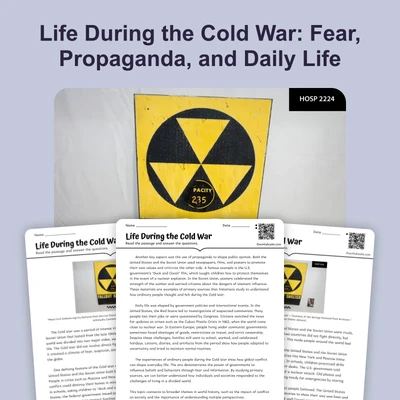
The Cold War was a period of intense rivalry and suspicion between the United States and the Soviet Union from the late 1940s through the 1980s. Both superpowers built up military forces, developed nuclear weapons, and competed for influence around the world. The world lived in the shadow of a possible nuclear conflict, as each side tried to spread its own system—capitalism or communism.
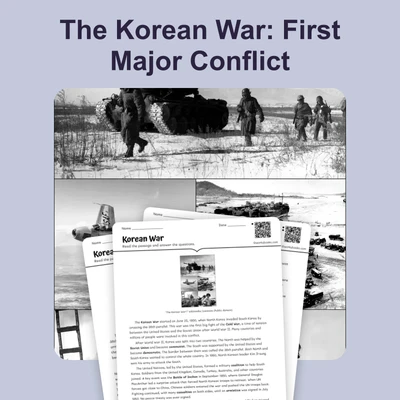
During the 1950s and 1960s, this rivalry led to dangerous moments, such as the Cuban Missile Crisis in October 1962. The United States discovered Soviet nuclear missiles in Cuba, just 90 miles from Florida. President John F. Kennedy demanded their removal, and for thirteen tense days, the world waited to see if war would break out. After secret talks and public threats, Soviet leader Nikita Khrushchev agreed to remove the missiles in exchange for a U.S. promise not to invade Cuba and a secret removal of U.S. missiles from Turkey. This event showed how close the world came to disaster and the importance of careful negotiation.
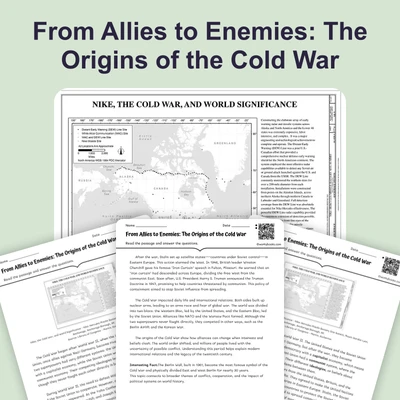
As both countries realized the dangers, they began to search for ways to reduce tension. This period became known as détente, a French word meaning "relaxing of tensions." One way the superpowers managed the danger was through espionage, or spying. Agencies like the CIA in the United States and the KGB in the Soviet Union gathered intelligence to learn what the other side was planning. Sometimes spies were caught and exchanged in dramatic "spy swaps," such as the 1962 exchange of U-2 pilot Francis Gary Powers for Soviet agent Rudolf Abel on Berlin's Glienicke Bridge.
Key to détente were major treaties that limited nuclear weapons. In 1972, President Richard Nixon and Soviet leader Leonid Brezhnev signed the Strategic Arms Limitation Treaty (SALT I) in Moscow. This treaty froze the number of nuclear missiles both sides could have, slowing the arms race. Another example is the 1963 Hotline Agreement, which set up a direct telephone link between Washington and Moscow to allow quick communication in a crisis. These agreements were turning points in global politics and helped avoid misunderstandings that could lead to war.
Détente marked a significant change in the Cold War, showing that even bitter enemies could find common ground. The process was not perfect or permanent, as new tensions would appear in the late 1970s and 1980s. However, the era of détente demonstrated the power of dialogue, negotiation, and mutual understanding in preventing catastrophe. The experience of the Cold War continues to influence international relations and the quest for peace in a complex world.
Interesting Fact: In 1975, American and Soviet astronauts met and shook hands in space during the Apollo-Soyuz mission, symbolizing a moment of cooperation during détente.
This study of détente connects to the broader themes of conflict, cooperation, and the impact of technology in world history.
Comprehension quiz (8 questions)
1. What was the main goal of détente?
2. Who signed the SALT I Treaty?
3. When did the Cuban Missile Crisis happen?
4. Why did the U.S. and Soviet Union set up a hotline?
5. What was one cause of the arms race?
6. Why was espionage important during the Cold War?
7. Détente was a time of increased conflict. True or false?
8. What does 'negotiation' mean?
Perfect for the way you teach
- Build comprehension skills
- Auto-graded quiz
- Differentiated reading
- Read together at home
- Improve fluency
- Quiet reading time
- Reading curriculum support
- Independent practice
- Track Lexile growth