This learning resource is available in interactive and printable formats. The interactive worksheet can be played online and assigned to students. The Printable PDF version can be downloaded and printed for completion by hand.
This engaging reading passage explores the Space Race, a critical chapter of the Cold War when the United States and the Soviet Union competed for dominance in space exploration. Students will learn about key events such as the launch of Sputnik, President Kennedy’s famous moon speech, and the Apollo 11 landing. The passage addresses cause and effect, change over time, and the significance of technological innovation, as well as the impact on daily life and global society. Primary sources and specific historical examples are woven throughout. Activities include a multiple-choice quiz, writing prompts, graphic organizers, and a detailed timeline. The passage is aligned with CA HSS 10.9.3 and CCSS.ELA-LITERACY.RI.6.3 standards, and includes a Spanish translation and read aloud audio support. This resource is perfect for deepening understanding of world history and analyzing historical events like a historian.
CONTENT PREVIEW
Expand content preview
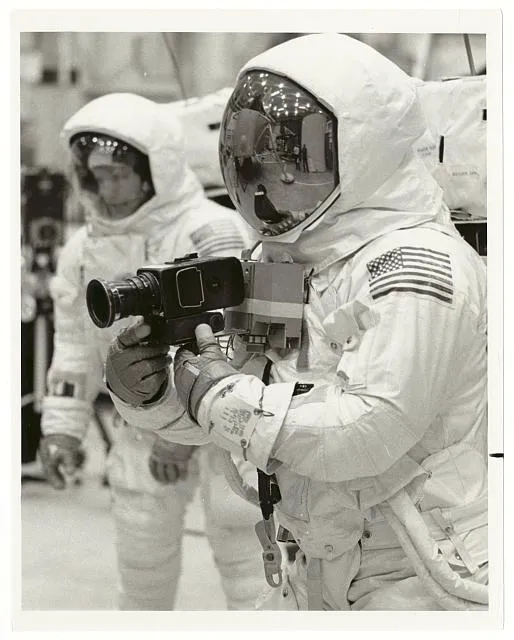
Apollo 11 Spacecraft Commander Neil Armstrong (front) and Lunar Module Pilot Edwin E. Aldrin (rear) practice lunar surface mobility at the Manned Spacecraft Center, Houston Armstrong has a camera attached to the chest area of the space suit. This method of attaching the camera is under study. The astronauts are in pressurized space suits. Source: Library of Congress - United States. National Aeronautics and Space Administration
The Space Race was a fierce competition between the United States and the Soviet Union during the Cold War. It began in the late 1950s, when both nations used their scientific and technological power to show their strength. This rivalry was not only about reaching space but also about spreading political ideas and boosting national pride.
The Soviet Union surprised the world on October 4, 1957, by launching Sputnik, the first artificial satellite. This small metal sphere sent radio signals back to Earth and showed that the Soviets had advanced technology. The United States felt threatened, fearing that Sputnik meant the Soviets could launch missiles from space. In response, America quickly created the National Aeronautics and Space Administration (NASA) in 1958 to coordinate space exploration. Primary sources from newspapers in 1957 show that Americans were shocked and even frightened by Sputnik's beeping signal, which could be heard on simple radios.
The race continued as both sides tried to achieve new "firsts." In 1961, Soviet cosmonaut Yuri Gagarin became the first human in space, orbiting Earth in his spacecraft Vostok 1. American astronaut John Glenn followed a year later, becoming the first American to orbit Earth. President John F. Kennedy challenged the United States to land a man on the Moon before the end of the 1960s. His famous 1962 speech at Rice University stated, "We choose to go to the Moon... not because it is easy, but because it is hard." This speech inspired a new era of scientific research and public support.
The Apollo program, led by NASA, was the American effort to reach the Moon. After many missions and setbacks, Apollo 11 succeeded in July 1969. Astronauts Neil Armstrong and Buzz Aldrin became the first humans to walk on the Moon, while Michael Collins orbited above. Their achievement was broadcast live around the world, uniting people in awe. The Moon landing was a powerful symbol of American innovation and determination.
The Space Race had lasting effects. It led to major advances in science and everyday technology, including satellites, computers, and medical equipment. The competition also increased tensions but later encouraged cooperation in space, such as joint missions like the Apollo-Soyuz project. The Space Race showed how political rivalry could drive progress, but also how shared goals could unite humanity.
This chapter in world history connects to broader themes of competition, technological change, and the impact of global conflicts on daily life.
Interesting Fact: Neil Armstrong's famous words, "That's one small step for man, one giant leap for mankind," were broadcast live to over 500 million people around the world in 1969.
When did the Soviet Union launch Sputnik?
October 4, 1957July 20, 19691958April 12, 1961
Who was the first human in space?
John GlennNeil ArmstrongYuri GagarinBuzz Aldrin
What was the main goal of the Apollo program?
Build satellitesLand on the MoonCreate computersLaunch Sputnik
How did Americans react to Sputnik?
With prideWith fearWith boredomWith anger
What did President Kennedy’s 1962 speech inspire?
Fear of technologySupport for space travelEnd of the Cold WarCreation of Sputnik
What effect did the Space Race have on technology?
No effectLed to inventionsDestroyed satellitesStopped science
The Space Race led to the creation of NASA. True or false?
TrueFalse
What is a cosmonaut?
Soviet space explorerAmerican astronautA satelliteA scientist
Perfect For:
👩🏫 Teachers
• Reading comprehension practice
• Auto-graded assessments
• Literacy skill development
👨👩👧👦 Parents
• Reading practice at home
• Comprehension improvement
• Educational reading time
🏠 Homeschoolers
• Reading curriculum support
• Independent reading practice
• Progress monitoring
Reading Features:
📖
Reading Passage
Engaging fiction or nonfiction text
❓
Comprehension Quiz
Auto-graded questions
📊
Instant Feedback
Immediate results and scoring
📄
Printable Version
Download for offline reading
🔊
Read Aloud
Voice-over with word highlighting
Reviews & Ratings
No reviews yet. Be the first to share your experience!
Related Content
Life During the Cold War
This world history reading passage explores life during the Cold War, focusing on the daily experiences, fear, and use o...
How the Cold War Began
This passage explores how the alliance between the United States and the Soviet Union during World War II broke down, le...
Easing Cold War Tensions
This engaging history reading passage examines the transformation of the Cold War from a period of confrontation and ext...
The Korean War
This comprehensive history reading passage explores the causes, events, and impact of the Korean War, the first major co...
America Fights in the Vietnam War
This engaging world history reading passage explores the Vietnam War and the Domino Theory, a key idea that shaped U.S. ...
Cold War Origins
This engaging passage examines the origins of the Cold War, focusing on the rivalry between the United States and the So...
D2.HIS.2.3-5D2.HIS.3.3-5RI.4.3RI.4.4
The Soviet Union Collapses
This comprehensive reading passage explores the end of the Cold War and the collapse of the Soviet Union, aligning with ...
War Bonds: Financing World War II
This passage examines the critical role of war bonds in financing World War II, focusing on how the U.S. government enco...
D2.HIS.2.3-5D2.HIS.3.3-5RI.4.3RI.4.4
Causes of World War I
This comprehensive history reading passage explores the complex causes of World War I, focusing on alliances, nationalis...
Events Leading to World War II
This passage explores the complex causes of World War II, focusing on the interwar period, the Treaty of Versailles, the...
World War I Impact on America
This engaging history reading passage explores World War I's impact on society and culture, highlighting key changes in ...
Trench Warfare in World War I
This comprehensive history reading passage explores the realities of life in the trenches during World War I, aligned to...
Europe Divided by the Iron Curtain
This rigorous history reading passage explores the division of Europe by the Iron Curtain during the Cold War, a key tur...
Russia Exits World War I
This comprehensive world history reading passage explores the Russian Revolution and how Russia exited World War I. Stud...
Nuclear Arms Race
This history reading passage examines the Cold War arms race and the global nuclear threat between the United States and...
Leaders and Decisions in World War II
This passage explores the major leaders of World War II and the critical decisions they made that shaped the course of g...
America Enters the War: 1917
This comprehensive history reading passage explores America’s entry into World War I in 1917, examining the causes, even...
American Life During World War II
This history reading passage explores life on the home front during World War II, focusing on the experiences of ordinar...
The Western Front in World War I
This engaging history reading passage explores the major battles of the Western Front during World War I, focusing on th...