Nuclear Arms Race
Interactive passage with audio narration, comprehension questions, and printable PDF.
By completing this purchase you agree to our Terms of Use and Privacy Policy. Your subscription renews automatically until you cancel. You can cancel anytime from your account settings. All sales are final and non-refundable. Digital content is available for download in your account immediately upon purchase.
What's included
Nuclear Arms Race preview and details
About this printable Nuclear Arms Race reading passage (Grades 5-8)
Sample passage and quiz from Nuclear Arms Race
Reading passage and comprehension quiz preview
The Pre-World War I Arms Race
![[Second atomic bombing of Nagasaki, Japan]](https://assets.workybooks.com/INTERACTIVE/media/pd--Second-atomic-bombing-of-Nagasaki--Japan--1763134447945-335204922.webp)
"[Second atomic bombing of Nagasaki, Japan]" / Library of Congress.
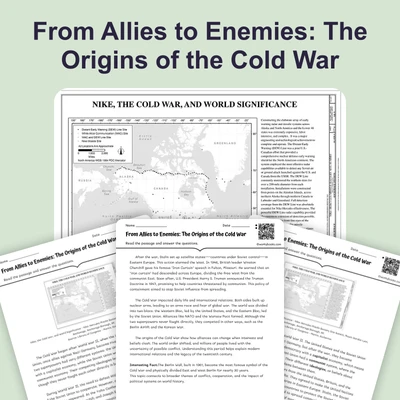
The Cold War was a period of intense tension and rivalry between the United States and the Soviet Union that lasted from the late 1940s to the early 1990s. One of the most important aspects of this era was the arms race, a competition to build more powerful and advanced nuclear weapons. This race changed international relations, affected daily life, and shaped the global balance of power.
After World War II ended in 1945, the United States was the first country to use an atomic bomb, dropping it on Hiroshima and Nagasaki in Japan. The devastation caused by these bombs prompted the Soviet Union to develop its own nuclear capabilities. By 1949, the Soviets had successfully tested their first atomic bomb, and the superpowers began building larger and more destructive weapons, including the hydrogen bomb in 1952 (U.S.) and 1953 (USSR). This escalation led to a dangerous situation known as mutually assured destruction (MAD), meaning that if either country launched a nuclear attack, both would face total destruction.
The arms race also led to major crises and confrontations. One of the most significant was the Cuban Missile Crisis in October 1962. The United States discovered Soviet nuclear missiles stationed in Cuba, just 90 miles from Florida. For thirteen tense days, leaders like President John F. Kennedy and Soviet Premier Nikita Khrushchev negotiated to avoid nuclear war. Primary sources, such as Kennedy’s televised address on October 22, 1962, show the seriousness of the threat. Finally, the Soviets agreed to remove their missiles in exchange for a U.S. promise not to invade Cuba and the secret removal of U.S. missiles from Turkey.
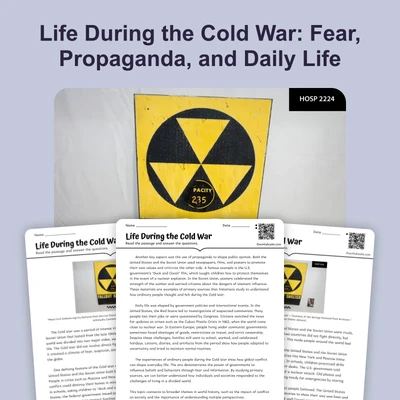
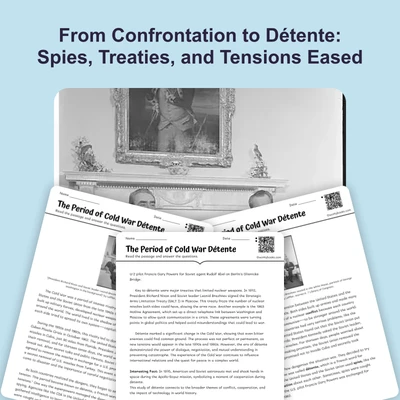
The nuclear threat affected people around the world. Many families built fallout shelters, schools held "duck and cover" drills, and governments issued warnings about radiation. The nuclear arms race also spurred diplomacy and arms control agreements, such as the Nuclear Non-Proliferation Treaty of 1968, which aimed to limit the spread of nuclear weapons. Despite periods of detente, or reduced tensions, both superpowers continued to build up their arsenals, spending vast resources that could have been used for social needs, like education or healthcare.
The arms race and nuclear threat of the Cold War had a profound impact on world history. It changed how nations interacted, shaped the lives of millions, and continues to influence global security today. Understanding this period is essential for grasping the challenges of international conflict and cooperation.
Throughout history, the arms race demonstrates the risks and responsibilities that come with technological advancement and global rivalry.
Interesting Fact: At the height of the Cold War, the combined nuclear arsenals of the United States and Soviet Union could have destroyed the world many times over!
Comprehension quiz (8 questions)
1. When did the Cuban Missile Crisis happen?
2. Which countries were superpowers?
3. What did families build for protection?
4. Why did the arms race start?
5. What was mutually assured destruction?
6. How did the arms race affect daily life?
7. The Cold War had no impact on daily life. True or false?
8. What does 'diplomacy' mean?
Perfect for the way you teach
- Build comprehension skills
- Auto-graded quiz
- Differentiated reading
- Read together at home
- Improve fluency
- Quiet reading time
- Reading curriculum support
- Independent practice
- Track Lexile growth