Egyptian Hieroglyphs
Interactive passage with audio narration, comprehension questions, and printable PDF.
By completing this purchase you agree to our Terms of Use and Privacy Policy. Your subscription renews automatically until you cancel. You can cancel anytime from your account settings. All sales are final and non-refundable. Digital content is available for download in your account immediately upon purchase.
What's included
Egyptian Hieroglyphs preview and details
About this printable Egyptian Hieroglyphs reading passage (Grades 5-8)
Sample passage and quiz from Egyptian Hieroglyphs
Reading passage and comprehension quiz preview
Egyptian Hieroglyphics
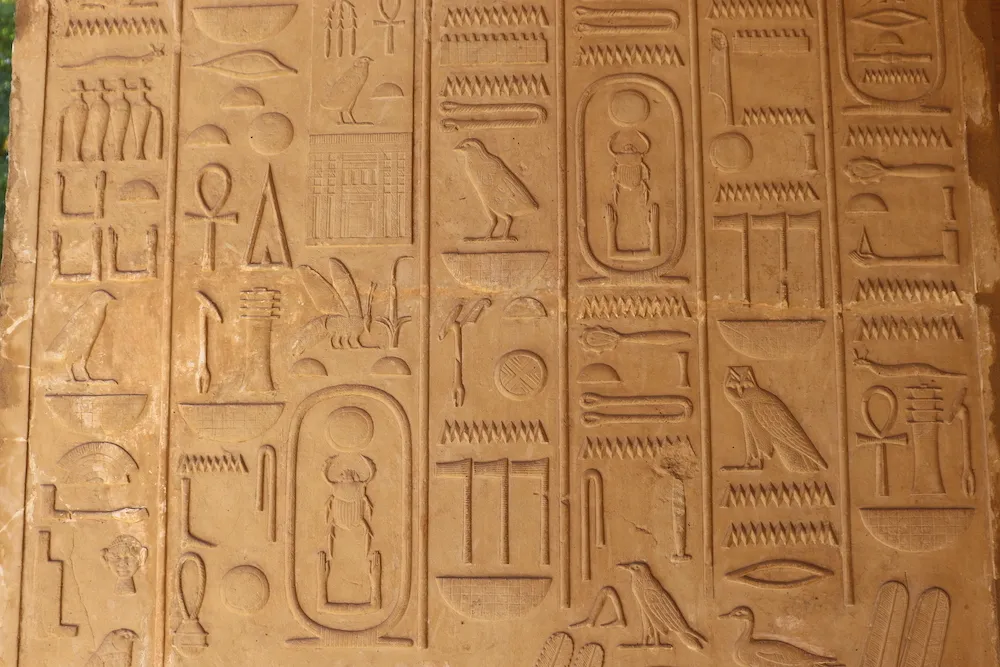
The hieroglyphs of Ancient Egypt form one of the world’s earliest and most remarkable writing systems. Developed over 5,000 years ago along the Nile River, hieroglyphs combined pictures and symbols to record language. This writing system played a crucial role in Egyptian society, allowing people to communicate across generations and preserve records of religious beliefs, government orders, and daily life.
Hieroglyphs were made up of more than 700 unique characters, each representing a word, sound, or idea. The word "hieroglyph" comes from Greek, meaning "sacred carving," because Egyptians used this script for important religious texts and temple walls. The earliest examples have been found on pottery and tombs from around 3200 BCE in Upper Egypt. Over time, hieroglyphs appeared on monuments, in the pyramids, and on papyrus scrolls. Ancient Egyptian scribes were highly trained officials who learned to read and write hieroglyphs. Because so few people were literate, scribes held a respected position in the social hierarchy and worked for pharaohs, priests, and government leaders.
Writing was essential for Egyptian civilization to function. Hieroglyphs allowed the government to collect taxes, keep records, and pass laws. They also played a central role in Egyptian religion. For example, the Book of the Dead—a collection of spells and prayers—was written in hieroglyphs to guide the dead through the afterlife. Archaeological discoveries, such as the painted walls of the tomb of Pharaoh Seti I in the Valley of the Kings and the inscriptions in the Temple of Karnak, provide primary evidence of the importance of hieroglyphs. For centuries, however, nobody outside Egypt could understand them.
This changed in 1799, when French soldiers discovered the Rosetta Stone. This artifact had the same text written in Greek, Demotic, and hieroglyphs. In 1822, the French scholar Jean-François Champollion used the Rosetta Stone to decipher hieroglyphs, unlocking the secrets of Ancient Egypt’s history and culture. Today, historians and archaeologists can read royal decrees, poems, and accounts of daily life thanks to hieroglyphs preserved on stone, papyrus, and monuments.
Hieroglyphs remain a lasting symbol of Ancient Egypt’s achievements. They connect us to the beliefs, politics, and creativity of a civilization that flourished for thousands of years. Understanding hieroglyphs allows historians to reconstruct the past and see how the invention of writing shaped Egyptian society and influenced later cultures.
This story of hieroglyphs shows how writing can transform a civilization. As you study world history, consider how written language helped societies organize, remember, and share ideas.
Interesting Fact: Some Egyptian scribes wrote so quickly that they developed a simpler script called "hieratic," which was used for everyday writing instead of formal hieroglyphs.
Comprehension quiz (8 questions)
1. What is a hieroglyph?
2. Who used hieroglyphs the most?
3. What helped decode hieroglyphs?
4. Why were hieroglyphs important?
5. What role did scribes have?
6. How did Champollion help historians?
7. Hieroglyphs were used for laws. True or false?
8. What is a "scribe"?
Perfect for the way you teach
- Build comprehension skills
- Auto-graded quiz
- Differentiated reading
- Read together at home
- Improve fluency
- Quiet reading time
- Reading curriculum support
- Independent practice
- Track Lexile growth