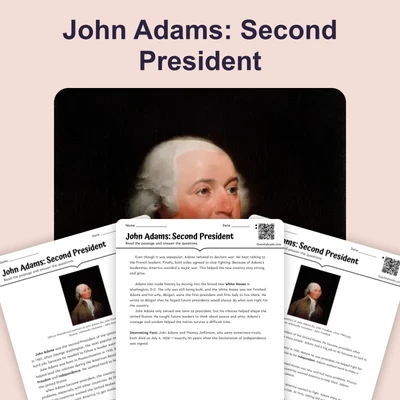
This learning resource is available in interactive and printable formats. The interactive worksheet can be played online and assigned to students. The Printable PDF version can be downloaded and printed for completion by hand.
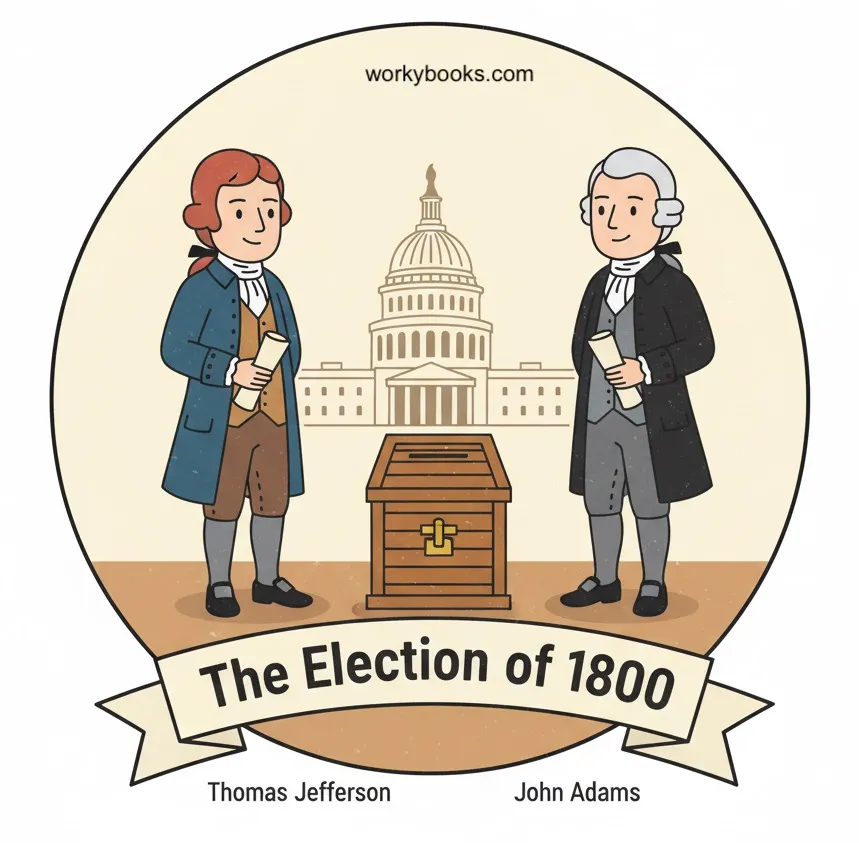
This detailed history reading passage delves into the Election of 1800, a pivotal moment in U.S. history when Thomas Jefferson and John Adams faced off in a heated presidential campaign. Students will explore the roles of political parties, the challenges of the electoral process, and the significance of the first peaceful transfer of power between rival parties. The passage is aligned with HSS 8.3.6 and 8.4.1 as well as Common Core RI.6-8.1 and RI.6-8.3 standards, offering rigorous content for middle school learners. Included are a glossary, timeline, multiple-choice and writing activities, differentiated and Spanish versions for accessibility, plus engaging graphic organizers. Read aloud audio and high-quality image enhance comprehension of how this historic election tested—and strengthened—American democracy.
CONTENT PREVIEW
Expand content preview
The election of 1800 was a critical moment in the early years of the United States. It was the first presidential contest between Thomas Jefferson, a leader of the Democratic-Republican Party, and John Adams, the sitting president from the Federalist Party. Their campaigns were filled with fierce debates about the future of the nation. The result would not only determine the next president but also test the ability of the young democracy to survive intense political conflict.
At the heart of the election was a deep disagreement over how the country should be governed. John Adams and the Federalists wanted a strong central government, believing it would keep order and support economic growth. In contrast, Thomas Jefferson and the Democratic-Republicans feared too much central power. They argued for more rights for the states and for ordinary citizens. This sharp contrast in beliefs led to strong feelings and even personal attacks during the campaign.
The electoral process in 1800 was very different from today. At that time, there were no nationwide ballots. Instead, each state chose its own method to select electors, who would then vote for president and vice president. The Constitution did not yet have clear rules for what would happen if there was a tie. This weakness became a major problem in the election.
When the votes were counted, both Jefferson and his running mate, Aaron Burr, received the same number of electoral votes. This tie sent the decision to the House of Representatives, where each state’s delegation cast one vote. The process became tense and bitter, with some Federalists even considering blocking Jefferson’s victory. After 36 rounds of balloting, Thomas Jefferson was finally chosen as the third president of the United States.
The transfer of power from John Adams to Thomas Jefferson was peaceful, although Adams quietly left Washington without attending Jefferson’s inauguration. This was the first time in world history that one political party handed over power to a rival without violence or chaos. The event set an important precedent for future transfers of power in American democracy.
The significance of the Election of 1800 cannot be overstated. It showed that the new nation could overcome deep divisions and allow the people’s will to be heard. The election also led to the passage of the 12th Amendment, which changed the way presidents and vice presidents were elected to prevent future ties. This historic event strengthened the idea that government should serve the people, not just those in power.
Interesting Fact: Thomas Jefferson and John Adams, once fierce rivals, later became friends again and died on the same day—July 4, 1826, exactly 50 years after the Declaration of Independence was adopted.
Who became president after the 1800 election?
Thomas JeffersonJohn AdamsAaron BurrGeorge Washington
What party did John Adams represent?
Federalist PartyDemocratic-Republican PartyWhig PartyLiberty Party
How did the election end?
With a tie in electoral votesBy a popular voteWith Adams winning easilyCongress refused to choose
Why was the election of 1800 significant?
First peaceful transfer of powerFirst U.S. electionJefferson lostAdams became vice president
What problem did the 12th Amendment fix?
Prevented future election tiesBanned political partiesChanged voting ageAllowed women to vote
What did Federalists want?
Strong central governmentMore state powerNo governmentOnly local laws
The election of 1800 was peaceful. True or false?
TrueFalse
What is a 'transfer of power'?
Change from one leader to anotherA type of electionA kind of speechA voting machine
Perfect For:
👩🏫 Teachers
• Reading comprehension practice
• Auto-graded assessments
• Literacy skill development
👨👩👧👦 Parents
• Reading practice at home
• Comprehension improvement
• Educational reading time
🏠 Homeschoolers
• Reading curriculum support
• Independent reading practice
• Progress monitoring
Reading Features:
📖
Reading Passage
Engaging fiction or nonfiction text
❓
Comprehension Quiz
Auto-graded questions
📊
Instant Feedback
Immediate results and scoring
📄
Printable Version
Download for offline reading
🔊
Read Aloud
Voice-over with word highlighting
Reviews & Ratings
No reviews yet. Be the first to share your experience!
Related Content
Native American Tribes Across America
This engaging history reading passage introduces students to Native American tribes across America, focusing on their da...
D2.HIS.1.3-5D2.HIS.2.3-5RI.4.1RI.4.2
Teepees: Homes on the Great Plains
This engaging history reading passage introduces students to teepees, the unique homes of Native American tribes on the ...
D2.HIS.2.3-5D2.HIS.14.3-5RI.4.1RI.4.2RI.4.4
Traditional Native American Clothing
This engaging history passage explores traditional Native American clothing and how it reflected the environment, values...
D2.HIS.2.3-5D2.HIS.3.3-5RI.4.3RI.4.4
The Iroquois Confederacy: A System of Peace
This engaging U.S. History reading passage introduces students to the Iroquois Confederacy, a powerful alliance of Nativ...
D2.HIS.2.3-5D2.HIS.3.3-5RI.4.3RI.4.4
The Cherokee Nation: History and Culture
This reading passage explores the rich history and culture of the Cherokee Nation, one of the largest Native American tr...
D2.HIS.2.3-5D2.HIS.14.3-5RI.4.3RI.4.4RI.4.10
The Sioux: Warriors and Tribal Leaders
This history reading passage explores the Sioux Nation, focusing on their roles as warriors and tribal leaders. Students...
D2.HIS.1.3-5D2.HIS.2.3-5RI.4.1RI.4.3
Native American Respect for Nature
This engaging history reading passage explores Native American respect for nature, emphasizing the close relationship be...
D2.HIS.2.3-5D2.HIS.3.3-5RI.4.3RI.4.4
Jamestown: The First Permanent English Colony
This engaging history passage explores the founding of Jamestown, the first permanent English colony in America. Aligned...
D2.HIS.1.3-5D2.HIS.2.3-5RI.4.3RI.4.4
Pocahontas and the Powhatan People
This engaging reading passage explores the life of Pocahontas and the Powhatan people and their important role in early ...
D2.HIS.1.3-5D2.HIS.2.3-5RI.4.1RI.4.3
Colonial Children: School and Chores
This reading passage explores the daily lives of colonial children, focusing on their experiences at school and their ma...
D2.HIS.2.3-5D2.HIS.3.3-5RI.4.1RI.4.2RI.4.4
Colonial Clothing and Homemade Goods
This engaging U.S. history passage explores the daily life of early American colonists with a focus on colonial clothing...
D2.HIS.2.3-5RI.4.3RI.4.4
Colonial Jobs: Blacksmiths, Bakers, and Craftsmen
This engaging history reading passage explores the vital roles of blacksmiths, bakers, and craftsmen in colonial America...
D2.HIS.2.3-5D2.HIS.3.3-5RI.4.3RI.4.4
Colonial Towns and Village Life
This engaging history reading passage explores the daily life, work, and unity found in colonial towns and villages. Ali...
D2.HIS.1.3-5D2.HIS.2.3-5RI.4.3RI.4.4
Colonial Trade with England and Africa
This history reading passage explores colonial trade between the American colonies, England, and Africa, focusing on the...
D2.HIS.2.3-5D2.HIS.14.3-5RI.4.3RI.4.4
Benjamin Franklin: Printer, Inventor, and Leader
This history reading passage explores the life and achievements of Benjamin Franklin, one of America's most important ea...
D2.HIS.2.3-5D2.HIS.3.3-5RI.4.1RI.4.3
George Washington Leads the Army
This engaging history reading passage explores how George Washington bravely led the Continental Army during the America...
D2.HIS.1.3-5D2.HIS.2.3-5RI.4.3RI.4.4
Women and Children During the Revolutionary War
This reading passage explores the important roles women and children played during the Revolutionary War. Students will ...
D2.HIS.2.3-5RI.4.3RI.5.3
African Americans Fight for Freedom
This educational passage explores the brave and inspiring story of how African Americans fought for freedom in the Unite...
D2.HIS.2.3-5D2.HIS.3.3-5RI.4.3RI.4.4
The Battle of Yorktown Ends War
This engaging U.S. history reading passage explores the Battle of Yorktown, a key event that ended the American Revoluti...
D2.HIS.1.3-5D2.HIS.2.3-5RI.4.1RI.4.3
Loyalists vs. Patriots: Divided Families
This engaging U.S. history reading passage explores the division between Loyalists and Patriots during the American Revo...