This learning resource is available in interactive and printable formats. The interactive worksheet can be played online and assigned to students. The Printable PDF version can be downloaded and printed for completion by hand.
This comprehensive history reading passage explores the Election of 1876, a pivotal moment in U.S. history that marked the end of Reconstruction and raised questions about electoral integrity. Students will learn about the disputed results between Rutherford Hayes and Samuel Tilden, the creation of a special commission, and the Compromise of 1877. The passage models historical reasoning by analyzing the causes, effects, and significance of the election's outcome. It is designed to support critical thinking and aligns with HSS 8.11.5 and CCSS.RI.6-8.1, RI.6-8.2. The resource includes read aloud audio, a Spanish translation, differentiated versions for accessibility, and a variety of activities including quizzes, writing prompts, and graphic organizers. This lesson helps students master key academic vocabulary and examine how history is shaped by conflict and negotiation.
CONTENT PREVIEW
Expand content preview
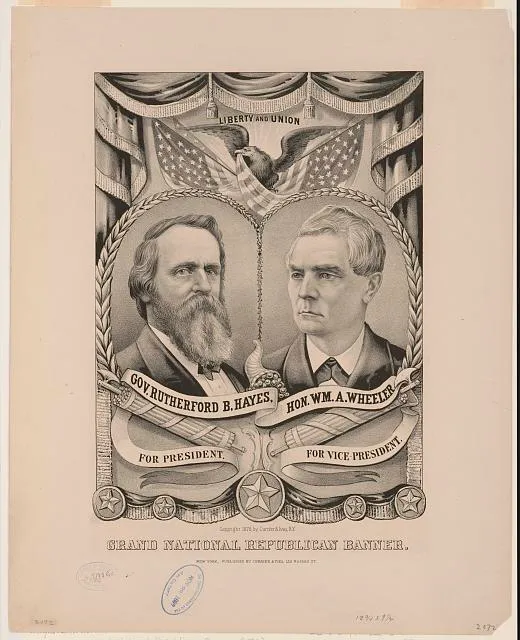
"Grand National Republican banner" by Currier & Ives. / Library of Congress.
The election of 1876 was one of the most controversial presidential elections in United States history. The main candidates were Rutherford B. Hayes, representing the Republican Party, and Samuel J. Tilden, representing the Democratic Party. This election took place during a period known as Reconstruction, when the country was recovering from the Civil War and working to rebuild the South and ensure rights for formerly enslaved people. The outcome of this election would have major consequences for the future of the nation.
On election night, it appeared that Tilden had won the popular vote and was leading in the electoral vote count. However, the results from four states—Florida, Louisiana, South Carolina, and Oregon—were immediately disputed. Both parties claimed victory in these states and accused each other of corruption and fraud. This created confusion and tension throughout the country, as no clear winner could be declared according to the Constitution.
To solve the crisis, Congress formed a special commission in early 1877. This commission was made up of five members from the House of Representatives, five from the Senate, and five Supreme Court justices. Their main task was to decide which candidate should receive the electoral votes from the disputed states. After weeks of heated debates, the commission voted 8 to 7 along party lines to award all the disputed votes to Hayes. This decision gave Hayes just enough electoral votes to win the presidency, even though Tilden had more popular votes.
The outcome was extremely controversial. Many Americans believed the process was unfair and that their voices had not been heard. In order to avoid further conflict, leaders from both parties reached the Compromise of 1877. Under this agreement, Democrats accepted Hayes as president. In return, Hayes promised to remove federal troops from Southern states and end Reconstruction policies. This compromise had a deep impact on the South and on African Americans, as it led to the loss of many civil rights protections.
The Election of 1876 highlights the importance of fair and transparent elections in a democracy. It shows how political disagreements can shape history and how solutions are sometimes found through negotiation and compromise rather than clear rules. The events of 1876 also remind us that every vote and every decision can affect the lives of millions.
Interesting Fact: When Hayes was finally declared president, he took the oath of office in secret at the White House before the public ceremony, due to fears of unrest.
Who won the popular vote in 1876?
Samuel TildenRutherford HayesUlysses GrantAndrew Johnson
How many states had disputed results?
ThreeFourTwoFive
What was the Compromise of 1877?
End of the Civil WarAgreement to end ReconstructionStart of ReconstructionA new election
Why was the election controversial?
Disputed votes and no clear winnerLow voter turnoutOnly one candidateNo popular vote
What did the special commission do?
Solved electoral disputeStarted a warDeclared both men winnersEnded slavery
What was one effect of the compromise?
Federal troops left the SouthTilden became presidentSlavery returnedWomen could vote
The election was decided by a coin toss. True or false?
TrueFalse
What does 'disputed' mean?
Argued or disagreed aboutCelebratedCompletedAnnounced
Perfect For:
👩🏫 Teachers
• Reading comprehension practice
• Auto-graded assessments
• Literacy skill development
👨👩👧👦 Parents
• Reading practice at home
• Comprehension improvement
• Educational reading time
🏠 Homeschoolers
• Reading curriculum support
• Independent reading practice
• Progress monitoring
Reading Features:
📖
Reading Passage
Engaging fiction or nonfiction text
❓
Comprehension Quiz
Auto-graded questions
📊
Instant Feedback
Immediate results and scoring
📄
Printable Version
Download for offline reading
🔊
Read Aloud
Voice-over with word highlighting
Reviews & Ratings
No reviews yet. Be the first to share your experience!
Related Content
Pocahontas: Myth vs. Historical Reality
This passage explores the nuanced history of Pocahontas, moving beyond the myth made popular by movies and stories. Stud...
HSS 5.3.1RI.6-8.1RI.6-8.8
Roger Williams Religious Freedom
This passage explores the life and legacy of Roger Williams, a key figure in Colonial America who was banished from Mass...
HSS 5.4.38.2.2RI.6-8.1RI.6-8.6
Benjamin Franklin in Colonial America
This U.S. History reading passage explores the life and influence of Benjamin Franklin, a key colonial leader whose idea...
HSS 5.58.1RI.6-8.1RI.6-8.3
Colonial Apprenticeship System
This comprehensive passage explores the Colonial Apprenticeship System and its role in education during Colonial America...
HSS 5.4.6RI.6-8.1RI.6-8.2
Cities in Colonial America
This engaging U.S. history reading passage explores the rise of colonial American cities such as Boston, Philadelphia, a...
HSS 5.4.68.1RI.6-8.1RI.6-8.7
Frontier Life in Colonial America
This passage examines the realities of frontier life in colonial America, highlighting both the promise and peril faced ...
HSS 5.4.68.1RI.6-8.1RI.6-8.2
Colonial Printing Press
This passage explores the revolutionary impact of the colonial printing press in America, examining how it enabled the s...
HSS 5.58.1RI.6-8.1RI.6-8.2
Mercy Otis Warren: Political Writer
This passage explores the life and impact of Mercy Otis Warren, a significant political writer during the American Revol...
HSS 5.6.38.1RI.6-8.1RI.6-8.6
Crispus Attucks
This comprehensive U.S. History reading passage examines the life and legacy of Crispus Attucks, the first person killed...
HSS 5.5.38.1RI.6-8.1RI.6-8.3
Lewis and Clark Expedition
This comprehensive U.S. History reading passage explores the Lewis and Clark Expedition (1804-1806), a pivotal journey l...
HSS 8.4.18.8.2RI.6-8.1RI.6-8.3
Exodusters
This passage explores the migration of Exodusters—African Americans who left the South in the 1870s to escape discrimina...
HSS 8.12.1RI.6-8.1RI.6-8.2
Uncle Tom's Cabin
This passage explores the impact of Harriet Beecher Stowe’s Uncle Tom’s Cabin on American society in the 1850s. It exami...
HSS 8.9.48.10.2RI.6-8.1RI.6-8.6
Dred Scott Decision
This rigorous history reading passage delves into the 1857 Dred Scott Decision, a pivotal moment in the lead-up to the C...
HSS 8.9.48.10.3RI.6-8.1RI.6-8.8
Election of 1860
This passage explores Abraham Lincoln’s election in 1860 and the critical reactions from Southern states, which set the ...
HSS 8.10.4RI.6-8.1RI.6-8.6
Southern Secession
This passage explores the significant moment in U.S. history when seven Southern states seceded from the Union after Abr...
HSS 8.10.4RI.6-8.1RI.6-8.2
Advantages and Disadvantages: North vs. South
This history reading passage examines the contrasting strengths of the Union and Confederacy during the U.S. Civil War. ...
HSS 8.10.5RI.6-8.1RI.6-8.3
Emancipation Proclamation
This U.S. history passage explores the Emancipation Proclamation of 1863, an executive order issued by President Abraham...
HSS 8.10.6RI.6-8.1RI.6-8.3
Women's Roles in Civil War
This reading passage explores the critical roles women played during the U.S. Civil War, highlighting how they managed f...
HSS 8.10.7RI.6-8.1RI.6-8.2
Surrender at Appomattox
This reading passage explores the historic surrender at Appomattox Court House in April 1865, which marked the conclusio...