Evidence for Current Climate Change — Reading Comprehension
Rate this
Premium Resource
Present
Present in classroom. No work saved
Assign
Classroom with student accounts, Track progress
Quick Play
No student accounts, assign with a link
Grades
5
6
7
8
Standards
MS-ESS3-5
PRINT+DIGITAL RESOURCE
This learning resource is available in interactive and printable formats. The interactive worksheet can be played online and assigned to students. The Printable PDF version can be downloaded and printed for completion by hand.
This middle school science reading passage introduces students to the multiple lines of evidence scientists use to identify current climate change. Aligned to NGSS MS-ESS3-5, the passage explores temperature records, ice core CO₂ data, sea level rise, glacier and Arctic ice loss, ocean warming, and changes in the timing of biological events (phenology). Students gain insight into how different types of scientific observations and measurements work together to show that Earth’s climate is changing, with emphasis on underlying mechanisms, cause-and-effect relationships, and the importance of using independent data sources. The resource includes a differentiated version, Spanish translations, glossary, comprehension questions, writing prompts, and graphic organizers to support all learners. Audio integration enhances accessibility, making it ideal for diverse classrooms.
CONTENT PREVIEW
Expand content preview
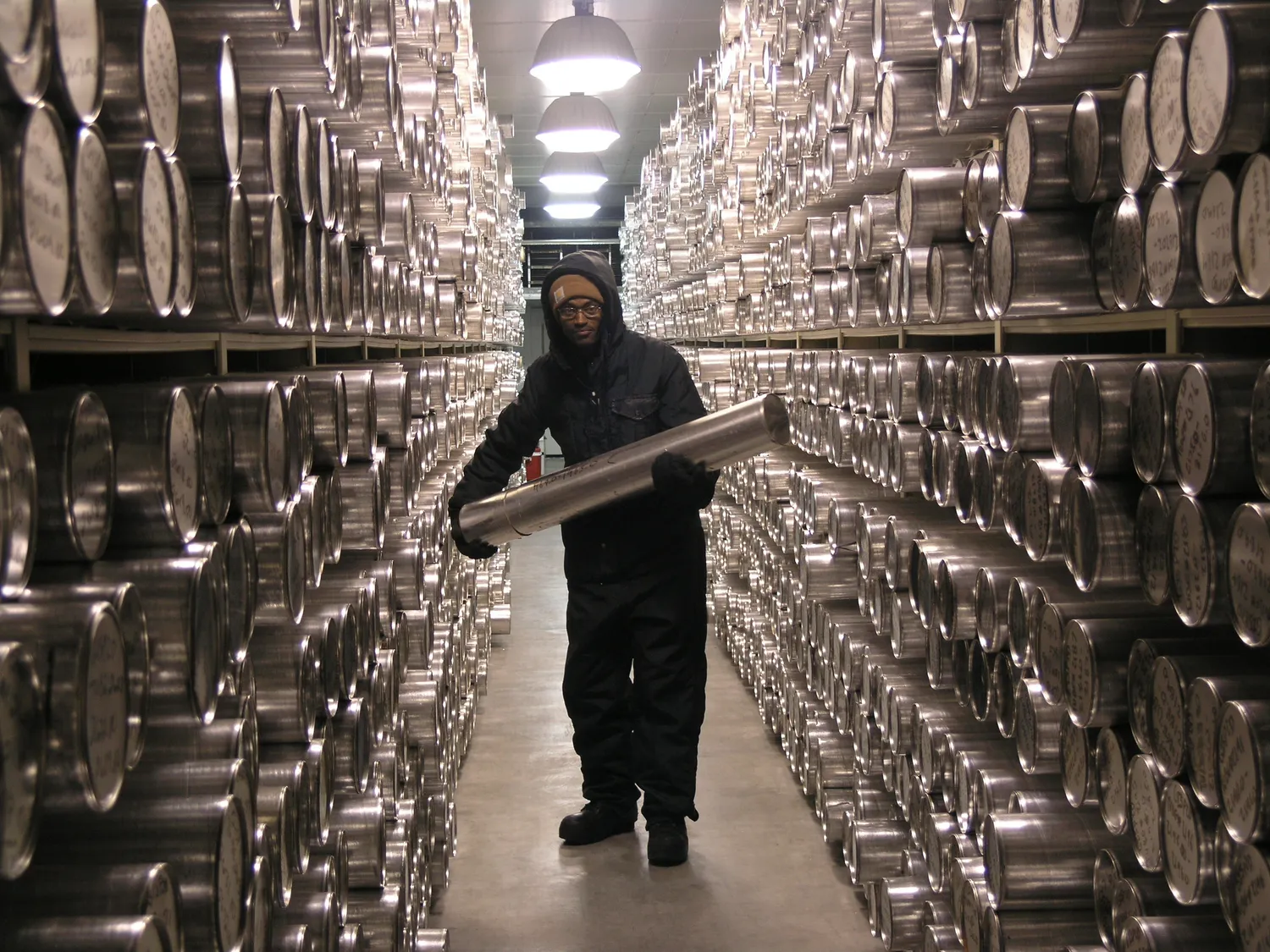
Storage room for global ice core samples. Wikimedia Commons
Earth’s climate is undergoing significant changes, a fact supported by many independent scientific observations. The global average temperature has increased by about 1.1°C (2°F) since the late 1800s. Scientists use a wide range of evidence—from modern temperature records to ancient ice cores—to understand both the causes and impacts of this change. By examining how different pieces of data connect, researchers can detect patterns that reveal how the climate system is changing over time.
Temperature Records and Ice Core Data
One major line of evidence comes from long-term temperature records. Daily and annual measurements from weather stations, ocean buoys, and satellites consistently show that Earth’s surface is warming. For example, nine of the ten warmest years on record have occurred since 2010. Another powerful tool is the study of ice cores drilled from Greenland and Antarctica. These ice cores trap ancient air bubbles, allowing scientists to measure past carbon dioxide (CO₂) levels. The data show that current CO₂ levels exceed 410 parts per million (ppm), much higher than any time in the past 800,000 years. This rise in CO₂ is closely linked to human activities like burning fossil fuels, which release greenhouse gases that trap heat in the atmosphere.
Melting Glaciers, Sea Level Rise, and Ocean Warming
The warming climate leads to observable changes in Earth's systems. Glaciers around the world are retreating rapidly; for example, the majority of glaciers in Montana’s Glacier National Park have shrunk by more than 70% since 1966. Arctic sea ice has declined by about 13% per decade since satellite measurements began in 1979. As ice melts, the resulting water flows into oceans, contributing to sea level rise. Global sea levels have risen by about 20 centimeters (8 inches) since 1900. Warmer ocean water expands, causing further sea level rise, and supports fewer cold-water species, disrupting marine ecosystems.
Extreme Weather and Phenology Shifts
Another important sign of climate change is the increase in extreme weather events, such as heatwaves, droughts, and intense storms. These patterns are linked to changes in atmospheric circulation caused by rising temperatures. Additionally, scientists observe shifts in phenology—the timing of natural events like plant blooming or animal migrations. For instance, many plants in the Northern Hemisphere now bloom several days earlier than they did decades ago. These shifts disrupt food webs and signal that living things are responding to a changing environment.
By combining all these independent sources of evidence, scientists are confident that climate change is real and primarily driven by human actions. Understanding these cause-and-effect relationships helps society develop strategies to reduce greenhouse gas emissions and adapt to new climate realities. This approach reflects a core scientific principle: using multiple, reliable observations to draw strong conclusions about complex systems.
Interesting Fact: The oldest ice cores drilled from Antarctica contain air that is over 800,000 years old, providing a direct record of Earth’s ancient atmosphere!
What has happened to the global average temperature since the late 1800s?
It has increased by about 1.1°C (2°F).It has stayed exactly the same.It has decreased slightly.It changes randomly each year.
Which tool do scientists use to measure ancient air and CO₂ levels?
ThermometersIce coresSeismographsTree rings
What is one effect of melting glaciers mentioned in the passage?
It causes sea level rise.It decreases ocean temperatures.It creates new glaciers.It makes winters colder everywhere.
What does the term 'phenology' refer to in the passage?
The study of air pollution.The timing of natural events like plant blooming or animal migration.The amount of carbon dioxide in the air.The process of sea ice melting.
What is the primary cause of recent increases in atmospheric CO₂, according to the passage?
Changes in Earth’s orbit.Volcanic eruptions.Human activities like burning fossil fuels.More plant growth.
Which of the following is NOT a line of evidence for climate change mentioned in the passage?
Temperature recordsGlacier retreatChanges in animal migrationEarthquake frequency
The passage describes how sea level has changed. What is the main reason for this change?
Melting glaciers and expanding warmer ocean waterIncreased rainfallMore fish in the oceanLess ocean evaporation
Which statement best summarizes how scientists are certain that climate change is happening?
They use multiple, independent sources of evidence.They rely on one type of measurement.They guess using weather forecasts.They compare only plant blooming dates.
True or False: The passage states that Arctic sea ice has increased since 1979.
TrueFalse
True or False: Many plants in the Northern Hemisphere now bloom earlier because of climate change.
TrueFalse
Perfect For:
👩🏫 Teachers
• Reading comprehension practice
• Auto-graded assessments
• Literacy skill development
👨👩👧👦 Parents
• Reading practice at home
• Comprehension improvement
• Educational reading time
🏠 Homeschoolers
• Reading curriculum support
• Independent reading practice
• Progress monitoring
Reading Features:
📖
Reading Passage
Engaging fiction or nonfiction text
❓
Comprehension Quiz
Auto-graded questions
📊
Instant Feedback
Immediate results and scoring
📄
Printable Version
Download for offline reading
🔊
Read Aloud
Voice-over with word highlighting
Reviews & Ratings
No reviews yet. Be the first to share your experience!
Related Content
Natural Disaster: Hurricanes
Hurricanes are massive storms with strong winds and rain. Tracking and preparing for them helps protect people in their ...
RI.3.1RI.4.4RI.4.2RI.5.2
How Climate Change Affects Animal Migration
This NGSS-aligned science reading passage explains how climate change affects animal migration by altering seasonal cues...
MS-LS2-6MS-ESS3-5
What Is Global Warming?
This NGSS-aligned reading passage explains global warming, the greenhouse effect, and how human activities like burning ...
MS-ESS3-5
What Causes Global Warming?
This NGSS-aligned reading passage explains what causes global warming, focusing on how human activities like burning fos...
MS-ESS3-5
How to Stop Global Warming
This NGSS-aligned reading passage helps students understand how to stop global warming by reducing greenhouse gases. It ...
MS-ESS3-5
Human Impacts: Climate Change
This standards-aligned science reading passage for grades 6-8 explains the mechanisms and effects of human-driven climat...
MS-LS2-4MS-ESS3-5
Climate Change: Vulnerable Ecosystems
This middle school science passage, aligned with NGSS standards MS-ESS3-5 and MS-LS2-4, helps students understand how cl...
MS-ESS3-5MS-LS2-4
Climate Change: Solutions and Mitigation
This passage explores scientific solutions and mitigation strategies for climate change, designed for middle school scie...
MS-ESS3-4MS-ESS3-5
Scientific Inquiry in Earth Science
This passage explores scientific inquiry in Earth science for grades 6-8, aligned with NGSS standards MS-ESS1-4, MS-ESS2...
MS-ESS1-4MS-ESS2-1MS-ESS3-5SEP
Great Barrier Reef
This passage introduces middle school students to the Great Barrier Reef, the world's largest coral reef system, located...
MS-LS2-1MS-LS2-4MS-ESS3-5
Siberian Taiga
This engaging middle school science passage explores the Siberian Taiga, the world’s largest forest ecosystem, stretchin...
MS-LS2-1MS-ESS3-5
The Greenhouse Effect
This comprehensive middle school science passage explores the greenhouse effect, a process essential to maintaining Eart...
MS-ESS2-6MS-ESS3-5
Melting Ice and Snow
This passage, designed for grades 6-8 and aligned with NGSS MS-ESS3-5, explores the mechanisms and impacts of melting ic...
MS-ESS3-5
Rising Sea Levels
This science passage, written for grades 6-8, explores the phenomenon of rising sea levels, a key topic aligned with NGS...
MS-ESS3-5
Ice Cores
This passage, aligned with NGSS standards MS-ESS3-5 and MS-ESS1-4, explores the scientific process of extracting and ana...
MS-ESS3-5MS-ESS1-4
How Climate Change Affects Weather
This middle school science passage explores how and why weather patterns are changing globally. Students will learn abou...
MS-ESS3-5
How Climate Change Affects Oceans
This NGSS-aligned passage explores major changes occurring in Earth’s oceans, focusing on the mechanisms and impacts of ...
MS-ESS3-5
Carbon Footprint
This NGSS-aligned passage for grades 6-8 explores the concept of a carbon footprint, focusing on how personal activities...
MS-ESS3-4MS-ESS3-5
El Niño
This middle school science passage provides an in-depth exploration of El Niño, the warm phase of the El Niño-Southern O...
MS-ESS2-6MS-ESS3-5
ENSO and Global Climate
This comprehensive passage explores the El Niño-Southern Oscillation (ENSO), a crucial driver of global climate variabil...